


Introduction to SECS/GEM in Semiconductor Manufacturing
Modern semiconductor fabrication relies heavily on automation to achieve predictable processes, maximize throughput, and maintain world-class yield. Every manufacturing step—from wafer loading to deposition, etching, metrology, and packaging—depends on precise coordination between equipment and the factory’s host systems. This coordination is made possible through one of the most important communication standards in the industry: the SECS/GEM protocol.
SECS/GEM (SEMI Equipment Communications Standard / Generic Equipment Model) is the universal language that allows semiconductor tools to communicate with manufacturing execution systems (MES), factory hosts, and automation software. Without SECS/GEM, fabs would require custom communication for each tool type, making integration slow, expensive, and nearly impossible to scale.
This complete beginner’s guide explains what SECS/GEM is, how it works, and why it remains the backbone of semiconductor automation—even as the industry rapidly advances toward Industry 4.0, digital twins, and AI-driven manufacturing.
Why the SECS/GEM Protocol Matters in Modern Semiconductor Fabs
Standardizing Equipment Communication Across the Fab
Before SECS/GEM, equipment vendors each had their own proprietary communication formats. Integrating a new tool could take months of engineering work. SECS/GEM standardizes message structures, events, commands, status reporting, alarms, and behaviors so that all tools from lithography to packaging communicate uniformly.
This standardization allows fabs to:
- Reduce integration complexity
- Achieve faster tool qualification
- Maintain consistent automation logic across hundreds of machines
Reducing Integration Time and Engineering Effort
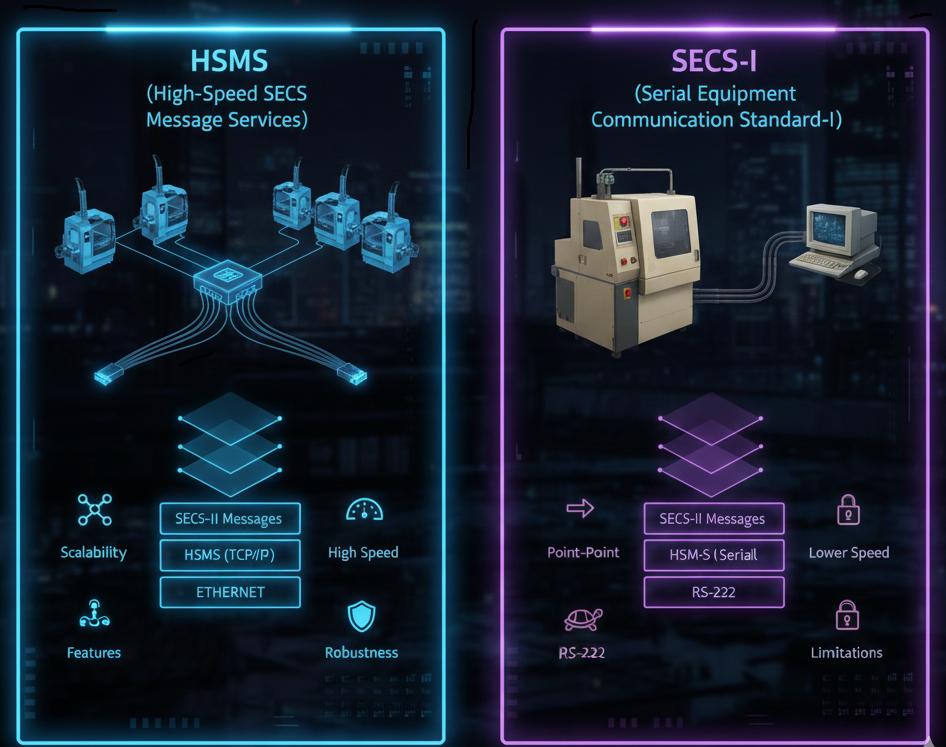
Because SECS/GEM defines predictable equipment behavior, factories no longer need to build custom drivers for every tool. Integrators simply connect the equipment to the host via HSMS (Ethernet) or SECS-I (serial), configure event reports, and begin automation.
The result:
- Shorter installation and ramp-up time
- Lower engineering cost
- Fewer communication-related errors
Enabling Reliable Equipment Monitoring and Control
It also enables remote operations through standardized Remote Commands (RCMD). This makes automation scalable, safer, and more efficient.
How SECS/GEM Works: Key Components Explained
SECS Message Structure (SxFy Format)
SECS messages follow a structured format: Stream x, Function y (SxFy).
For example:
- S1F1 — Are You There?
- S6F11 — Event Report
- S2F41 — Remote Command
This structured messaging ensures tools behave predictably in all factories globally.
HSMS vs SECS-I: Communication Layers and Transport Protocols
SECS-I (RS-232 serial) was the original method of communication, but most fabs today use HSMS (SEMI E37)—a high-speed Ethernet-based transport.
HSMS advantages:
- Reliable networking
- Higher data throughput
- Better support for factory-wide automation
Event Reporting, Data Collection, and Alarm Handling
Key structures include:
- Data Collection Events (DCEs)
- Event IDs (CEIDs)
- Status Variables (SVs)
- Equipment Constants (ECs)
- Alarms (ALIDs)
This rich dataset feeds into supervisory control, analytics systems, yield management tools (YMS), and AI/ML platforms.
SECS/GEM Data Analytics for Real-Time Insights
Using SECS/GEM Data for Trend Analysis and Process Stability
Fabs use SECS/GEM data to track:
- Chamber temperature
- Pressure stability
- Motor torque
- Recipe parameters
- Wafer movement timing
Analyzing this data helps detect early process drift and maintain stability across high-volume production.
Role of SECS/GEM Data in Semiconductor Yield Optimization
Yield strongly depends on equipment health and process consistency.
SECS/GEM enables:
- Rapid root-cause analysis
- Correlation of equipment parameters to wafer defects
- Faster identification of out-of-control (OOC) conditions
Yield management teams rely on clean, structured SECS/GEM data to drive consistent output quality.
Integrating SECS/GEM Data With AI/ML and Predictive Models
Modern fabs connect SECS/GEM data streams to:
- Predictive maintenance systems
- Fault detection and classification (FDC)
- Machine learning-based anomaly detection
The result is fewer unexpected tool failures and significantly improved uptime.
Equipment Monitoring Through SECS/GEM
Tracking Status Variables (SVs) for Tool Health
Status Variables are real-time data points that describe machine conditions, such as:
- Machine state
- Substate
- Carrier positions
- Material handling status
These are essential for production monitoring and automated decision-making.
Using Data Collection Events (DCEs) for Performance Monitoring
DCEs trigger when key events occur—wafer load, vacuum start, recipe completion, or process errors. This allows factories to trace every part of the manufacturing process.
Alarm Management and Fault Detection
Alarms are automatically reported with:
- Alarm ID
- Description
- Timestamp
- Severity
This supports fast troubleshooting, root-cause identification, and reduced downtime.
SECS/GEM for Automation Engineers: Practical Use Cases
Remote Commands (RCMD) for Recipe and Job Control
Hosts can remotely send commands such as:
- Start
- Stop
- Pause
- Resume
- Select Recipe
This eliminates the need for manual operator intervention.
Material Handling and Wafer Tracking Through SECS/GEM
The protocol supports automated material flow by reporting:
- Carrier load/unload
- Wafer count
- Slot mapping
- Robot errors
MES Integration and Factory Host Connectivity
SECS/GEM connects directly to:
- MES (Manufacturing Execution System)
- RMS (Recipe Management System)
- FDC/SPC systems
- Yield Management Systems (YMS)
It is the foundation of end-to-end digital manufacturing.
Comparing SECS/GEM With Other Semiconductor Communication Standards
SECS/GEM vs GEM300
GEM300 builds on SECS/GEM to support:
- Wafer-level tracking
- Carrier management
- Durable handling
Material transport automation
SECS/GEM vs SECS-II
- SECS-II defines message structure
- GEM defines behavior models (automation rules)
Together, they form the complete standard.
Where EDA/Interface A Fits in Modern Fabs
EDA (Interface A) is used for high-frequency, high-volume data acquisition like fault detection and real-time analytics. SECS/GEM is still required for control, events, and commands.
Common Challenges When Implementing the SECS/GEM Protocol
Handling Custom Equipment Variations
Even with standardization, vendors may customize GEM implementations.
This requires careful mapping and validation.
Ensuring Robust Connection and Message Handling
HSMS sessions need reliable handling of:
- Heartbeats
- Reconnect logic
- Message buffering
Maintaining Data Quality for Analytics Platforms
Poorly defined event reports or SVs degrade data analytics.
Standardized naming and timestamp accuracy are critical.
Future of SECS/GEM in Industry 4.0 Semiconductor Manufacturing
Integration With Digital Twin and AI Systems
SECS/GEM data is essential for the digital thread—from real-time digital twins to predictive process simulations.
Expanding SECS/GEM Data for Predictive Maintenance
AI-driven monitoring can detect anomalies before failures occur.
How Standards Will Evolve in Next-Gen Fabs
Future trends include:
- Hybrid SECS/GEM + EDA architectures
- Greater interoperability
- Enhanced data models for robotics and automation
Conclusion
The SECS/GEM protocol is the foundation of semiconductor automation, enabling seamless communication between thousands of tools and factory systems. Even as the industry moves toward AI, real-time analytics, and hyper-automated fabs, SECS/GEM remains essential due to its reliability, consistency, and global adoption.
For beginners, mastering SECS/GEM opens doors to careers in equipment integration, automation engineering, and data-driven manufacturing—fields central to the future of semiconductor production.
FAQ Section
-
What is SECS/GEM?
SECS/GEM is the global communication standard that connects semiconductor equipment to factory host systems.
-
Why is SECS/GEM important?
It standardizes automation, event reporting, remote control, and data collection across fabs.
-
What does SECS stand for?
SEMI Equipment Communications Standard.
-
What does GEM stand for?
Generic Equipment Model.
-
What is the difference between SECS-I and HSMS?
SECS-I uses serial communication; HSMS uses high-speed Ethernet.
-
How does SECS/GEM support equipment monitoring?
Through status variables (SVs), alarms, and event reporting.
-
Can SECS/GEM be used for data analytics?
Yes—SECS/GEM Data Analytics is widely used for yield improvement and predictive maintenance.
-
What is GEM300?
An extension of SECS/GEM used for 300mm wafer automation.
-
Does SECS/GEM work with AI/ML platforms?
Yes, SECS/GEM data is often fed into ML models for process optimization.
-
Is SECS/GEM still relevant with newer standards like EDA?
Yes—SECS/GEM is essential for control and automation; EDA complements it for high-volume data.

📅 Posted by Nirav Thakkar on December 4, 2025
Nirav Thakkar
Semiconductor Fab Automation & Equipment Software specialist with 18 years of industry experience.