


Summary
- Market Growth: The industrial automation sector is expanding rapidly, driving high demand for skilled control system experts.
- Role Evolution: A PLC programmer no longer just writes code; they integrate complex IIoT systems, manage data flow, and ensure cybersecurity.
- Language Shift: While Ladder Logic remains king for maintenance, Structured Text and Function Block Diagrams are gaining ground for complex algorithms.
- Hardware Ecosystem: Understanding the nuances between major platforms, particularly the Siemens PLC controller family and Rockwell Automation, is vital for career flexibility.
- Future Trends: Edge computing and cloud integration are reshaping how PLCs interact with the factory floor.
Introduction
The machinery that powers our world doesn’t run on magic; it runs on logic. According to Precedence Research (2024), the global industrial automation market size is poised to surpass $400 billion by 2032. This massive financial injection isn’t just buying more robot arms—it is funding the brains behind the operation. At the center of this technological nervous system sits the PLC programmer, the architect responsible for turning mechanical potential into kinetic reality.
For decades, the Programmable Logic Controller (PLC) has been the ruggedized computer of choice for harsh industrial environments. However, the role of the person programming it has shifted dramatically. It used to be enough to understand relay logic and possess a steady hand with a screwdriver. Now, the job requires a fusion of electrical engineering, computer science, and network architecture.
Whether you are a seasoned engineer looking to update your toolkit or a student eyeing a career in PLC automation, understanding the modern landscape is non-negotiable. We are going to break down the software, the hardware heavyweights, and the skills required to keep the lights on and the conveyors moving.
The Evolving World of the PLC Programmer
The title “programmer” can be deceptive here. If you tell a web developer that you program in “Ladder Logic,” they might look at you like you just claimed to write code in hieroglyphics. A PLC programmer effectively acts as a translator between human intent and machine action. You are telling a machine exactly what to do, when to do it, and, most importantly, what to do when things go wrong.
Beyond Simple Coding
Writing the code is often the easy part. The real challenge lies in the “what if” scenarios. A standard software developer might worry about a server crashing or a page loading slowly. A controls engineer worries about a robotic arm swinging through a safety fence because a sensor failed.
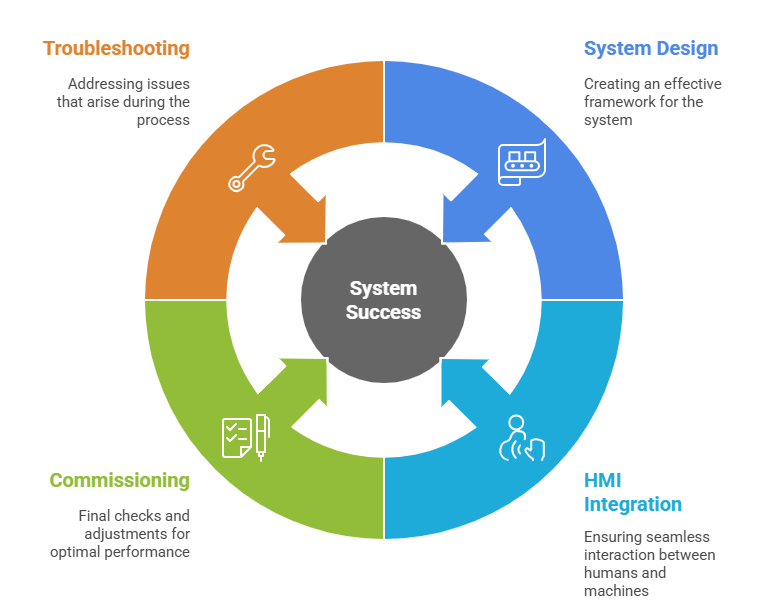
The scope of work usually involves:
- System Design: creating the logic flow before touching a keyboard.
- HMI Integration: Building the Human Machine Interface so operators can actually run the machine.
- Commissioning: The high-stress phase of testing code on live machinery.
- Troubleshooting: Figuring out why a motor won’t start at 2:00 AM.
This role requires a specific mindset. You have to be pessimistic. You have to assume every sensor will eventually fail and write code that handles that failure safely.
Navigating PLC Programming Software
The software environment is where the magic happens or where the headaches begin, depending on your licensing situation. Unlike the open-source world of Python or JavaScript, PLC programming software is largely proprietary and tied strictly to the hardware manufacturer.
The IEC 61131-3 Standard
Despite the proprietary nature of the development environments (IDEs), the languages themselves are standardized under IEC 61131-3. This standard ensures that a timer in one brand’s software behaves mostly like a timer in another’s.
There are five languages defined by this standard, though three dominate the market:
- Ladder Diagram (LD): This looks like an electrical schematic. It is the most popular language because it is easy for electricians and maintenance technicians to troubleshoot. If you are working in PLC automation in North America, you live here.
- Structured Text (ST): This resembles Pascal or C. It is powerful for complex data handling, math, and sorting algorithms. As more computer science graduates enter the field, ST is becoming the go-to for backend logic.
- Function Block Diagram (FBD): This visual language connects blocks of code like wiring components on a breadboard. It is excellent for process control (like temperature or flow regulation).
Major Software Platforms
You generally don’t get to pick your software; the hardware spec dictates it.
- Studio 5000 (Rockwell/Allen-Bradley): The standard in the United States. It is robust, user-friendly, and comes with a price tag that makes accountants weep.
- TIA Portal (Siemens): The dominant force in Europe and Asia. Totally Integrated Automation (TIA) Portal is a beast of a software suite that combines PLC, HMI, and drive configuration into one interface.
- CODESYS: An independent hardware-agnostic platform used by hundreds of smaller PLC manufacturers (like Beckhoff or Wago).
Hardware Heavyweights: The Siemens PLC Controller and Competitors
While code is critical, it is useless without the iron. The hardware landscape is a battlefield of reliability, processing speed, and I/O (Input/Output) density.
The Siemens Ecosystem
The Siemens PLC controller lineup, specifically the SIMATIC S7 series, is a marvel of German engineering. They are ubiquitous in manufacturing, automotive, and process industries globally.
S7-1200: The compact, modular choice for small to medium automation tasks. It’s cost-effective but powerful enough for standalone machines.
S7-1500: The flagship. This controller handles high-speed processing, complex motion control, and massive data throughput.
Siemens hardware is famous for its diagnostic capabilities. When an S7-1500 faults, it usually tells you exactly why, down to the specific wire break, provided you configured the diagnostics correctly in the PLC software.
Rockwell and Others
On the other side of the Atlantic, Rockwell Automation’s ControlLogix and CompactLogix platforms reign supreme. They are known for their ruggedness and the massive support network available in North America.
There are also strong contenders like Mitsubishi (huge in Asia), Omron, and Beckhoff. Beckhoff is particularly interesting because it utilizes PC-based control, turning a standard industrial computer into a super-fast PLC.
PLC Automation in the Era of Industry 4.0
Factory floors are changing. We used to be happy if the red light turned on when the tank was empty. Now, the tank needs to email the supplier, log the data to an SQL database, and predict when the pump will fail based on vibration analysis.
The Convergence of OT and IT
Operational Technology (OT) and Information Technology (IT) are merging. A modern PLC programmer needs to understand networking just as well as they understand voltage drops.
MQTT & OPC UA: These are the protocols of the modern factory. They allow PLCs to talk to the cloud (AWS, Azure) or upper-level SCADA systems securely.
Edge Computing: Instead of sending all data to the cloud, newer PLCs can process data locally (“at the edge”) to make faster decisions and reduce bandwidth.
This shift means the days of “air-gapped” systems (systems completely disconnected from the internet) are fading. Security is now a massive part of the job. You aren’t just protecting the machine from the operator; you’re protecting the plant from cyber threats.
Integrating with HMIs and SCADA
The Human Machine Interface (HMI) is the window into the PLC’s soul. Modern HMIs are essentially tablets mounted to machines. The trend is moving toward web-based HMIs, where the visualization lives on a web server running on the PLC, accessible via any browser on the secure network.
Does a conveyor motor really need to talk to the cloud? Maybe not. But the vibration sensor attached to it definitely does.
Essential Skills and Career Path
So, how do you survive and thrive in this field? It takes a specific cocktail of hard and soft skills.
The Technical Toolkit
You obviously need to know the languages (Ladder, ST). But that is the baseline.
Electrical Fundamentals: You must know how to read a schematic. If you can’t tell the difference between a PNP and an NPN sensor, you will have a bad time.
Networking: IP addresses, subnet masks, and VLANs are now a daily vocabulary.
Motion Control: Understanding servos, VFDs (Variable Frequency Drives), and PID loops is what separates a junior programmer from a senior engineer.
Soft Skills for Hard Environments
Patience is your greatest asset. You will spend hours staring at a rung of logic, wondering why it isn’t true. You will deal with production managers screaming that the line is down and costing $10,000 a minute.
Communication is key. You have to explain complex technical constraints to non-technical management. You also need to listen to the machine operators; they know the machine’s quirks better than you ever will.
Troubleshooting: The Reality of the Job
The glory of PLC automation is seeing a machine hum to life perfectly. The reality is often standing on a concrete floor in safety boots, laptop balanced on a cardboard box, trying to figure out why a limit switch is flickering.
The logical Approach
Effective troubleshooting is a process of elimination.
- Is it the code? Did someone change something?
- Is it the hardware? Is the sensor actually detecting the part?
- Is it the wiring? Did a mouse chew through a Profinet cable? (It happens more than you think.)
Modern PLC software tools offer “online monitoring,” allowing you to watch the logic execute in real-time. This is the superpower of the PLC programmer. You can see exactly where the signal stops.
Conclusion
The role of the PLC programmer is expanding, not shrinking. As manufacturing becomes smarter, the need for humans who can bridge the gap between heavy machinery and high-level data systems becomes critical. Whether you are specializing in the Siemens PLC controller environment or mastering the nuances of universal PLC software, the future is bright, automated, and full of interesting challenges.
Frequently Asked Questions
It depends on your background. If you have experience with electrical circuits or logical thinking, Ladder Logic is quite intuitive. However, mastering the hardware configurations, communication protocols, and advanced motion control takes years of practice.
There is no objective “better.” Allen-Bradley (Rockwell) dominates the US market and is known for user-friendliness but high costs. Siemens dominates globally and offers incredible depth and diagnostic power but has a steeper learning curve. A good PLC programmer should be familiar with both.
Not strictly. While many have degrees in Electrical or Mechatronics Engineering, many successful programmers started as industrial electricians or technicians and learned on the job. Certifications and hands-on experience often matter more than a diploma.
Usually not for the core real-time logic due to safety and speed requirements. However, Python is increasingly used for data analytics, scripting interactions with the PLC, and running on edge devices that communicate with the PLC.
