


Summary
- Cost Implications: Preventive maintenance often leads to “over-maintenance,” wasting spare parts and technician hours, while predictive strategies target only what is necessary.
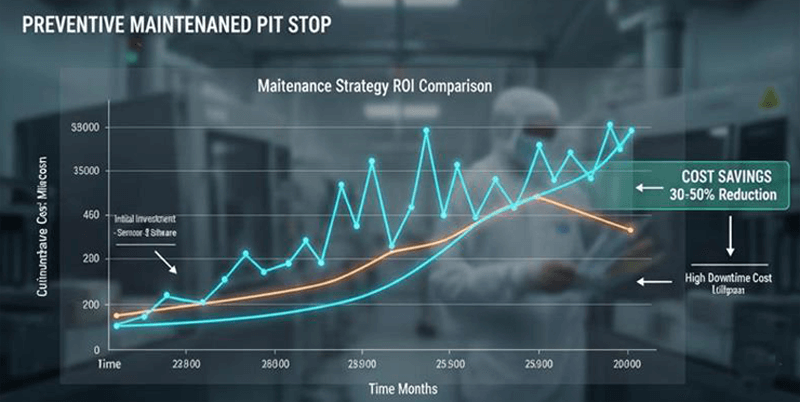
- Downtime Reduction: Predictive methods can reduce machine downtime by 30–50% and increase machine life by 20–40% compared to standard preventive schedules.
- Data Dependency: While preventive maintenance relies on the calendar, predictive maintenance relies on real-time data integrity, requiring robust predictive maintenance software.
- Implementation: The transition isn’t binary; a hybrid approach often yields the best ROI for semiconductor manufacturing facilities.
- The Bottom Line: Moving from “repair when broken” or “repair on schedule” to “repair when needed” is the key to maximizing wafer yield and equipment availability.
Introduction
In the high-stakes world of semiconductor manufacturing, downtime is the ultimate antagonist. It burns money, ruins wafer yields, and gives fab managers gray hairs before their time. According to a recent report by McKinsey (2024), utilizing Industry 4.0 technologies specifically regarding machine health can reduce machine downtime by up to 50% and lower maintenance costs by 10–40%. Yet, many facilities remain stuck in a loop of fixing things that aren’t broken.
This brings us to the central debate in modern reliability engineering: predictive maintenance vs preventive maintenance. While the terms are often tossed around interchangeably in boardrooms, they represent fundamentally different philosophies. One relies on the safety of the calendar; the other trusts the honesty of the data.
For equipment engineers and fab managers, choosing the right path isn’t a philosophical exercise. It is a financial necessity.
The Core Conflict: Calendar vs. Condition
To understand the shift occurring in fabs right now, we have to strip these concepts down to their mechanics.
Preventive Maintenance: The Scheduled Pit Stop
Preventive maintenance (PM) is the industry veteran. It is time-based or usage-based. You service the etch tool every 500 RF hours. You replace the vacuum pump seals every six months. You do this regardless of whether the seal is actually worn out.
The logic here is statistical. We assume that because most bearings fail after 10,000 cycles, we should replace all bearings at 9,000 cycles.
The Pros:
- Easier to budget and plan.
- Requires less complex technology to implement.
- Extends equipment life compared to reactive (run-to-failure) maintenance.
The Cons:
- Labor Drain: Technicians spend time fixing healthy machines.
- Post-Maintenance Failure: Ironically, human intervention is a leading cause of equipment failure. Opening a chamber to replace a part that didn’t need replacing introduces the risk of particles or vacuum leaks.
- Unexpected Breakdowns: Machines rarely die on a schedule. Random failures still occur between scheduled intervals.
Predictive Maintenance: The Smart Sensor Approach
Predictive maintenance (PdM) flips the script. Instead of asking “What day is it?”, it asks “How is the equipment feeling?”
By using predictive maintenance tools, engineers monitor the actual condition of the asset in real-time. Sensors track vibration, temperature, acoustic and ultrasonic signatures, and power consumption. The maintenance action is triggered only when parameters drift outside a specific control limit.
The Pros:
- Maximized Part Life: You use a component until it is actually near the end of its life, not just when the manual says time is up.
- Reduced Downtime: Maintenance is planned for when it is needed, avoiding unnecessary shutdowns.
- Root Cause Analysis: The data trail helps pinpoint why a failure is developing.
The Cons:
- High Upfront Cost: Requires investment in sensors and predictive maintenance software.
- Data Complexity: You need teams capable of interpreting the noise.
Deep Dive: Predictive Maintenance vs Preventive Maintenance in the Fab
When we look at predictive maintenance vs preventive maintenance specifically through the lens of a semiconductor fab, the stakes change. A pump failure in a water treatment plant is annoying; a pump failure in a CVD process can scrap many valuable wafers.
Here is how the two approaches stack up in a cleanroom environment:
1. The Trigger Mechanism
- Preventive: A work order is generated automatically by the CMMS (Computerized Maintenance Management System) based on elapsed time or wafer count.
- Predictive: A work order is generated by the IoT platform or MES (Manufacturing Execution System) when a specific threshold (e.g., vibration on a turbopump) is breached.
2. The Hardware Requirement
Preventive maintenance generally utilizes standard tools. If you have a wrench and a clipboard (or a tablet), you are good to go.
Predictive maintenance requires a digital nervous system. You need vibration sensors on motors, current transducers on power supplies, and particle counters in vacuum lines. This brings us to the realm of predictive vs preventive maintenance infrastructure. You cannot do PdM without the “P” (Predictive) hardware.
3. The Skill Gap
This is often overlooked. Moving to a predictive model requires your maintenance staff to evolve. They stop being just mechanics and start becoming data analysts. They need to understand what an FFT (Fast Fourier Transform) spectrum looks like on a vibration plot.
Note: The goal isn’t to replace technicians with software. It is to give technicians superpowers so they know exactly which screw to turn before they even gown up.
Why Preventive Maintenance Isn’t Enough Anymore
Fab managers are dealing with node sizes that are shrinking faster than a wool sweater in a hot dryer. As we move toward 3nm and 2nm processes, the margin for error effectively vanishes.
Predictive Maintenance vs Preventive Maintenance: The Over-Maintenance Trap
In an effort to avoid downtime, many fabs fall into the trap of over-maintenance. They shorten their PM cycles. Instead of cleaning a chamber every week, they do it every three days.
This kills availability. If your tool is down for scheduled maintenance 20% of the time, that is 20% lost production capacity. Preventive vs predictive maintenance debates often settle here: PdM buys you that time back.
According to the U.S. Department of Energy (2022), a functional predictive maintenance program can yield a 30% to 40% reduction in maintenance costs and a 35% to 45% reduction in downtime. For a high-volume fab, those percentages translate to millions of dollars in recovered revenue.
The Role of Data and Software
You cannot simply “decide” to do predictive maintenance. You need the ecosystem. This is where predictive maintenance software enters the chat.
Connecting the Dots (literally)
Semiconductor equipment is chatty. Through SECS/GEM and Interface A (EDA) standards, tools are constantly broadcasting data. The challenge is catching it.
Robust software solutions act as the aggregator. They pull data from:
- FDC (Fault Detection and Classification) Systems: Watching process parameters.
- Add-on Sensors: Vibration or thermal monitors retrofitted to older equipment.
- Facility Systems: Chiller temps, cleanroom humidity.
Making Sense of the Noise
Raw data is useless. If a graph spikes, does it mean the motor is dying, or did someone just bump the machine?
Advanced predictive maintenance tools use Machine Learning (ML) algorithms to learn the “normal” behavior of a specific tool. They can distinguish between a harmless anomaly and a developing catastrophe.
- Analogy Time: It is like a doctor listening to your heart. A preventative approach is a checkup once a year. A predictive approach is wearing a smartwatch that alerts you the second your heart rate creates an irregular pattern.
Implementation Challenges (and How to Beat Them)
Switching strategies is not as simple as flipping a switch. If it were easy, everyone would have done it by now.
Challenge 1: The Legacy Equipment Problem
Fabs are a mix of brand-new ASML scanners and 20-year-old wet benches. Older tools often lack the built-in sensors required for deep analytics.
- Solution: Retrofitting. Utilizing non-intrusive sensors (like clamping current sensors) allows you to extract data from legacy tools without voiding warranties or risking signal interference.
Challenge 2: Data Silos
The vibration data lives in one server; the process data lives in another.
- Solution: Integration middleware. You need a unified layer that brings OT (Operational Technology) and IT together. This is a core competency for teams working on MES integration.
Challenge 3: Alert Fatigue
If your predictive maintenance software screams “Emergency!” every five minutes, technicians will eventually mute it.
- Solution: Tuning. The implementation phase requires a period of “training” the model to minimize false positives.
The ROI Equation
When pitching predictive vs preventive maintenance to leadership, speak the language of finance.
Unplanned Downtime Costs
In the semiconductor industry, unplanned downtime is exceptionally expensive due to the WIP (Work in Progress) at risk. If a batch process fails, you don’t just lose time; you might scrap a cassette of wafers that has already accumulated weeks of processing value.
Inventory Reduction
With preventive maintenance, you need a warehouse full of spare parts “just in case.” With predictive strategies, you order parts based on the degradation curve of the component. This creates a Just-In-Time (JIT) maintenance inventory, freeing up capital tied up in stock.
Making the Switch: A Hybrid Approach
Here is the secret that purists might not tell you: You don’t have to choose one or the other exclusively.
The most effective maintenance strategies are hybrid.
- Run-to-Failure: For cheap, non-critical assets (like lightbulbs in the hallway).
- Preventive: For assets with strict regulatory requirements or where failure modes are purely age-related and totally predictable.
- Predictive: For critical assets (Cluster tools, pumps, RF generators) where uptime is revenue.
Understanding the balance of predictive maintenance vs preventive maintenance allows you to allocate resources where they hurt the least and help the most.
Conclusion
The battle of predictive maintenance vs preventive maintenance isn’t about proving one is superior in a vacuum. It is about matching the strategy to the asset. However, as semiconductor manufacturing becomes more automated and data-rich, the scales are tipping heavily toward predictive strategies.
The days of opening up a perfectly good machine just because the calendar says so are numbered. By adopting the right predictive maintenance software and shifting your culture from reactive to proactive, you gain the ultimate competitive advantage: reliability.
Frequently Asked Questions
A: Predictive maintenance costs more upfront because of sensors and analytics, but the real difference between preventive vs predictive maintenance is long-term savings. PdM reduces unnecessary scheduled work, cuts unplanned downtime, and delivers higher ROI, especially in semiconductor fabs.
A: Predictive maintenance is best for high-value tools like lithography and etch systems, where failures are extremely expensive. Preventive tasks still matter, but the ideal approach is a hybrid model fixed PM cycles supported by real-time condition monitoring to protect yield and extend tool life.
A: The toughest hurdles are cultural, not technical. Teams used to scheduled PM may resist change, and managers may worry about cost. Shifting to a predictive vs preventive maintenance model requires training, clear ROI communication, and strong change management.
A: Yes. A preventive vs predictive maintenance review usually shows that low-risk, predictable assets work fine with simple time-based PM. Use predictive maintenance for high-impact, complex tools where failures cause major downtime or scrap.
A: High data quality is critical. Poor sensor data, missing integrations, or siloed systems (FDC, MES, CMMS) lead to false alerts. PdM only works well when data is clean, consistent, and accurate enough for the model to learn normal vs abnormal behavior.
