

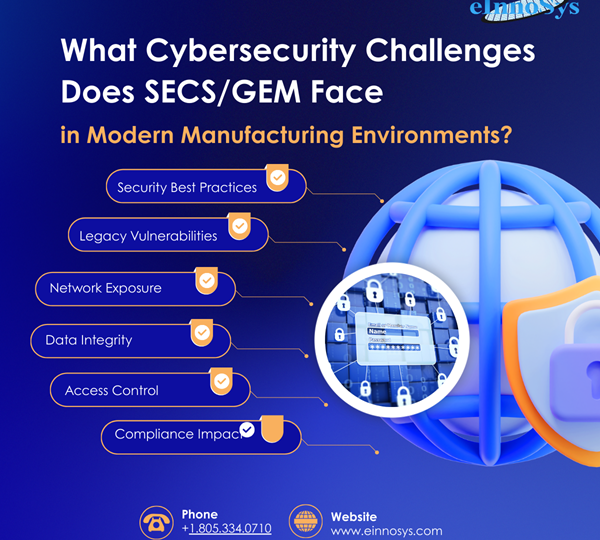
Introduction
As semiconductor manufacturing rapidly evolves toward smart fabs and fully connected Industry 4.0 environments, equipment communication standards such as SECS/GEM have become the backbone of factory automation. SECS/GEM enables reliable data exchange between equipment and host systems, supporting productivity, traceability, and real-time control. However, with increased connectivity comes increased exposure to cyber threats.
Today, SECS/GEM cybersecurity challenges are no longer theoretical concerns. Modern fabs operate in hybrid environments where legacy tools coexist with advanced digital infrastructure, creating new attack surfaces. Many organizations underestimate SECS GEM security risks, assuming that factory networks are isolated or inherently secure. In reality, SECS/GEM cybersecurity in semiconductor manufacturing faces mounting pressure from ransomware, insider threats, insecure protocols, and unprotected equipment interfaces.
This blog explores Cybersecurity issues in SECS GEM, analyzes SECS GEM vulnerabilities, and explains why SECS GEM protocol security must be a top priority for manufacturers seeking Secure SECS GEM communication in modern manufacturing environments.
Understanding SECS/GEM in Modern Manufacturing
SECS/GEM was designed decades ago to standardize communication between semiconductor equipment and host systems. While it excels at interoperability and reliability, security was not a primary design goal. As fabs digitize, SECS/GEM is now integrated with MES, SCADA, cloud analytics, AI platforms, and remote monitoring systems.
This evolution introduces SECS GEM security in modern manufacturing challenges. Equipment once isolated on closed networks is now connected to enterprise IT systems and external vendors. This convergence of IT and OT significantly increases Industrial automation cybersecurity risks, especially when communication protocols lack encryption, authentication, or access control.
The growing reliance on real-time data makes SECS GEM data security critical. Any compromise in equipment communication can impact yield, safety, and production continuity. As a result, Semiconductor equipment cybersecurity must now address SECS/GEM at both the protocol and network levels.
Legacy Design and Inherent Protocol Vulnerabilities
One of the most significant SECS GEM vulnerabilities stems from its legacy design. SECS/GEM was developed in an era when factory networks were physically isolated and trusted. As a result, SECS GEM protocol security lacks built-in mechanisms such as encryption, authentication, or message integrity checks.
These weaknesses create substantial Cybersecurity issues in SECS GEM, including:
- Plain-text data transmission
- No native user or device authentication
- Limited ability to detect message tampering
- Trust-based session establishment
In modern fabs, these limitations translate directly into Legacy fab equipment security risks. Attackers who gain network access can intercept, replay, or manipulate SECS/GEM messages. This exposes fabs to Cyber threats in semiconductor fabs, including unauthorized equipment control and data exfiltration.
Without compensating controls, SECS/GEM cybersecurity challenges become more severe as factories adopt remote access and centralized monitoring.
Network Exposure and Attack Surface Expansion

Modern fabs rely on interconnected networks to enable smart manufacturing. Unfortunately, this connectivity amplifies SECS GEM network security risks. Flat network architectures, common in older facilities, allow attackers to move laterally once inside the network.
Inadequate segmentation significantly increases Industrial automation cybersecurity risks. If SECS/GEM traffic is accessible beyond the equipment zone, attackers can exploit SECS GEM security risks to disrupt operations. This makes Equipment Communication Security SECS GEM a critical concern for modern manufacturers.
Common network-related threats include:
- Unauthorized access to equipment interfaces
- Man-in-the-middle attacks on SECS/GEM communication
- Malware propagation across OT networks
- Unmonitored vendor connections
Without proper controls, SECS/GEM cybersecurity in semiconductor manufacturing can become the weakest link in an otherwise advanced security strategy.
Data Integrity and Confidentiality Risks
SECS/GEM handles sensitive production data such as process parameters, alarms, recipes, and equipment states. If compromised, this information can be used to disrupt manufacturing or steal intellectual property. This makes SECS GEM data security a critical aspect of Semiconductor equipment cybersecurity.
Because SECS/GEM does not natively encrypt data, attackers can easily capture or modify messages. These Cybersecurity issues in SECS GEM can result in:
- Unauthorized recipe changes
- False alarms or suppressed alerts
- Corrupted production data
- Loss of traceability and compliance
Ensuring Secure SECS GEM communication is essential to prevent data manipulation and maintain operational integrity. Without additional security layers, SECS GEM vulnerabilities can directly impact yield and quality.
Authentication and Access Control Challenges
Another major contributor to SECS/GEM cybersecurity challenges is the lack of strong authentication mechanisms. Traditional SECS/GEM implementations assume that any connected host or tool is trusted.
In modern manufacturing environments, this assumption no longer holds. Shared credentials, default configurations, and unmanaged access points increase SECS GEM security risks. These weaknesses allow unauthorized users or compromised systems to interact with equipment.
Poor access control directly affects SECS GEM security in modern manufacturing, especially when combined with remote access and third-party integrations. Strengthening Equipment communication security SECS GEM requires external controls such as secure gateways, firewalls, and role-based access enforcement.
Integration with IT, Cloud, and Industry 4.0 Systems
Smart manufacturing initiatives require SECS/GEM data to flow into MES, analytics platforms, and cloud environments. While this improves visibility, it also expands the attack surface. SECS/GEM cybersecurity in semiconductor manufacturing becomes more complex when OT data crosses into IT domains.
Cloud connectivity introduces additional Industrial automation cybersecurity risks, including:
- Insecure APIs
- Improper data exposure
- Weak identity management
- Supply chain vulnerabilities
Without secure architectures, Cyber threats in semiconductor fabs can propagate from IT systems back into equipment networks. Maintaining SECS GEM protocol security across hybrid environments requires careful design and continuous monitoring.
Compliance, Safety, and Operational Impact
Cyber incidents involving SECS/GEM can have far-reaching consequences beyond data loss. Equipment manipulation can affect worker safety, regulatory compliance, and production uptime. This makes SECS GEM security risks a business-critical issue, not just a technical one.
Many manufacturers must comply with OT security standards and customer audits. Failing to address SECS GEM vulnerabilities can result in:
- Audit failures
- Production shutdowns
- Loss of customer trust
- Regulatory penalties
Addressing SECS/GEM cybersecurity challenges proactively supports both operational resilience and long-term competitiveness.
Best Practices for Securing SECS/GEM Communication
Although SECS/GEM has inherent limitations, manufacturers can significantly reduce risk by implementing compensating controls. Achieving Secure SECS GEM communication requires a layered security approach.
Key strategies include:
- Network segmentation and zoning for SECS GEM network security
- Secure gateways to protect legacy equipment
- Encrypted tunnels for SECS/GEM traffic
- Continuous monitoring for Cybersecurity issues in SECS GEM
- Access control and authentication enforcement
- Regular vulnerability assessments for Semiconductor equipment cybersecurity
By addressing Legacy fab equipment security risks, manufacturers can safely modernize without disrupting production.
Conclusion
As semiconductor manufacturing embraces digital transformation, SECS/GEM cybersecurity challenges are becoming increasingly urgent. The protocol’s legacy design, combined with modern connectivity demands, creates significant SECS GEM security risks that cannot be ignored.
From unencrypted communication and weak authentication to network exposure and data integrity concerns, Cybersecurity issues in SECS GEM affect every layer of the smart fab. Addressing SECS GEM vulnerabilities is essential to protect operations, intellectual property, and safety.
By prioritizing SECS GEM protocol security, strengthening SECS GEM network security, and implementing strategies for Secure SECS GEM communication, manufacturers can mitigate Cyber threats in semiconductor fabs while continuing to benefit from automation and Industry 4.0 innovation.
In modern manufacturing environments, cybersecurity is no longer optional. Securing SECS/GEM is a foundational step toward resilient, future-ready semiconductor production.
Secure Your SECS/GEM Communication Today
Legacy SECS/GEM implementations were never designed for modern cyber threats. If your fab or equipment still relies on unsecured equipment communication, it’s time to act.
