

Summary
- Smart pump monitoring is transitioning from reactive fixes to proactive, data-driven maintenance strategies.
- The integration of AI in pump maintenance and IoT pump monitoring enables continuous, real-time assessment of equipment health.
- Predictive analytics for pumps uses advanced algorithms to forecast potential failures, significantly boosting reliability.
- Key benefits for industrial plants include minimized unplanned downtime, optimized maintenance schedules, reduced operational costs, and extended asset lifespan.
- The future involves fully autonomous monitoring systems that integrate seamlessly across the entire industrial ecosystem, driving the shift to Industry 4.0.
Introduction
Pumps are the unsung, workhorse heroes of the industrial world, the relentless heart of nearly every process facility. According to a report by McKinsey & Company, unexpected equipment downtime often caused by pumps costs industrial companies an estimated $50 billion annually. This staggering figure proves why outdated maintenance strategies lead directly to financial loss and operational chaos.
The good news? A revolution is underway. The shift to smart pump monitoring is not just an upgrade; it’s a fundamental change in how industries approach asset management. By combining cloud computing, advanced sensors, and sophisticated machine learning, companies can now truly understand their machinery’s operational health.
This convergence of IoT, AI, and advanced predictive analytics for pumps is redefining equipment reliability. Maintenance is evolving from a necessary evil to a highly optimized, strategic advantage.
Beyond the Basics: Defining Smart Pump Monitoring and its Technology Pillars
The transition to smart maintenance starts with understanding the technological foundation. Smart pump monitoring is an end-to-end system where physical assets are digitally connected and analyzed to provide actionable insights. It moves us past simple pressure or temperature gauges to a holistic view of pump health.
The Trio Driving Digital Pump Maintenance
The “smart” in smart monitoring relies on a powerful three-part stack:
Sensor-Based Pump Monitoring (IoT)
This is the system’s eyes and ears. Cost-effective sensors measure vibration, acoustics, speed, and current directly on the pumps. These IoT pump monitoring devices collect massive, granular data streams continuously. The data is wirelessly sent to a central cloud platform, ensuring no operational anomaly goes unnoticed.
Real-Time Data Analytics for Pumps
Here, raw data is immediately turned into actionable information. Data streams are cleaned, aggregated, and processed instantly. The goal is to establish a “digital fingerprint” for the pump under normal conditions. Any significant deviation triggers an immediate alert. This real-time pump monitoring is vital for spotting incipient faults that manual checks would miss.
Predictive Analytics and AI in Pump Maintenance
This acts as the brain of the operation. Machine learning models train on historical failure and maintenance records. These predictive algorithms for pump failures learn the subtle patterns preceding common faults. The system predicts when a failure is likely to occur with high certainty and a generous lead time. This enables planned, cost-effective maintenance instead of panicked, expensive emergency repairs.
The ROI of Foresight: How Predictive Analytics Improves Reliability
Why invest in advanced systems when a technician with a clipboard can do a route check? Because the cost of unplanned downtime is exponentially higher than the cost of prevention. Predictive maintenance for pumps doesn’t just promise efficiency; it guarantees a massive return on investment (ROI) by fundamentally altering the maintenance equation.
Maximizing Pump Reliability and Minimizing Downtime
The primary value proposition is the direct increase in asset reliability. By shifting from reactive to predictive, unexpected equipment failures become a rarity, not a routine event.
Targeted Interventions: Models identify the exact failing component and the optimal time for repair. This eliminates unnecessary preventive checks and avoids the risks associated with needless overhauls.
Reduced Emergency Costs: Planned maintenance is 3 to 9 times cheaper than emergency repairs. Pump condition monitoring allows scheduling repairs during planned outages, eliminating expensive premiums like overtime or rush shipping.
Optimized Inventory Management: Predicting a part replacement 30-60 days in advance eliminates the need for large, expensive stockpiles. The right parts are ordered and arrive just in time for the scheduled repair. Ever tried to find a specialty mechanical seal at 2 AM on a Sunday? It’s not a fun or budget-friendly scavenger hunt.
Advanced Pump Performance Analytics for Efficiency
It’s just not about avoiding a breakdown; it’s also about ensuring the pump is always running optimally. Pumps often silently degrade in performance before they outright fail, a phenomenon known as “hidden inefficiency.”
Catching the ‘Silent Killers’: Issues like impeller fouling or misalignment subtly increase power consumption. Industrial pump analytics flag deviations by tracking energy usage against the pump’s output, indicating operational drift and hidden inefficiency.
Energy Savings: A pump losing even 5% efficiency due to buildup can waste substantial electricity. By using pump performance analytics to identify and correct these issues, plants achieve significant energy cost savings. This continuous auditing and optimization drives sustainability and achieves digital transformation and Industry 4.0.
Using the insights provided by this data is key for managers looking to make the most of their assets.
The Future Landscape: Integration, Autonomy, and the Reliability Engineer 4.0
What does the horizon look like for pump reliability? The next generation of smart pump monitoring is about full integration and true autonomy, moving towards the vision of Industry 4.0.
Seamless Integration into the Industrial Ecosystem
Future systems will not operate in isolation. They will talk to:
- CMMS/EAM: Work orders will be automatically generated in the Computerized Maintenance Management System (CMMS) or Enterprise Asset Management (EAM) system based on a predictive alert, including a suggested parts list and estimated time-to-failure. This eliminates the manual data entry that slows down response times for maintenance engineers and technicians.
- SCADA/DCS: The monitoring system will inform the Supervisory Control and Data Acquisition (SCADA) or Distributed Control System (DCS) to subtly adjust operating parameters (like speed or pressure) to extend the life of a failing component until the next scheduled shutdown. This is a powerful safety net, buying valuable time for maintenance planning.
- Supply Chain: Integration with pump OEMs will allow for automatic initiation of spare parts ordering when a specific component failure is predicted.
The Rise of AI-Driven Pump Health Monitoring
The evolution of algorithms means greater accuracy and the ability to detect increasingly complex, multi-factor failure modes. Advanced machine learning models are becoming adept at factoring in environmental variables like ambient temperature, seasonal load changes, and even process fluid characteristics to fine-tune their predictions. This level of sophistication provides pump health monitoring that is hyper-personalized to each asset’s unique operating environment. This is why forward-thinking companies are embracing this technology.
For reliability engineers, this shift means less time spent on routine inspections and more time dedicated to strategic analysis and long-term planning. Their role evolves from a troubleshooter to a strategic asset manager, focusing on system optimization rather than crisis management.
Key Benefits of Smart Pump Monitoring Systems for Industrial Plants
Adopting a sophisticated monitoring solution is more than a technical decision; it’s a strategic one that impacts the entire organization, from the plant floor to the balance sheet.
Tangible Operational and Financial Gains
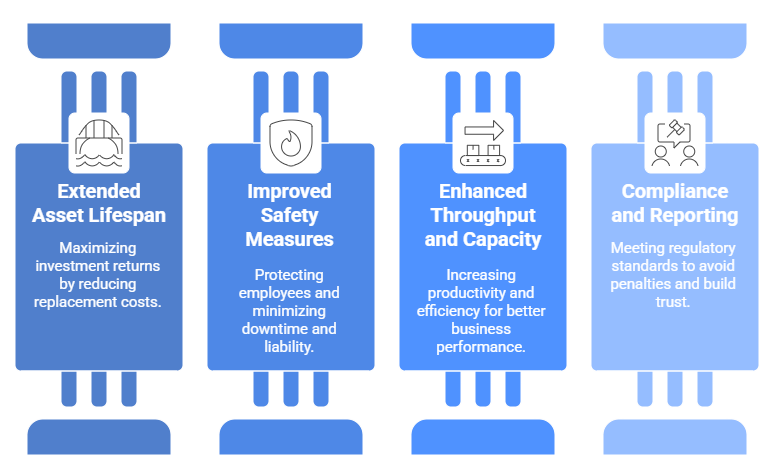
- Extended Asset Lifespan: By identifying the root causes of premature wear and correcting underlying issues (like misalignment or bearing lubrication problems), the service life of expensive equipment is substantially prolonged, a key concern for mechanical engineers and R&D teams.
- Improved Safety: Failures often lead to catastrophic events, including high-pressure leaks, fires, or explosions. Continuous, precise monitoring drastically reduces the probability of these high-risk failures, creating a safer environment for plant managers and operations heads, and the entire team.
- Enhanced Throughput & Capacity: Reliability translates directly into utilization. When equipment doesn’t fail, production lines run longer and more predictably, boosting overall production capacity. This enhanced operational predictability is vital for meeting customer commitments.
- Compliance and Reporting: Automated data collection creates a clear, auditable trail of maintenance actions and equipment status, simplifying regulatory compliance and internal reporting for industrial technology providers.
It begs the question: Can an industrial plant truly compete globally if it’s still guessing about the health of its most critical rotating equipment?
Conclusion
The era of blind, reactive maintenance is drawing to a close. The convergence of IoT, AI, and predictive analytics for pumps has laid the groundwork for a more efficient, reliable, and profitable industrial future. By adopting smart pump monitoring systems, industries can transform unexpected failures into scheduled maintenance appointments, ensuring the relentless heart of their operations keeps beating without interruption. It’s an investment in foresight that pays continuous dividends.
FAQs
-
What does the future of pump monitoring technology look like with the rise of AI, IoT, and predictive maintenance?
The future lies in autonomous monitoring and hyper-integration. Driven by AI and ubiquitous IoT, systems will automatically optimize operations and schedule repairs. This evolves pump monitoring into a core, intelligent component of the fully connected factory envisioned by Industry 4.0.
-
How does predictive analytics improve pump reliability and reduce unexpected equipment failures?
Predictive analytics shifts the maintenance trigger from time-based to "condition reached." Machine learning models detect subtle, multivariate anomalies that precede failure. This allows reliability engineers to intervene precisely when needed, preventing small issues from escalating into catastrophic, unexpected equipment failures.
-
What are the key benefits of smart pump monitoring systems for industrial plants?
Key benefits span operational, financial, and safety domains. Plants achieve higher uptime and throughput while drastically reducing maintenance costs by eliminating expensive emergency repairs and optimizing inventory. Furthermore, continuous monitoring prevents critical mechanical failures, creating a safer environment for all facility management companies.
-
How does real-time data analytics for pumps help in detecting performance issues before they lead to downtime?
Real-time data analytics continuously scrutinize a pump's "digital fingerprint" and its normal profile. The system instantly compares current parameters (vibration, power) against this baseline, flagging subtle deviations like early cavitation or bearing defects. This crucial early warning prevents performance issues from causing total system downtime.
-
How do predictive algorithms for pump failures support advanced pump monitoring solutions in modern industries?
Predictive algorithms are the intelligent core, calculating the Probability of Failure (PoF) and Remaining Useful Life (RUL). This advanced forecasting supports "Just-in-Time" maintenance. It allows industrial automation and IoT specialists to schedule interventions only when necessary, minimizing disruption and maximizing asset lifecycle value

📅 Posted by Nirav Thakkar on November 21, 2025
Nirav Thakkar
Semiconductor Fab Automation & Equipment Software specialist with 18 years of industry experience.