

Summary
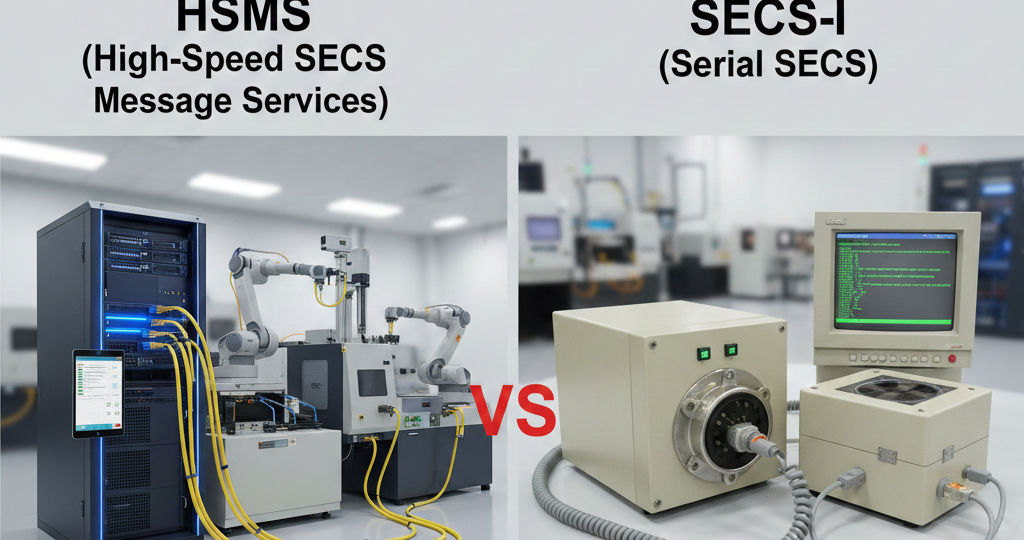
Speed Gap: SECS-I operates on legacy serial connections (often limited to 9600 baud), while HSMS utilises TCP/IP over Ethernet, offering significantly higher bandwidth for modern data demands.
Infrastructure: Moving from point-to-point RS-232 cabling (SECS-I) to network-based architecture (HSMS) simplifies fab layouts and allows for remote diagnostics.
GEM Compliance: While both transport layers support SECS-II messaging, the advanced capabilities of GEM300 and high-frequency data collection usually necessitate the speed of HSMS.
Legacy Integration: Factories often run hybrid environments; understanding the nuances between these protocols is vital for integrating older “workhorse” tools with modern MES systems.
Introduction
The semiconductor industry is witnessing a massive surge in data generation. According to a 2024 market analysis by Statista, the global smart manufacturing market is projected to grow to over $240 billion by 2028, driven largely by data-heavy processes like predictive maintenance and real-time fault detection (Statista, 2024). For fab managers and SECS/GEM integration engineers, this data explosion presents a distinct challenge: the communication pipes connecting the equipment to the host must be big enough to handle the flow. This brings us to the critical infrastructure debate of HSMS vs SECS-I.
For decades, the industry relied on serial cables and modest transmission speeds. However, as 200mm fabs upgrade and 300mm facilities push for higher throughput, the limitations of older protocols have become glaringly obvious. It isn’t merely about sending a “Start Process” command anymore; it is about streaming thousands of variable data points per wafer without choking the system.
Understanding the technical and practical differences between these two transport layers is essential for anyone involved in SECS/GEM communication protocol implementation. Whether you are building a new driver for an OEM tool or retrofitting a legacy etcher into a modern Smart Factory, choosing the right transport protocol dictates the reliability and scalability of your automation.
The Evolution from Serial to Ethernet
To understand why the industry is shifting, we have to look at where we started. The SEMI standards were developed to ensure equipment from different vendors could talk to a central host, essentially speaking a common language. However, the medium through which that language travels has changed drastically.
SECS-I Protocol (The Legacy Standard)
The SECS-I protocol (SEMI E4) was the original workhorse. It defines the communication interface using RS-232 serial ports. If you have been in the industry long enough, you likely remember the struggle of soldering DB-25 or DB-9 connectors and praying you didn’t swap the transmit and receive pins.
SECS-I is a point-to-point protocol. It connects one distinct port on the equipment to one distinct port on the host computer. While robust and deterministic, it is undeniably slow by modern standards. Typical baud rates hover around 9600 bps. For context, that is roughly the speed of a decent dial-up internet connection in 1994.
HSMS Protocol (The Modern Standard)
As fabs grew larger and data requirements became more complex, the HSMS protocol (SEMI E37) arrived as the successor. HSMS stands for High-Speed Message Services. It takes the familiar SECS-II messages and wraps them in TCP/IP packets, sending them over standard Ethernet networks.
This shift was revolutionary. It removed the distance limitations of serial cables and allowed for vastly superior speeds (100 Mbps or 1 Gbps). Suddenly, equipment software developers could stream recipe data and trace logs almost instantly, paving the way for advanced GEM300 standards.
HSMS vs SECS-I: A Technical Comparison
When analysing HSMS vs SECS-I, the differences go beyond just the cable type. The implications touch on speed, reliability, and how the host system manages connections.
Bandwidth and Throughput
The most immediate difference is speed. SECS-I is serial-based. Even if you push an RS-232 connection to its limits (typically 19.2 kbps or slightly higher in custom setups), it is a bottleneck. Sending a large Process Program (recipe) or a dense map of wafer defect data can take seconds or even minutes. In a high-volume manufacturing environment, those minutes add up to lost productivity.
HSMS, utilising Ethernet, clears this bottleneck. The transmission time for standard control messages is negligible. More importantly, it allows for high-frequency data collection polling sensors every 100 milliseconds without delaying critical control signals.
Connectivity and Distance
RS-232 cables have a physical limit. Standard specification suggests a maximum cable length of about 50 feet (15 meters) before signal degradation occurs. This forces the host computer (or a terminal server) to be physically close to the tool.
Ethernet allows for a virtually unlimited range via switches and routers. A host system in a server room three floors up can communicate seamlessly with a generic lithography tool on the cleanroom floor. For factory automation managers, this flexibility simplifies the physical architecture of the fab.
Connection Management
In SECS-I, the connection is “always on” as long as the cable is plugged in, but the protocol has to manage block transfer protocols aggressively to ensure data integrity. It uses a specific handshake (ENQ, EOT, ACK, NAK) for every block of data.
HSMS handles this differently. It establishes a logical connection (Selected or Not Selected state) over the TCP/IP link. Because TCP/IP handles packet integrity and ordering at the lower network layer, HSMS doesn’t need the chatty “Is it okay to send?” handshaking for every single packet that SECS-I requires. This reduces overhead and improves efficiency.
The Role of SECS-II and GEM
A common misconception among junior Control system engineers is that changing from SECS-I to HSMS changes the messages themselves. It does not. This is where the layered architecture of the SEMI standards shines.
Same Language, Different Carrier
Think of SECS II (SEMI E5) as the language (English, for example) and the transport protocol as the medium (a handwritten letter vs. an email).
SECS-I: The handwritten letter. It gets there, but it takes time and physical handling.
HSMS: The email. It delivers the same words (SECS-II messages) but does so instantly.
The message content Stream 1, Function 1 (Are you there?) or Stream 6, Function 11 (Event Report) remains identical regardless of the transport. This backward compatibility is why the industry was able to transition to HSMS without rewriting every single host application from scratch.
The SEMI E30 GEM Standard
The SEMI E30 GEM standard sits on top of SECS-II. It defines behaviour. It dictates that a machine must have a “Remote” state and a “Local” state, or that it must generate specific events when a process starts or finishes.
While GEM can technically run over SECS-I, modern implementations strongly favour HSMS. The sheer volume of variables required for full GEM compliance, and specifically the rigorous demands of GEM300 for 300mm wafer handling, make SECS-I impractical. If you are trying to push complex Control Jobs and Carrier Management data over a 9600 baud serial line, you are going to have a bad time.
Why Modern Fabs Prefer HSMS
The preference for HSMS isn’t just about speed; it is about the capability to support Industry 4.0 initiatives.
Enabling Big Data and Analytics
Smart factory consultants constantly preach the value of data. Modern fabs use Fault Detection and Classification (FDC) systems that require massive amounts of trace data. They want to know the pressure, temperature, and gas flow rates every second of the process.
HSMS handles this load with ease. SECS-I simply cannot. If you attempt high-frequency tracing on SECS-I, the communication bus saturates. The host might miss a critical alarm because the line was clogged with temperature readings.
Ease of Troubleshooting
Troubleshooting an RS-232 connection often involves a breakout box (a device with LEDs showing which pins are active) and an oscilloscope. It is hardware-intensive.
Troubleshooting HSMS is done with software tools like Wireshark. An automation architecture team can capture network traffic remotely to diagnose why a tool went offline. This remote capability reduces the need for engineers to gown up and physically enter the cleanroom, saving time and reducing contamination risks.
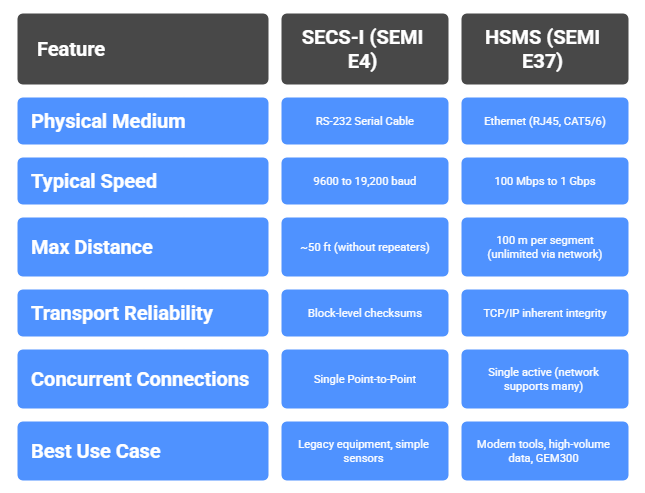
Data Comparison: HSMS vs SECS-I
Below is a quick reference guide for semiconductor manufacturing system integrators comparing the two protocols.
Managing the Transition in Hybrid Fabs
Unless you are building a “greenfield” fab from the ground up, you will likely encounter a mix of both protocols. This is the reality for most MES/Factory IT teams.
Strategies for Legacy Equipment
You might have a perfectly good sputtering tool from the late 90s that only speaks SECS-I. You cannot simply scrap a multi-million dollar tool because it has a slow port.
Terminal Servers: The most common solution. These devices convert RS-232 signals to Ethernet. The host talks to the terminal server via TCP/IP (often raw sockets), and the server talks to the tool via Serial. Note: This does not make the tool “HSMS.” It just allows a serial tool to live on the network.
Protocol Converters: These are smarter hardware or software boxes that actually translate SECS-I packets into HSMS messages. To the host, the old tool looks like a modern HSMS machine.
Future-Proofing New Tools
For tool OEM communication engineers, the directive is clear: Implement HSMS. Even if the current data requirements of the tool are low, customer demands will evolve. Providing an Ethernet port and a native HSMS driver ensures the tool is ready for whatever data-hungry analytics the fab decides to implement next year.
Conclusion
The battle between HSMS and SECS-I was technically won years ago, but SECS-I’s legacy remains in fabs worldwide. While SECS-I laid the groundwork for standardised automation, HSMS provided the highway necessary for the data-driven revolution of Industry 4.0. For modern Station controller designers and factory managers, HSMS is not just an option; it is a requirement for scalability, speed, and advanced control.
As you look to upgrade your facility or develop new equipment, ensure your communication layers are robust enough to handle the future. Don’t let a 30-year-old cabling standard bottleneck your million-dollar process.
FAQ
-
1. Can I use SECS-I and HSMS on the same host system?
Yes. Most Equipment Automation Programs (EAP) or Station Controllers are designed to handle multiple connections simultaneously. You can configure one channel to communicate via a COM port (SECS-I) and another via an IP address (HSMS) within the same application.
-
2. Is HSMS synonymous with GEM?
No. HSMS is the transport protocol (how data moves). GEM (SEMI E30) is the standard for equipment behaviour (what the data means). You can have HSMS without full GEM compliance, though they are usually implemented together in modern equipment.
-
3. Does upgrading to HSMS require changing the equipment hardware?
Usually, yes. If the tool only has a serial port, you cannot force it to speak HSMS without an intermediary PC or a protocol converter box. However, some newer controllers on older tools may have dormant Ethernet ports that can be activated with a software license upgrade.
-
4. What is the main downside of SECS-I in a modern fab?
Throughput. SECS-I is too slow to support detailed wafer maps, frequent trace data collection, or the rapid command/response cycles required by high-volume automated material handling systems (AMHS).
