

Modern semiconductor fabrication relies heavily on automation to achieve predictable processes, maximize throughput, and maintain world-class yield. Every manufacturing step—from wafer loading to deposition, etching, metrology, and packaging—depends on precise coordination between equipment and the factory’s host systems. This coordination is made possible through one of the most important communication standards in the industry: the SEC and GEM communication protocols.
SECS/GEM (SEMI Equipment Communications Standard / Generic Equipment Model) serves as the universal language that allows semiconductor tools to communicate with manufacturing execution systems (MES), factory hosts, and automation software. Without the uniform implementation of SECS/GEM communication protocols, fabs would require custom communication drivers for each tool type, making integration slow, expensive, and nearly impossible to scale across production floors.
Why SECS/GEM Protocols Matter in Modern Fabs
Before SECS/GEM standardization, equipment vendors utilized proprietary communication formats, meaning integrating a new tool could consume months of intensive engineering work. SECS/GEM standardizes message structures, events, commands, status reporting, alarms, and behaviors so that all tools from lithography to packaging communicate uniformly.
Key Integration Benefits:
- Complexity Reduction: Lowers engineering cost and integration friction across multi-vendor tools.
- Accelerated Qualification: Shorter installation and ramp-up windows lead to faster tool qualification.
- Fewer Errors: Minimizes communication-related logic discrepancies across hundreds of active machines.
📋 Semiconductor SECS/GEM Standards Matrix
Fabs use specific SEMI standards to maintain robust interface baselines between individual tools and factory host arrays.
| SEMI Standard | Core Designation | Primary Function & Purpose |
|---|---|---|
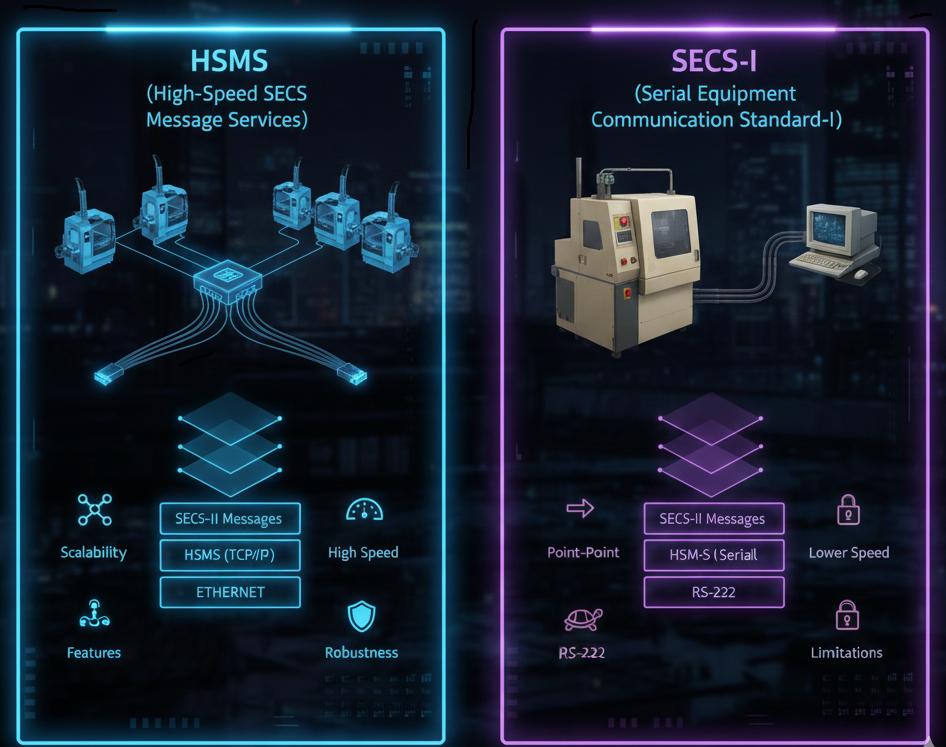
| SEMI E4 | SECS-I | Defines legacy serial electrical connections (RS-232), character structures, and point-to-point protocol lines. |
| SEMI E5 | SECS-II | Defines the data structure, data types, and standard streams/functions (SxFy) grammar for message contents. |
| SEMI E30 | GEM | Outlines the operational state models, control logic rules, and basic automation scenarios that equipment must adhere to. |
| SEMI E37 | HSMS | Specifies High-Speed Messaging Services over high-throughput TCP/IP networks to replace slower SECS-I interfaces. |
| GEM 300 | Advanced Automation | Augments base SECS/GEM to coordinate 300mm wafer handling, robotic carrier pods (FOUPs), and hardware sorting maps. |
🏗️ SECS/GEM Stack & Automation Architecture
This technical map shows how data moves from physical machinery layers up to enterprise production applications:
Executes Remote Commands (RCMD), Recipes, & Data Logging
Controls State Models, Event Definitions, Alarms, & Behaviors
Formats Message Layouts & Stream/Function Logic (SxFy Structures)
High-Speed TCP/IP Ethernet
Legacy RS-232 Serial Link
Tracks Chamber Data, Dynamic Status Variables (SVs), & Alarms
Need Help with SECS/GEM Software Integration?
Accelerate Your SECS/GEM Compliance & Tool Connectivity
Whether you are adding SECS/GEM capabilities to your existing legacy tools or deploying an enterprise Recipe Management System (RMS), our expert integration engineers can help minimize configuration friction.
What are the Main Features of the SECS/GEM Communication Protocol?
The SECS/GEM protocol provides a highly organized and rich feature set designed to deliver robust equipment monitoring, automated data acquisition, and remote machine control. The core features of this communication standard include:
1. Structured SxFy Message Format
SECS messages follow a highly structured format categorized as Stream x, Function y (SxFy). This predictable messaging blueprint ensures tools behave identically in all global factories. Key examples include:
- S1F1: “Are You There?” query used for connectivity health checks.
- S6F11: Dynamic Event Report publication.
- S2F41: Remote Command execution transmission.
2. High-Speed Transport Layers (HSMS vs. SECS-I)
While SECS-I originally relied on legacy RS-232 serial links, modern semiconductor manufacturing runs on High-Speed Messaging Services (HSMS via SEMI E37) over Ethernet infrastructure. HSMS offers high data throughput, dependable network fabrics, and enhanced support for enterprise-wide cluster automation.
3. Event Reporting and Data Collection
The protocol acts as a primary data generator inside the fab by structuring metrics through custom parameters:
- Data Collection Events (DCEs): Triggers that execute when critical shifts occur, such as a wafer load or process completion, enabling total traceability.
- Status Variables (SVs): Real-time parameters reflecting current machine health, carrier mapping, and material sub-states.
- Equipment Constants (ECs): Internal software parameters that define how a tool configures and executes commands.
4. Automated Alarm Handling and Fault Detection
Alarms (ALIDs) are reported directly with clear descriptions, unique identifiers, timestamps, and severity levels. This feature minimizes downtime by supporting near-instant troubleshooting and rapid engineering root-cause isolation.
5. Remote Command Execution (RCMD)
Hosts utilize remote commands to safely control recipe selection, job start sequences, stop signals, pauses, and resumption parameters. This feature cuts down human interaction errors and eliminates the need for manual physical interventions at tool faces.
6. Protocol Stack Layer Differentiation
The standard establishes a distinct division of labor between its components: SECS-II strictly maps out the structured grammar and core message layouts, while GEM defines the dynamic behavioral models, control states, and automation compliance rules that the equipment must maintain.
Real-Time Data Analytics & Factory Integration
Fabs leverage the highly structured logs generated via SECS/GEM interfaces to plot precise trend analysis curves, keeping close tabs on critical hardware attributes like chamber temperatures, motor torque, wafer timing, and pressure stability.
Smart Manufacturing Integration Vectors
Clean SECS/GEM streams feed directly into enterprise systems like Manufacturing Execution Systems (MES), Recipe Management Systems (RMS), Fault Detection & Classification (FDC), and Yield Management Systems (YMS). Today, this rich data layer acts as the foundation for feeding next-gen AI/ML platforms, enabling accurate predictive maintenance models, process stability enhancements, and rapid root-cause defect isolation.
Protocol Evolutions: SECS/GEM vs. GEM300 & EDA
As manufacturing needs expand, new paradigms augment the base protocol. GEM300 builds directly on top of basic SECS/GEM architectures to introduce dedicated rules for large-scale wafer tracking, carrier management, and automated material robotics. Meanwhile, EDA (Interface A) handles high-frequency big data diagnostics separate from control lines, but SECS/GEM remains absolutely mandatory for executing core events, recipe changes, and remote factory commands.
Common Operational Challenges:
- Custom Variations: Equipment vendors often customize aspects of their GEM configurations, necessitating mapping validation cycles.
- Connection Stability: Ensuring robust HSMS network reconnect logic, active heartbeats, and reliable message buffering.
- Data Quality Control: Guarding against poorly defined status variables that degrade analytics models.
Conclusion
The SECS/GEM protocol remains the essential cornerstone of semiconductor automation. Even as contemporary fabs advance toward hybrid Industry 4.0 setups, predictive twins, and AI interfaces, this robust protocol stack retains its absolute dominance due to its unmatched stability, structural simplicity, and massive global adoption footprint.


