


In modern fabs, competitive advantage is increasingly determined by how quickly and accurately operational data can be collected, contextualized, and acted upon. That’s why MES SECS/GEM Integration has become a strategic imperative: it bridges the gap between manufacturing execution systems (MES) and tool controllers, enabling reliable, automated, real-time MES data collection using SECS/GEM. Many facilities still struggle with inconsistent equipment connectivity, slow data latency, and costly custom interfaces. By standardizing SECS/GEM for MES, fabs can improve utilization, traceability, and responsiveness—without reinventing the wheel per tool. In this post, we’ll explore the value of SECS/GEM MES Communication, common pitfalls, and architectural patterns that make SECS/GEM Integration with MES scalable across a heterogeneous toolset, from legacy to GEM300-compliant equipment. We’ll also cover SECS/GEM data mapping for MES systems, SECS/GEM host implementation for MES, and how to measure the impact—such as improving OEE with MES SECS/GEM integration—with practical guidance for the Best SECS/GEM integration solution for MES.
Why MES SECS/GEM Integration Matters Now
Semiconductor manufacturing demands precision and repeatability at scale. Yet, many fabs face fragmented data pipelines: some tools emit logs without structure, others rely on vendor-specific APIs, and legacy equipment lacks modern interfaces. SECS/GEM Equipment to MES Integration standardizes the communication layer so MES can interact with tools in a consistent manner—issuing commands, subscribing to events, collecting parameters, and enforcing process states. With MES and SECS/GEM Communication Protocol, the MES becomes the orchestrator of lot movement, recipe enforcement, alarms, and performance tracking.
Two megatrends make Semiconductor MES SECS/GEM non-negotiable. First, product complexity is increasing (advanced nodes, heterogeneous integration, compound semiconductors), creating more recipes, more process steps, and more interlocks to manage. Second, cycle-time expectations and yield pressures require SECS/GEM Automation for MES to eliminate manual data entry and reduce variability. Done right, SECS/GEM Host MES Interface enables deterministic data flow, faster exception handling, and closed-loop control—key ingredients for Improving OEE with MES SECS/GEM integration.
Core Concepts: From Protocol to Performance
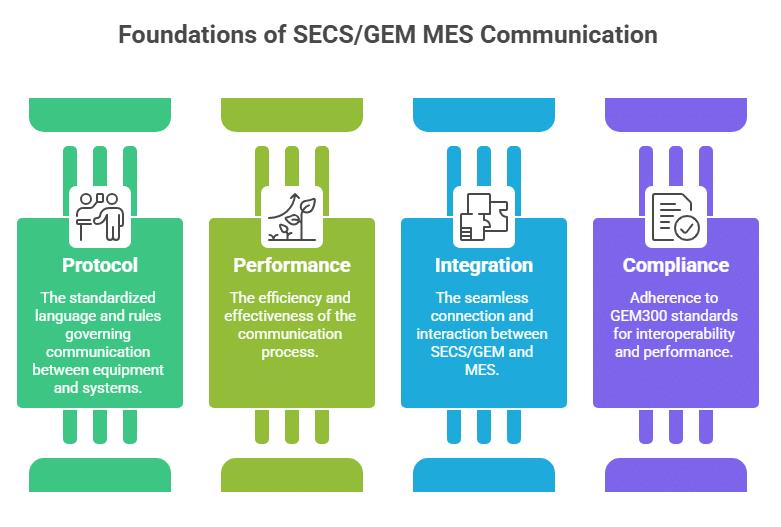
SECS/GEM for MES is more than just a protocol handshake. It’s a blueprint for robust, model-driven equipment integration:
SECS/GEM MES Communication: The SECS (SEMI E5/E37) messaging and GEM (SEMI E30) model define how the host (MES or an integration service) and equipment exchange messages for status, alarms, collection events (CEIDs), variables (SVIDs), and control commands (remote start/stop, PP select, etc.).
SECS/GEM Integration with MES: Typically realized by a host layer that translates MES business logic into SECS/GEM operations—subscribing to events (e.g., lot start, process start), retrieving data (durations, temperatures, pressures), and enforcing workflows (recipe validation, carrier movement).
GEM300 compliance for MES integration: For 300mm fabs (SEMI E84/E87/E90/E94/E116, etc.), compliance enables standardized carrier handling, substrate mapping, process program management, and equipment status modeling. Ensuring a SECS/GEM host implementation for MES that aligns with GEM300 simplifies scale-out across a 300mm line.
When these elements align, SECS/GEM Equipment to MES Integration supports a stable, scalable data backbone—meeting latency targets for real-time MES data collection using SECS/GEM while ensuring data integrity and traceability.
Architecture That Works: Patterns for Reliability and Scale
A proven architecture for SECS/GEM Based MES Integration includes four layers:
Equipment Connectivity Layer
A host (or connectivity server) maintains persistent SECS/GEM sessions, handles primary/secondary messages, manages keepalives, and buffers transient network issues. This insulates the MES from tool-level instability and ensures robust SECS/GEM MES Communication.
Semantic Mapping Layer
Here, raw CEIDs/SVIDs/ALIDs are mapped to MES domain concepts: lot start/stop, process step, recipe name, parameter snapshot, SPC tags. Configurable templates make SECS/GEM data mapping for MES systems consistent across tools and vendors, paving the way for the Best SECS/GEM integration solution for MES that minimizes custom code.
Business Logic Orchestration
The MES (or an orchestration microservice) applies context: route enforcement, recipe/version validation, material tracking, and alarm policies. It leverages SECS/GEM Host MES Interface to send commands (e.g., PPSELECT), react to alarms, and coordinate multi-equipment flows. This is the heart of SECS/GEM Integration with MES.
Data Services and Analytics
Time-series storage for high-frequency variables, event-ledgers for genealogy, and dashboards/KPIs for Improving OEE with MES SECS/GEM integration. This layer supports SPC, predictive maintenance, and anomaly detection—closing the loop from sensor to decision.
In brownfield environments, you’ll likely blend native GEM300 tools with older equipment. A good SECS/GEM host implementation for MES should offer protocol adapters and simulators, enabling staged rollout and regression-free testing of SECS/GEM Automation for MES.
Closing Real-Time Data Gaps: Practical Techniques
Fabs often experience three types of data gaps: missing events, delayed updates, and unstructured parameters. Here’s how MES SECS/GEM Integration addresses them.
Event Completeness with CEID Governance
Audit your event model: every business-critical transition (e.g., lot arrival, process start/end, wafer transfer, alarm raised/cleared) should map to a CEID subscription. Use host-side health checks to detect silent failures (e.g., re-subscribe on connection drop). This ensures SECS/GEM for MES receives the complete state machine to drive dispatching and traceability workflows.
Latency Control with Edge Buffering
Implement edge buffering at the host to queue high-frequency SVIDs and batch commits to the MES data service. This hybrid pull/push approach maintains real-time MES data collection using SECS/GEM within SLA while avoiding backpressure on the MES. It’s foundational to SECS/GEM MES Communication at scale.
Deterministic Parameter Capture
Tie parameter snapshots (SVID reads) to CEIDs (e.g., PROCESS_START, PROCESS_END) with atomic transactions. Tag each snapshot with route step, recipe version, carrier ID, and EID (equipment ID). This practice standardizes SECS/GEM data mapping for MES systems, vital for audits and SPC.
GEM300 Material Handling Discipline
Enforce GEM300 compliance for MES integration—use E87 Carrier Management and E90 Substrate Tracking to prevent ambiguous material states. Coupled with E94 Control Job and E40 Processing Management, your SECS/GEM Host MES Interface gains precise control, reducing misprocessing and boosting OEE.
Measuring Impact: OEE, Yield, and Cycle Time
Improving OEE with MES SECS/GEM integration comes from three levers:
Availability: Proactive alarm handling via SECS/GEM MES Communication reduces MTTR. With structured ALIDs and automated e-notifications, maintenance responds faster; persistent sessions mean fewer “invisible” tool downtimes.
Performance: Dispatching driven by live state (RUN/IDLE/SETUP) and queue times reduces micro-stoppages. SECS/GEM Automation for MES can auto-release lots when prerequisites are met—cutting idle and setup times.
Quality: Parameter and recipe validation at start prevents excursions; atomic SECS/GEM data mapping for MES systems improves SPC sensitivity, reducing scrap and rework.
Track leading indicators: CEID-to-business-event coverage, message round-trip time, subscription health, and parameter completeness rate. These correlate strongly with sustained gains from SECS/GEM Integration with MES and help justify continued investment in Semiconductor MES SECS/GEM maturity.
Implementation Roadmap: From Pilot to Scale
A pragmatic rollout of SECS/GEM Equipment to MES Integration follows five steps:
Baseline Assessment
Inventory tool capabilities (GEM, GEM300, custom), existing host(s), and MES APIs. Identify critical routes/steps for a pilot that will demonstrate real-time MES data collection using SECS/GEM.
Canonical Data Model
Define a standard set of business events, variables, and metadata tags. This is your foundation for SECS/GEM data mapping for MES systems and reduces future integration friction—key to the Best SECS/GEM integration solution for MES.
Host Configuration and Adapters
Stand up or enhance your SECS/GEM host implementation for MES with equipment-specific profiles. Where GEM is partial, supplement with vendor APIs temporarily—but normalize into the canonical model so the MES and SECS/GEM Communication Protocol stays consistent.
Automation Policies
Codify recipe validation, alarm reaction, and material control policies into orchestrations that exercise the SECS/GEM Host MES Interface. Include GEM300 interlocks to ensure compliance during automated carrier handling.
Pilot, Telemetry, Scale-Out
Run a multi-week pilot; instrument everything—CEID subscription health, message latency, event coverage, exception frequency. Use insights to tune subscriptions, batching, and error handling. Then scale across similar tool families to expand SECS/GEM Integration with MES systematically.
Common Pitfalls and How to Avoid Them
Assuming GEM compliance equals complete coverage
Even GEM-compliant tools may expose different CEIDs/SVIDs. Validate your needs against actual equipment dictionaries to ensure SECS/GEM MES Communication covers all business-critical events.
Underestimating legacy variability
Legacy tools might require protocol gateways or soft-sensors. Budget time for adapters while maintaining the SECS/GEM for MES canonical model to avoid one-off MES logic.
Lack of version control for mappings
Treat SECS/GEM data mapping for MES systems like code: version mappings, test changes in a sandbox with simulators, and roll forward/back safely. This is crucial for the Best SECS/GEM integration solution for MES.
No KPIs for host health
Without visibility into the host’s connection state, subscriptions, and throughput, issues fester. Build dashboards for the SECS/GEM host implementation for MES and alert on anomalies.
Selecting the Best SECS/GEM Integration Solution for MES
Look for these capabilities when evaluating platforms and partners:
GEM/GEM300 breadth: Full coverage (E30, E37, E5, E87, E90, E94, E116) to assure GEM300 compliance for MES integration.
Config-driven mapping: Low-code templates for SECS/GEM data mapping for MES systems that reduce engineering lead time.
Scalability and resilience: Horizontal scaling of sessions, persistent queues, and replay; crucial for real-time MES data collection using SECS/GEM.
Testing toolchain: Simulators, protocol analyzers, and automated regression tests for the SECS/GEM Host MES Interface.
Security and governance: Audit trails, role-based access, and encryption without sacrificing SECS/GEM MES Communication performance.
The right choice empowers SECS/GEM Automation for MES to evolve with your fab—absorbing new tools quickly and keeping the MES at the center of digital operations.
Conclusion
As fabs push for higher yields, shorter cycle times, and resilient operations, MES SECS/GEM Integration delivers a durable foundation for automation and analytics. By operationalizing SECS/GEM for MES—from event coverage and latency control to GEM300 compliance for MES integration—you eliminate data blind spots and unlock deterministic control. A robust SECS/GEM Host MES Interface, backed by consistent SECS/GEM data mapping for MES systems, transforms disparate tools into a cohesive, orchestrated line. The payoff is tangible: fewer exceptions, faster response, and Improving OEE with MES SECS/GEM integration at scale. With a structured roadmap and the Best SECS/GEM integration solution for MES, your fab can turn equipment data into real-time decisions—closing the loop between process intent and process reality through world-class SECS/GEM Integration with MES and reliable SECS/GEM MES Communication.
