

Modbus Protocol: Complete Guide to Modbus TCP vs Ethernet IP
- modbus tcp
- ethernet ip
- modbus rtu protocol
- modbus tcp ip protocol
- modbus tcp protocol
In modern industrial automation, seamless communication between devices is critical. Whether you are connecting PLCs, HMIs, sensors, or industrial controllers, communication protocols play a central role. Among the most widely adopted standards is the Modbus protocol.
At Einnosys, we help industries implement reliable and scalable industrial communication solutions. This guide explains what is Modbus, how Modbus TCP/IP protocol works, how it compares with EtherNet/IP, and when to use Modbus RTU protocol or Modbus TCP communication protocol in real-world applications.

What is Modbus?
Modbus is an open, application-layer communication protocol originally developed by
Modicon (now Schneider Electric) in 1979. It is used to transmit data between industrial
electronic devices such as PLCs, drives, meters, and sensors.
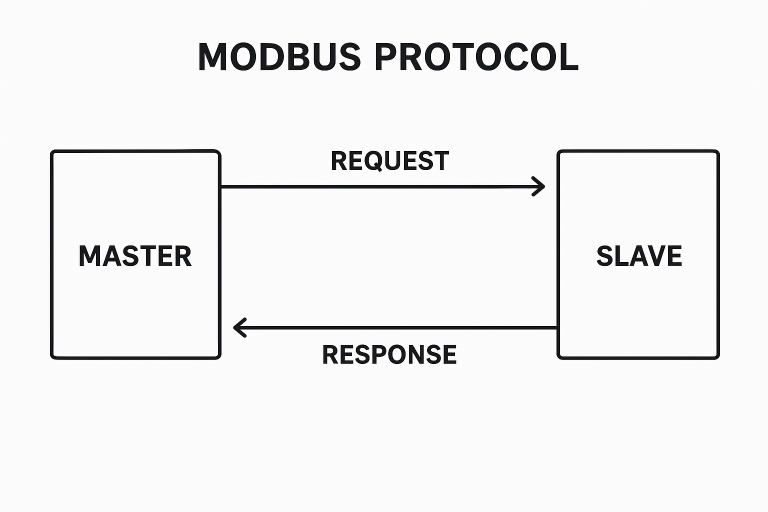
The Modbus communication protocol follows a simple master–slave (client–server)
architecture, making it easy to implement, debug, and scale. Because it is open and
vendor-neutral, Modbus remains one of the most popular protocols in factory automation,
energy systems, oil & gas, water treatment, and manufacturing.
Key Benefits of Modbus

Modbus Protocol
Modbus Protocol Basics
The Modbus protocol is designed to exchange data using registers. Devices communicate by
reading or writing data from these registers.
Common data types include:
The protocol itself does not define the physical layer. This flexibility allows Modbus to
operate over different transport methods such as serial lines or Ethernet.
Modbus RTU Protocol
The Modbus RTU protocol is the serial implementation of Modbus. It is commonly used over
RS-232 or RS-485 communication lines.
Modbus RTU protocol is still heavily used in legacy equipment automation, where Ethernet
infrastructure is unavailable.
Key Characteristics
Modbus TCP IP Protocol
The Modbus TCP/IP protocol is the modern Ethernet-based version of Modbus. It encapsulates
Modbus messages inside TCP/IP packets and runs over standard Ethernet networks.
Because it uses standard Ethernet, the Modbus TCP IP communication protocol integrates
easily with IT systems, SCADA, cloud platforms, and MES solutions.
Key Advantages
Protocolo Modbus TCP IP
Protocolo Modbus TCP IP is the Spanish-language reference commonly used in
global technical documentation. Despite the language difference, the protocol functionality
remains the same.
It is globally adopted due to:
This makes it especially useful in multinational industrial projects.
Modbus TCP vs Ethernet/IP
A frequent question in industrial networking is Modbus TCP vs EtherNet/IP. Both run over Ethernet, but they serve different needs.
| Feature | Modbus TCP | EtherNet/IP |
|---|---|---|
| Protocol Type | Open | ODVA-managed |
| Complexity | Simple | High |
| Data Model | Registers | Object-oriented |
| Implementation Cost | Low | Higher |
| Real-Time Control | Limited | Strong |
| Ideal Use Case | Monitoring, data exchange | Motion & control |
Modbus TCP protocol is excellent for monitoring, diagnostics, and data acquisition. EtherNet/IP is better for high-speed deterministic control.
At Einnosys, we help customers choose the right protocol based on performance, scalability, and long-term cost.
Modbus TCP Tools, Practice & Implementation
Modbus Software and Tools
Modbus software plays a critical role in development, testing, and monitoring. These tools
allow engineers to:
Einnosys also develops custom Modbus TCP IP communication protocol software solutions
tailored for industrial automation and monitoring.
Modbus TCP IP Communication Protocol in Practice
The Modbus TCP IP communication protocol is widely used in modern factories due to its
simplicity and reliability.
Common applications:
Technical Example: Modbus TCP Implementation
A manufacturing plant wants to monitor temperature and pressure data from industrial pumps.
Using this approach, the plant gains real-time visibility without expensive hardware changes.
At Einnosys, we deploy similar architectures for industrial analytics and
predictive maintenance systems.
Scenario
Solution Using Modbus TCP
Sample Modbus Registers
SECS/GEM Integration Products
Fabs & Assembly/Test/Packaging Products
- SECS/GEM addition & enhancement on legacy equipment – EIGEMBox & EIGEM-HMI
- E84 & E87 addition on legacy equipment – EIGEMBox
- AI/ML-based health monitoring & predictive maintenance – XPump
- Factory host – EIStationController
- Recipe Management System – EIRMS
- AI/ML based Smart FDC with Predictive Analytics – SeerSight
- Analog Gauge Monitoring – EIGaugeMonitor
- Equipment Simulator – EIGEMSim
- Factory host SDK – EIGEMHost & EIGEM300Host
- Chemical Management – EIBarcodeGuardian
- Spare Parts & Vendor Management – EICMMS
OEMs (Original Equipment Manufacturer) Products
Why Choose Modbus with Einnosys?
Einnosys provides end-to-end industrial communication solutions, including:
- Modbus RTU protocol integration
- Modbus TCP IP protocol development
- Custom Modbus software solutions
- Legacy system modernization
Our expertise ensures secure, scalable, and future-ready automation systems.

Conclusion
Understanding what is Modbus, how the Modbus communication protocol works, and the difference between Modbus TCP vs EtherNet/IP is essential for modern automation projects.
Whether you are upgrading legacy equipment with Modbus RTU protocol or building smart factories using Modbus TCP IP communication protocol, Modbus remains a reliable and cost-effective solution.
With deep industrial experience, Einnosys helps businesses implement robust Modbus-based architectures that scale with evolving automation needs.
FAQ
What is Modbus?
Modbus is an open industrial communication protocol used to exchange data between PLCs, sensors, HMIs, and industrial devices.
What is Modbus TCP IP protocol?
Modbus TCP/IP protocol is an Ethernet-based version of Modbus that uses TCP/IP for fast and reliable industrial communication.
What is the difference between Modbus TCP and Modbus RTU?
Modbus TCP uses Ethernet and TCP/IP, while Modbus RTU uses serial communication such as RS-485.
Modbus TCP vs EtherNet/IP – which is better?
Modbus TCP is simpler and cost-effective, ideal for monitoring and data exchange. EtherNet/IP is suited for real-time motion and control systems.
Where is Modbus TCP used?
Modbus TCP is used in factory automation, energy monitoring, equipment health analysis, industrial IoT, and SCADA systems.
Contact US
Contact us
North America
5899 Remer Terrace, Fremont,
CA 94555, USA
Tel: +1.805.334.0710
Skype: einnosys
Email: sales@einnosys.com