

Summary
- Market Context: The semiconductor market is projected to hit nearly $1 trillion by 2030, making automation critical for meeting demand (McKinsey, 2023).
- The Challenge: Mixed fleets of modern and legacy equipment create communication silos, hindering data collection and process control.
- The Solution: Adopting fab automation standards like SECS/GEM and GEM300 ensures seamless equipment-to-host communication.
- Legacy Retrofits: Einnosys provides hardware and software solutions to make non-compliant “dumb” tools smart without expensive replacements.
- Key Benefits: Enhanced yield management, reduced scrap, and a clear path to Industry 4.0 compliance.
Introduction
The semiconductor industry is sprinting. According to McKinsey (2023), the global semiconductor market is poised to reach $1 trillion by 2030. To keep up with this insatiable demand, manufacturers cannot rely on manual data entry or siloed machinery. Efficiency is the only currency that matters.
Yet, a surprising number of production floors still struggle with equipment that refuses to “talk” to the central management system. This disconnect often stems from a lack of adherence to fab automation standards. When machines cannot communicate their status, alarms, or process data to the Manufacturing Execution System (MES), production slows down. Errors creep in. Yields drop.
For any facility, whether it is a cutting-edge 300mm wafer fab or a specialised LED manufacturing plant, establishing a universal language for equipment is non-negotiable. That language is defined by the SEMI standards, specifically SECS/GEM. This article breaks down these protocols and explores how Einnosys solutions bridge the gap between mute machinery and a fully connected smart factory.
Decoding the Alphabet Soup: What is SECS/GEM?
If you have ever tried to get a Windows PC to talk to a printer from the early 2000s without the right driver, you understand the pain of equipment integration. In a fab, the stakes are significantly higher than a stuck paper tray.
Fab automation standards are the agreed-upon protocols that allow different machines from different vendors to communicate with a host computer. The most prevalent of these is SECS/GEM.
The Two Parts of the Equation
- SECS (Semiconductor Equipment Communication Standard): This handles the transport of data. It defines how messages get sent over a connection (usually RS-232 or TCP/IP). It breaks down into SECS-I (serial) and HSMS (High-Speed SECS Message Services for Ethernet).
- GEM (Generic Model for Communications and Control of Manufacturing Equipment): This handles the behaviour. It defines what the machines should say. GEM ensures that when the host asks for a “Status Variable,” every machine responds predictably.
Without GEM, an etcher might report temperature in Celsius while a deposition tool reports it in Kelvin, and neither would tell you when they finished a batch. Fab automation standards SECS/GEM harmonise this chaos.
Why This Protocol Rules the Floor
Why do we still use a standard developed decades ago? Reliability.
SECS/GEM is robust. It allows for:
- Remote Control: Starting and stopping processing jobs from a control room.
- Alarm Management: Instant notification if a process variable goes out of spec.
- Data Collection: Gathering critical metrology data for yield analysis.
- Recipe Management: Uploading the correct process recipe directly to the tool to prevent human error.
Does your toaster need this level of control? Probably not. But for semiconductor fab automation, where a single misstep ruins distinct wafers worth thousands of dollars, it is mandatory.
Scaling Up: GEM300 and Interface A
As the industry moved from 200mm to 300mm wafers, the logistics became too complex for basic GEM. Moving a cassette of 25 wafers (a FOUP) became a job for automated material handling systems (AMHS), not humans.
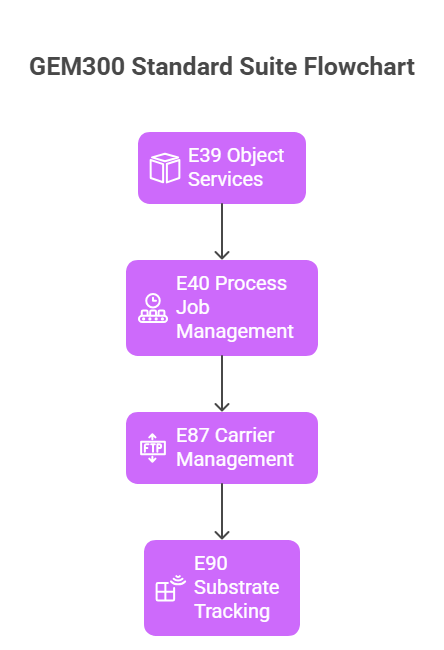
The GEM300 Standard Suite
To handle full fab automation, the GEM300 standards were introduced. These include:
- E39 (Object Services): dealing with data as objects.
- E40 (Process Job Management): tracking the processing of specific wafers.
- E87 (Carrier Management): managing the movement of the FOUPs (Front Opening Unified Pods) to and from the load ports.
- E90 (Substrate Tracking): keeping tabs on individual wafers within the carrier.
For a modern 300mm fab, compliance with these standards is the difference between a synchronised ballet of robots and a collision-prone disaster.
Interface A (EDA)
While SECS/GEM is great for control, it can get clogged if you try to pull massive amounts of data for high-frequency analysis. Enter Interface A (Equipment Data Acquisition).
Interface A runs alongside SECS/GEM but is dedicated solely to data collection. It enables fab automation manufacturing teams to pull high-speed data for fault detection without slowing down the tool’s control operations.
The Legacy Equipment Challenge
Here is the reality for many factories: you are not building a greenfield fab from scratch. You likely have a mix of brand-new tools and reliable workhorses that have been running since the late 90s.
According to a report by the SEMI Foundation (2022), a significant portion of the global capacity for 200mm wafers relies on legacy equipment. These machines cut silicon perfectly well, but their computers are ancient. Some run on Windows 98. Some have no Ethernet ports. Some lack the software capable of speaking SECS/GEM.
The “Dumb” Machine Problem
When a machine cannot connect to the MES, it creates a “black hole” in your data.
- Operators must manually type in lot numbers (prone to typos).
- Engineers cannot see real-time performance.
- Recipe selection is manual, leading to the dreaded “wrong recipe” scrap event.
For fab automation assembly lines in LED or PV manufacturing, replacing these expensive tools just to get connectivity is financial suicide. The ROI generally does not exist.
So, how do you modernise without buying new?
Einnosys Solutions: Bridging the Gap
This is where Einnosys steps in. We specialise in making the impossible connections possible. We understand that adhering to fab automation standards shouldn’t require scrapping functional equipment.
EIGEM – The SECS/GEM Driver
For equipment manufacturers (OEMs) building new tools, writing the SECS/GEM code from scratch is a massive headache. It distracts developers from focusing on the core process technology.
EIGEM is our library/driver solution. It is a plug-and-play software component that OEMs can integrate into their equipment control software. It instantly makes the machine compliant with fab automation standards SECS/GEM and GEM300. It supports C#, C++, Java, and Python, making integration smooth regardless of the base architecture.
Retrofitting with Hardware Adapters
For the factories holding onto those legacy tools, software alone often isn’t enough. If the machine’s controller is a proprietary black box or an ancient PLC, you need an intermediary.
Einnosys provides smart hardware adapters (E-Box) that act as a translator.
- Connection: We connect to the tool’s internal signals (via analogue/digital I/O, PLC registers, or log files).
- Translation: The E-Box interprets these signals: “The heater is on,” “The door is open.”
- Communication: The adapter converts these states into standard SECS/GEM messages and sends them to the factory host.
To the MES, the 30-year-old sputtering machine now looks and acts like a brand-new, smart-compatible tool.
Key Benefits of Standardisation
Why go through the trouble? Why invest in retrofitting or upgrading to these standards?
Yield and Quality Control
When you automate recipe selection via SECS/GEM, you eliminate the “fat finger” error. An operator cannot accidentally select the “High Temp” recipe for a “Low Temp” lot if the host computer prevents it.
Furthermore, with automated data collection, process engineers can spot drifts in temperature or pressure before they ruin the batch.
Operational Efficiency (OEE)
You cannot improve what you do not measure. By bringing all equipment under fab automation standards, you gain visibility into:
- Idle Time: Is the machine waiting for a distinct operator?
- Down Time: How often does the vacuum pump fail?
- Throughput: Are we meeting the targets per hour?
This data feeds directly into OEE (Overall Equipment Effectiveness) calculations, allowing management to pinpoint bottlenecks.
Future-Proofing for Industry 4.0
The buzzword “Industry 4.0” is thrown around often, but it essentially means using data to make smart decisions. AI and Machine Learning models need clean, structured data.
If your data comes from manual Excel sheets, your AI models will fail. Fab automation standards ensure that the data feeding your advanced analytics is accurate, timely, and standardised.
Implementation: How to Get Started
Transforming a fab into a smart factory is not an overnight event. It requires a strategic approach.
Assessment and Audit
Start by auditing your floor.
- Which machines are already GEM compliant?
- Which machines have GEM but need it enabled?
- Which machines are “dumb” and need a retrofit box?
Partnering for Success
Don’t try to build a SECS/GEM driver in-house unless you have a team of developers with nothing else to do. It is a complex protocol with hundreds of edge cases.
Partnering with experts like Einnosys allows your internal teams to focus on process engineering while we handle the connectivity. Whether you are an OEM needing a library for a new wire bonder or a fab manager trying to connect a fleet of legacy ovens, we have the specific toolset required.
Conclusion
The semiconductor landscape is unforgiving. As feature sizes shrink and production volumes swell, the margin for error vanishes. Adhering to fab automation standards is no longer a luxury for the elite 300mm fabs; it is a survival requirement for every manufacturing unit in the supply chain.
From enabling basic communication with SECS/GEM to managing complex logistics with GEM300, these protocols form the nervous system of the modern factory. And for the equipment that time forgot, Einnosys offers the bridge to bringing them into the future.
Frequently Asked Questions
A: SECS/GEM is the specific standard for the semiconductor industry, designed for the unique control and recipe management needs of wafer processing. OPC-UA is a more general industrial automation protocol. While OPC-UA is gaining traction for general data collection, SECS/GEM remains the gold standard for tool control and MES integration in fabs.
A: Yes. For equipment running on PLCs or simple microcontrollers without a PC interface, Einnosys uses hardware adapters. These tap into the electrical signals or PLC memory maps to generate the necessary data for SECS/GEM compliance.
A: No. While it started there, fab automation standards are now widely used in PV (solar), LED, Flat Panel Display (FPD), and PCB manufacturing. Any industry with high-value batch processing can benefit from the granularity of control that GEM offers.
A: Timelines vary based on complexity. A software-only integration using the EIGEM library can be done in weeks. A hardware retrofit for a legacy tool might take slightly longer to map out the I/O points and validate the data, but it is significantly faster and cheaper than replacing the equipment.
