


Introduction
In the semiconductor industry, SECS GEM Integration is the backbone of equipment-to-host communication. The SEMI Equipment Communication Standard (SECS) and Generic Equipment Model (GEM) protocol enable seamless data exchange between manufacturing equipment and factory host systems. However, despite its importance, many organizations face recurring SECS GEM Integration Challenges during implementation. These challenges range from protocol mismatches to compliance issues, often leading to costly delays and inefficiencies. This blog explores the most common hurdles in SECS GEM Implementation, highlights typical SECS GEM Communication Errors, and provides practical fixes to ensure smoother SECS GEM Host Integration.
Challenge 1: Protocol Misalignment
One of the most frequent SECS GEM Integration Issues is protocol misalignment. The SECS GEM Protocol defines strict communication rules, but equipment vendors sometimes interpret specifications differently. This leads to SECS GEM Communication Errors where the host system cannot properly parse or respond to equipment messages.
Fix:
- Conduct thorough protocol validation against the SECS II GEM Standard.
- Use simulation tools to test Equipment to Host Communication before deployment.
- Collaborate with vendors to resolve discrepancies early in the integration cycle.
Challenge 2: GEM Compliance Issues
Ensuring GEM Compliance is critical for reliable Semiconductor Equipment Integration. Non-compliance often manifests as missing required messages or unsupported commands, creating bottlenecks in automation.
Fix:
- Perform compliance audits using SEMI-certified test suites.
- Document all SECS GEM Implementation Challenges and track fixes systematically.
- Establish a feedback loop with equipment suppliers to enforce compliance.
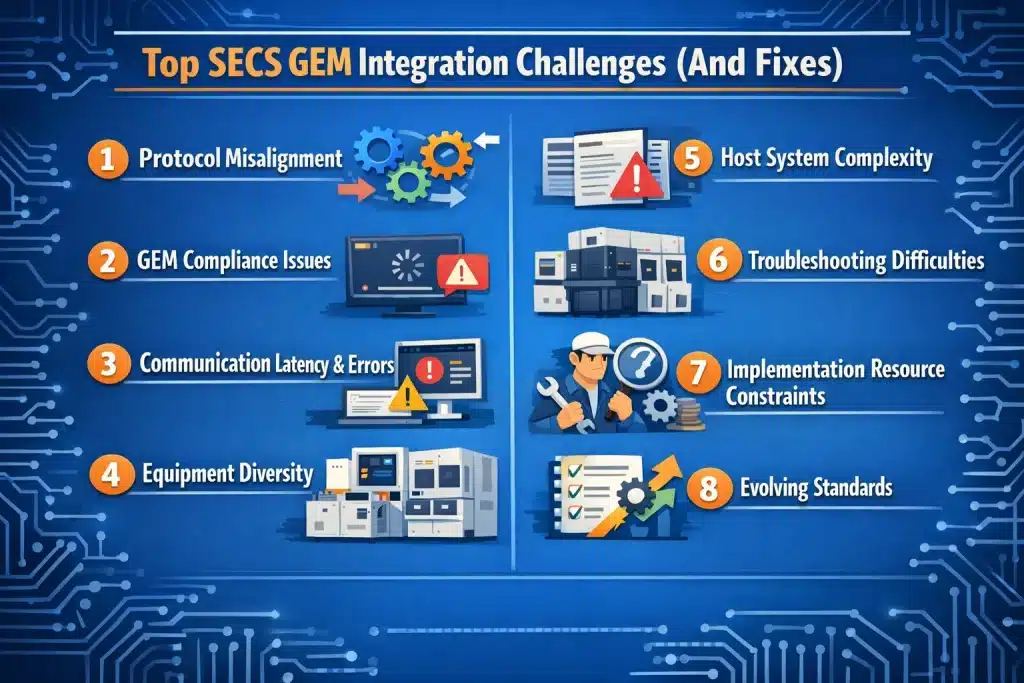
Challenge 3: Communication Latency and Errors
Factories often encounter SECS GEM Communication Errors due to network latency, message loss, or improper session handling. These errors disrupt SECS GEM Host Integration, leading to downtime.
Fix:
- Implement robust retry and timeout mechanisms.
- Use monitoring tools for SECS GEM Troubleshooting to detect anomalies.
- Optimize network infrastructure to reduce latency.
Challenge 4: Equipment Diversity
Different equipment models may support varying levels of the SECS GEM Protocol, creating inconsistencies in Semiconductor Equipment Integration. This diversity complicates SECS GEM Implementation across production lines.
Fix:
- Standardize integration frameworks across equipment types.
- Maintain a centralized repository of SECS GEM Integration Issues and solutions.
- Train engineers on handling diverse equipment communication patterns.
Challenge 5: Host System Complexity
Host systems often require customization to handle specific SECS GEM Integration Challenges. Complex workflows, data mapping, and error handling increase the risk of SECS GEM Implementation Challenges.
Fix:
- Use modular host architectures to simplify customization.
- Employ middleware solutions to bridge gaps in Equipment to Host Communication.
- Continuously validate host logic against the SECS II GEM Standard.
Challenge 6: Troubleshooting Difficulties
SECS GEM Troubleshooting can be daunting due to limited visibility into equipment logs and host responses. Engineers often struggle to pinpoint the root cause of SECS GEM Communication Errors.
Fix:
- Deploy advanced diagnostic tools for real-time monitoring.
- Implement structured logging for both equipment and host systems.
- Create a knowledge base of recurring SECS GEM Integration Issues.
Challenge 7: Implementation Resource Constraints
Many organizations underestimate the resources required for SECS GEM Implementation. Lack of skilled engineers and inadequate testing environments lead to prolonged SECS GEM Integration Challenges.
Fix:
- Invest in specialized training for integration engineers.
- Allocate dedicated testbeds for SECS GEM Host Integration.
- Partner with industry experts to accelerate deployment.
Challenge 8: Evolving Standards
The SECS II GEM Standard continues to evolve, introducing new requirements and compliance checks. Keeping up with these changes is a persistent SECS GEM Implementation Challenge.
Fix:
- Regularly update integration frameworks to align with new standards.
- Participate in SEMI working groups to stay ahead of compliance updates.
- Document and adapt fixes for emerging GEM Compliance Issues.
Conclusion
SECS GEM Integration is vital for modern semiconductor manufacturing, but it comes with its share of hurdles. From protocol misalignment to compliance gaps, SECS GEM Integration Challenges can disrupt production efficiency if not addressed proactively. By focusing on robust SECS GEM Implementation, minimizing SECS GEM Communication Errors, and streamlining SECS GEM Host Integration, organizations can achieve reliable Semiconductor Equipment Integration. The key lies in continuous monitoring, structured SECS GEM Troubleshooting, and adherence to the SECS II GEM Standard. With these fixes, manufacturers can overcome SECS GEM Implementation Challenges and ensure smooth, compliant, and efficient equipment-to-host communication.
