
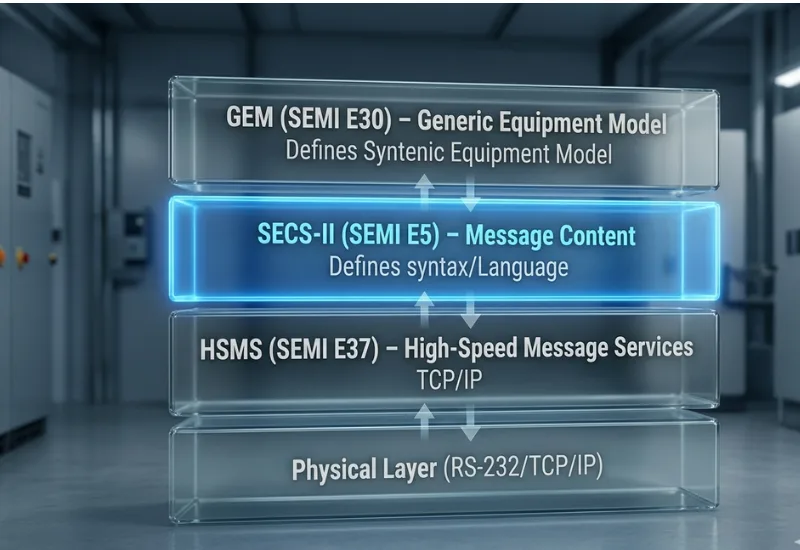
SECS-I and HSMS outline how the communication takes place (such as over RS-232C or Ethernet), SECS-II defines the format and content of messages that can be sent over SECS-I/HSMS.

Custom messages can be supported to incorporate custom features for the formats which are not defined in SEMI E5 if agreed by both the host and equipment. SECS-II messages are categorized into streams, which are identified by an integer within the range of 0 and 255 Primary Messages are odd-numbered functions and Secondary Messages are the corresponding even-numbered function. In most of the messages transmissions, either the host or equipment sends a primary message; the response is the corresponding secondary message.
Only if the reply bit is clear, a primary message should always be responded to with the complementary secondary message. A secondary Reply message is required for most of the SECS2 messages. For example, if the host sends an S1, F1 (stream1, function1) message to request ‘Are you there?’, then the equipment will send a reply S1, F2 message to indicate ‘I am here. Every Single SECS-II message exchange has a distinct transaction ID number. The standards allow message incorporation where there is more than one open, parallel transaction.
SECS-II standard also defines lists of valid data types listed below
ASCII

Binary

Boolean

4 and 8 byte floating points

Signed and Unsigned integers of byte length 1, 2, 4, or 8

Container for other data elements & lists. SECS II messages are sent as structured Binary Data.


It’s a very efficient means to package information across any network without wasting bandwidth. When using the SECS-I standard, RS-232 serial communication, the message size is limited to 7995148 bytes (about 8 MB). When using the HSMS standard, TCP/IP network communication, the maximum message size is – 4294967295 bytes (about 4.3 GB). The structure of each standard SECS-II message is well-defined by the SEMI E5 SECS-II standard. A message can either be a simple data element, such as a binary response or an ASCII string. A message can also be a complex list structure with multiple levels of lists in the hierarchy. The SECS-II standard limits a single element within a SECS-II message to 16777215 bytes (about 16.5 MB).
SECS-II standard also defines lists of valid data types listed below
SEMI Equipment Communications Standard II
Enable reliable, standardized data exchange between your equipment and host systems using our expert SECS-II implementation and integration services.
FAQs
What is SECS-II (SEMI Equipment Communications Standard 2)?
SECS-II (SEMI E5) is a communication standard that defines the message structure, data formats, and communication rules between semiconductor equipment and host systems. It ensures consistent and reliable data exchange across different tools.
How does SECS-II differ from SECS-I and HSMS?
SECS-II defines what data is communicated, while SECS-I (E4) and HSMS (E37) define how the data is transmitted (via serial or TCP/IP). Together, they form the complete communication stack used in semiconductor automation.
What are Streams and Functions in SECS-II?
SECS-II messages are organized into Streams (categories) and Functions (specific actions). For example, Stream 1 handles equipment status, while functions define actions like communication checks or event reporting, enabling structured communication.
Why is SECS-II important in semiconductor manufacturing?
SECS-II enables standardized communication between equipment and factory systems, supporting automation, real-time monitoring, alarm handling, and data collection. This leads to improved efficiency, reduced downtime, and better production control.
How does SECS-II support SECS/GEM integration?
SECS-II acts as the foundation of SECS/GEM communication, providing the message structure used by GEM (E30) to control equipment behavior, monitor processes, and enable smart factory automation.