
SEMI E120 Specification for the Common Equipment Model (CEM)
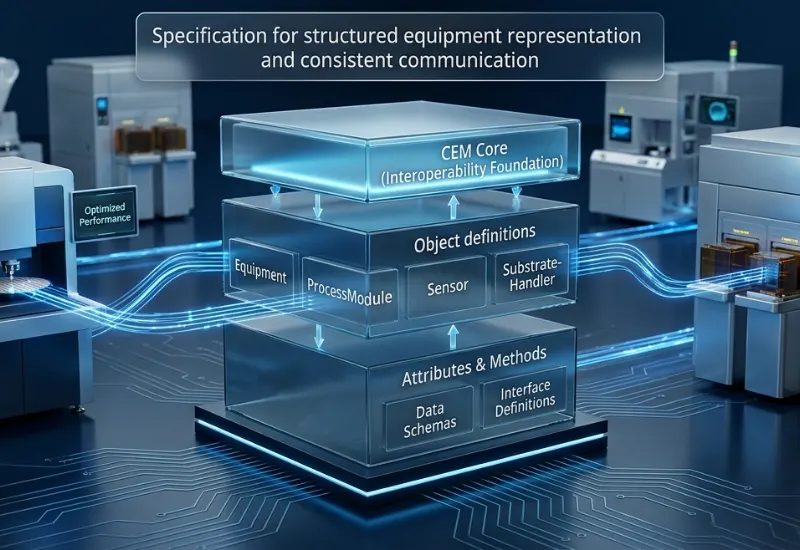
Welcome to Einnosys, your trusted partner in automation solutions for the semiconductor industry. Our commitment to adhering to SEMI standards ensures that your equipment and processes are optimized for performance and interoperability.
SEMI E120 Overview
Specification for the Common Equipment Model (CEM)
The SEMI E120 Standard provides a comprehensive object model for semiconductor equipment structures and related elements. This standard is crucial for ensuring consistent communication and representation of equipment in semiconductor manufacturing environments.
Key Features
General Applicability
SEMI E120 serves as a versatile object model applicable to various semiconductor equipment, facilitating communication and integration across different systems.

Guidance for Equipment Suppliers
This specification offers a framework for equipment suppliers to accurately represent their equipment’s external view to factory hosts, ensuring clarity and consistency.

Extensibility
SEMI E120 acts as a foundational model that can be extended by other SEMI Equipment Communication Standards, promoting flexibility and adaptability in evolving technological landscapes.

Technology-Specific Object Model Creation
It serves as a reference point for developing technology-specific object models, such as XML schema, enabling manufacturers to tailor solutions to their specific needs.

Components of the Specification

Classes: Representing different types of equipment and their functionalities.
Attributes: Specific characteristics associated with each class.
Relationships: Connections between different elements within the equipment model.
This comprehensive documentation ensures that equipment structures are accurately represented and easily understood by factory host applications through available communication interfaces.
Subordinate Standards
| Source Protocol | Conversion Capability |
|---|---|
| SEMI E120.1-0414 | XML Schema for the Common Equipment Model (CEM) A standardized XML schema that provides a structured way to represent equipment data. |
| SEMI E120.2-0823 | Specification for Protocol Buffers for Common Equipment Model (CEM) This specification details the use of Protocol Buffers in conjunction with the CEM. |
| SEMI E121 | Guide for Style and Usage of XML for Semiconductor Manufacturing Applications This guide provides recommendations on best practices for XML usage in semiconductor manufacturing contexts. |
| Enhanced Interoperability | By adhering to SEMI E120, equipment manufacturers can ensure their systems are compatible with other standards, promoting seamless integration. |
| Improved Communication | The common object model facilitates better communication between equipment and factory host systems, reducing miscommunication and errors. |
| Future-Proofing Your Operations | Compliance with SEMI E120 prepares your operations for future advancements and standards in the semiconductor industry. |
einnosys E120 standard supported products
Plug & Play GEM300 and E84 capability for legacy equipmentEnsure Seamless Traceability with SEMI E120
Implement the SEMI E120 standard to achieve accurate material tracking, improved process control, and better visibility across your semiconductor operations.
FAQs
What is SEMI E120 standard?
SEMI E120 is a standard that defines the Common Equipment Model (CEM), providing a structured way to represent semiconductor equipment and its components. It helps factory systems understand equipment structure and data more easily.
What is the Common Equipment Model (CEM)?
The Common Equipment Model (CEM) is a hierarchical object model that represents all physical and logical components of equipment, such as modules, subsystems, sensors, and software elements. This model ensures consistent data interpretation across systems.
What components are defined in SEMI E120?
SEMI E120 defines key equipment components including:
Equipment (entire system)
Modules (process units like chambers)
Subsystems (support units like load ports)
IO Devices (sensors and actuators)
Material Locations (where wafers/material are stored)
These components are organized in a structured hierarchy for better data visibility.
How does SEMI E120 support Equipment Data Acquisition (EDA)?
SEMI E120 is part of the EDA (Interface A) standards, which enable high-speed data collection from equipment. It provides a standardized model so data can be easily accessed and interpreted by multiple factory systems without relying on SECS/GEM messaging.
Why is SEMI E120 important for semiconductor manufacturing?
SEMI E120 improves equipment visibility, data consistency, and interoperability. By standardizing how equipment is modeled, it enables better analytics, faster integration, and supports smart manufacturing initiatives.
How does SEMI E120 differ from SECS/GEM?
SEMI E120 focuses on data modeling and structure, while SECS/GEM focuses on communication and control. E120 is used in EDA for advanced data acquisition, whereas SECS/GEM is used for real-time equipment communication and control.
Can SEMI E120 be extended for specific applications?
Yes, SEMI E120 is designed to be flexible and extendable, allowing equipment manufacturers and fabs to customize the model based on specific requirements while maintaining standardization.