
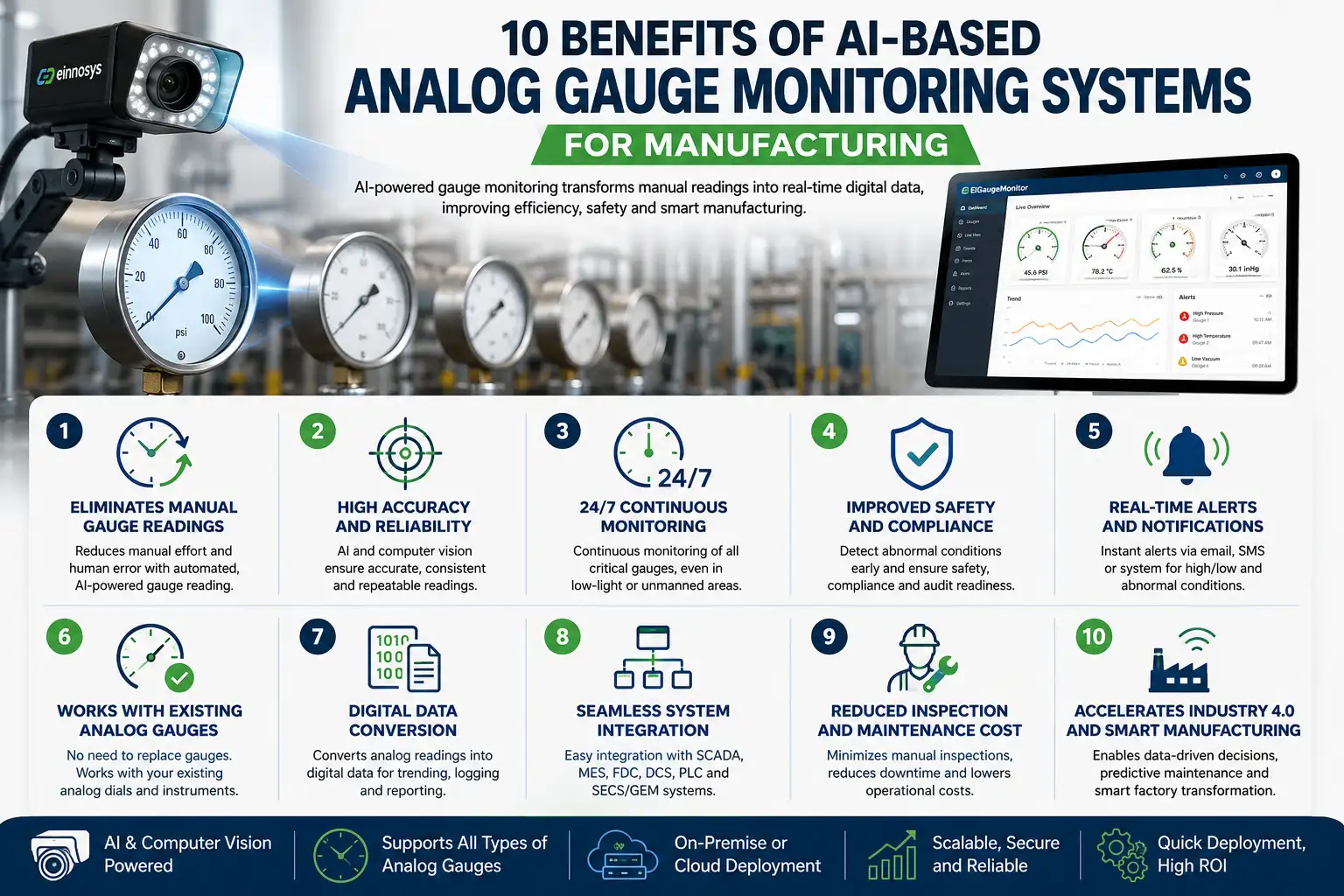
Walk through almost any manufacturing plant, fab, or utility site and you’ll still find rows of analog gauges — pressure dials, vacuum meters, gas flow indicators — doing the same job they’ve done for decades: showing a needle position that a technician has to walk over, read, and write down. It’s a process that hasn’t changed much even as everything around it has gone digital, and it quietly creates gaps in data quality, safety, and responsiveness that modern manufacturing can’t really afford anymore.
AI-based analog gauge monitoring closes that gap without ripping out the gauges themselves. Using computer vision, a camera reads the analog dial the same way a person would, then converts that reading into a structured digital data stream that feeds directly into factory systems. Here are ten concrete ways that shift changes day-to-day operations.
1. It Eliminates Manual Reading Errors
Manual gauge logging depends on a person walking a route, reading a needle position correctly, and transcribing it without a mistake — three separate places for human error to creep in. An AI-based system reads the same dial continuously and converts it to a digital value automatically, removing transcription lag and misreads from the process entirely.
2. It Enables True Continuous Monitoring
A technician can check a gauge once per shift, maybe once per hour on a critical asset. A vision-based monitoring system can capture a reading every few seconds. That difference matters when a pressure or flow parameter can drift out of range between manual checks — continuous monitoring catches the deviation as it happens, not hours later.
3. It Removes the Need for Physical Inspection Rounds
Sending a person to physically check a gauge — especially one located in a hazardous area, a cleanroom, or a hard-to-reach part of a facility — carries real safety and time cost. Automated gauge reading removes the need for that physical presence altogether, improving both safety and the hours available for higher-value maintenance work.
4. It Works With Equipment Already Installed
One of the more practical advantages of a vision-based approach is that it doesn’t require replacing the gauge itself. Instead of swapping analog dials for new digital sensors — a costly and often disruptive retrofit — a camera-based system reads the existing analog gauge exactly as installed, which matters enormously for facilities with hundreds of legacy dials across older equipment.
5. It Converts Legacy Data Into Digital Streams
Digitizing an analog reading isn’t just about accuracy — it’s about making that data usable. Once a gauge reading becomes a structured digital value, it can be logged, trended, alarmed on, and analyzed the same way any other sensor data would be, turning a previously isolated data point into part of the broader digital plant.
6. It Enables Real-Time Alerting
Instead of waiting for the next scheduled inspection to discover a gauge has moved into a concerning range, a monitoring system can push an alert — via SMS, email, or a factory alarm system — the moment a threshold is crossed. That shift from periodic checking to real-time notification is often the difference between catching a developing issue early and responding to it after the fact.
7. It Frees Up Significant Inspection Labor
Manual gauge rounds consume real staff hours across a year — hours that scale with the number of gauges and the frequency required. Automating that reading process frees up that labor for higher-value maintenance and process work, rather than routine walking and logging.
8. It Supports Broader Visual Inspection, Not Just Gauges
The same computer-vision approach that reads a dial accurately can extend to related visual inspection tasks — spotting surface defects on wafers or PCBs, or flagging contamination and debris on equipment surfaces before it affects yield. That means a single camera-based platform can cover more than one manual inspection task that used to require separate routines.
9. It Integrates Directly With Factory Systems
A gauge reading is only as useful as the systems it reaches. Modern gauge monitoring platforms are built to push digitized readings straight into SECS/GEM, SCADA, MES, or OPC UA frameworks — meaning the data lands directly in the same systems operators and engineers already use, instead of sitting in a separate standalone dashboard.
10. It Closes a Long-Standing Gap in Factory Data Architecture
Every analog gauge that isn’t feeding into a factory’s data systems is a blind spot in that facility’s overall visibility — a place where automation, predictive analytics, and closed-loop process control simply can’t reach. Digitizing that last layer of analog infrastructure completes the picture, letting facilities apply the same data-driven approaches to legacy gauges that they already apply to modern digital sensors.
Why This Matters More in Semiconductor and High-Tech Manufacturing
For semiconductor fabs and other high-tech manufacturing environments specifically, the stakes around gauge accuracy are higher than in general industry. A missed pressure or vacuum drift can affect wafer yield, not just equipment uptime — and cleanroom protocols make sending a technician in for a routine gauge check more disruptive than in a standard industrial setting. That’s exactly the environment AI-based gauge monitoring systems like EIGaugeMonitor are built for: a plug-and-play camera and analytics platform that reads existing analog gauges without any hardware replacement, and streams the digitized readings directly into SECS/GEM, SCADA, or MES systems in real time.
The Bottom Line
Analog gauges aren’t going away anytime soon — they’re durable, reliable, and deeply embedded in existing equipment across most manufacturing facilities. What’s changed is that they no longer have to remain a manual, disconnected part of the plant. AI-based gauge monitoring gives facilities a way to bring that last analog layer into the same digital, real-time visibility as everything else on the floor — without the cost or disruption of replacing the gauges themselves.
For facilities looking to digitize analog gauge readings without a hardware retrofit, EIGaugeMonitor by eInnoSys offers a turnkey, camera-based monitoring solution with native SECS/GEM, SCADA, and MES integration.


