
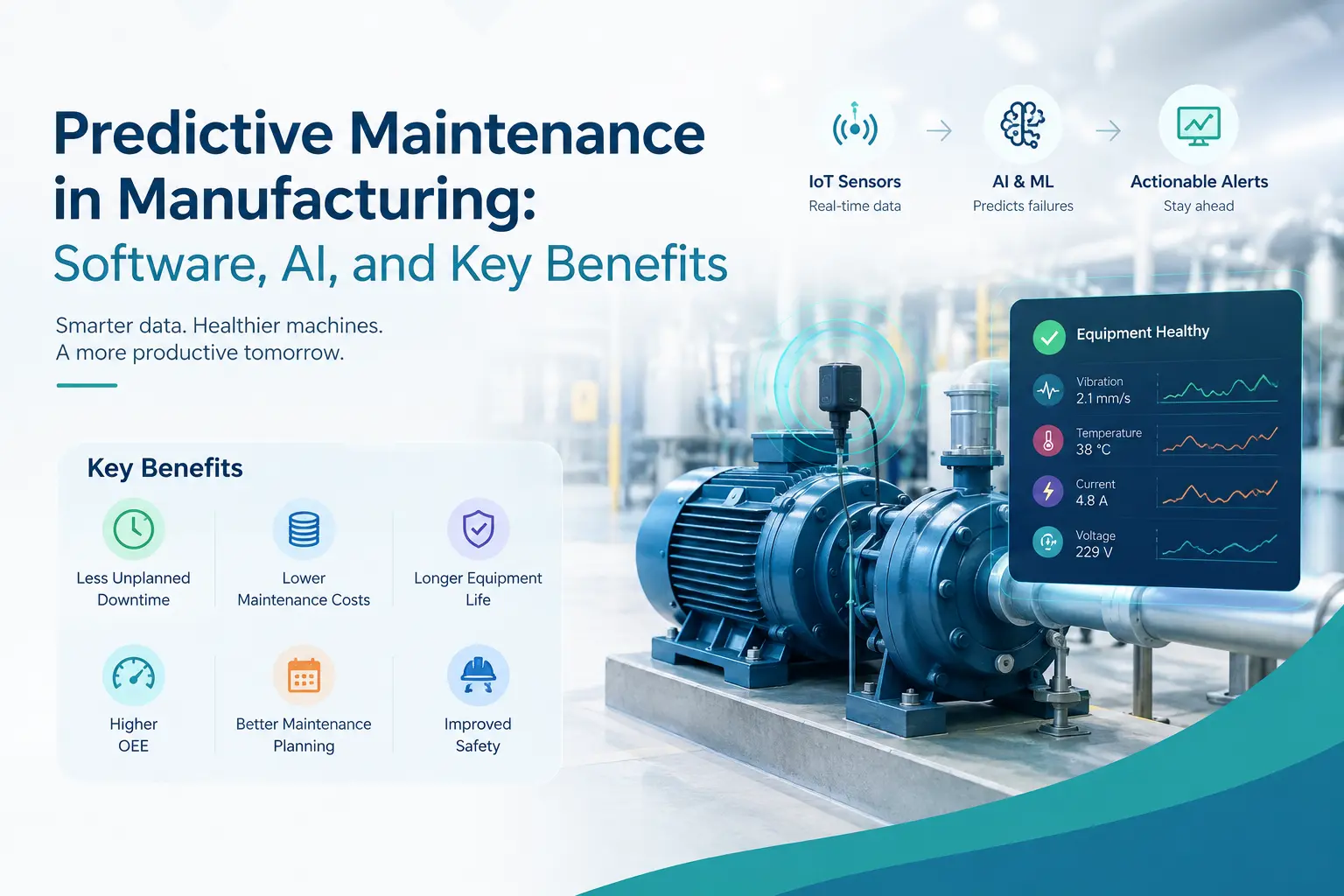
Unplanned downtime is one of the most expensive problems on any factory floor. A single motor, pump, or blower failure can halt a production line, delay shipments, and send maintenance teams scrambling for parts. Predictive maintenance in manufacturing solves this problem by using sensor data, IoT connectivity, and AI-driven analytics to flag equipment issues before they turn into breakdowns.
This guide explains how predictive maintenance software works, the role AI and machine learning play in it, the technologies behind it, and the real business benefits plant managers, reliability engineers, and operations teams can expect from adopting it.
What Is Predictive Maintenance in Manufacturing?
Predictive maintenance in manufacturing is a data-driven maintenance strategy that continuously monitors equipment condition and uses analytics to predict when a machine is likely to fail. Instead of fixing equipment after it breaks down (reactive maintenance) or servicing it on a fixed calendar schedule (preventive maintenance), predictive maintenance triggers action only when real equipment data shows early signs of wear, vibration anomalies, temperature drift, or abnormal power draw.
For plants running pumps, motors, HVAC systems, exhausts, ovens, and production line equipment, this shift means maintenance happens exactly when it’s needed — not too early, and not too late.
How Predictive Maintenance Software Works
A predictive maintenance system typically follows four stages:
- Data collection – IoT sensors attached to critical assets capture vibration, temperature, current, voltage, and acoustic data around the clock.
- Continuous monitoring – The software tracks this data in real time, building a baseline of normal equipment behavior.
- AI-driven analysis – Machine learning models compare live readings against historical patterns to detect subtle deviations that signal developing faults.
- Alerts and action – When a risk is identified, the system sends alerts to maintenance teams — often weeks before a failure would otherwise occur — so repairs can be scheduled without disrupting production.
This workflow is the foundation of most modern predictive maintenance solutions, including platforms purpose-built for industrial and semiconductor equipment.
Role of AI and Machine Learning in Predictive Maintenance
AI is what separates true predictive maintenance from simple threshold-based alarms. Machine learning models are trained on historical equipment data to recognize the subtle combinations of vibration, temperature, and electrical signatures that precede a failure — patterns a human operator or a fixed alarm limit would likely miss.
Over time, these models improve. As more operating data flows in, AI predictive maintenance systems refine their failure predictions, reduce false positives, and adapt to the specific behavior of each machine. This is especially valuable for equipment with irregular duty cycles, where a one-size-fits-all threshold simply doesn’t work.
Key Technologies Used in Predictive Maintenance
| Technology | What It Monitors | Why It Matters |
|---|---|---|
| IoT Sensors | Connects equipment to the monitoring platform | Enables 24/7 data collection without manual checks |
| Vibration Monitoring | Bearing wear, misalignment, imbalance | Detects early signs of mechanical degradation |
| Temperature Monitoring | Overheating, friction, insulation breakdown | Flags thermal stress before component failure |
| Current/Voltage Monitoring | Motor load, electrical faults | Detects power inefficiencies and early motor issues |
| AI/ML Analytics | Cross-references all sensor inputs | Identifies failure patterns that may be difficult to detect manually |
| Real-Time Alerts | Converts monitoring data into actionable alerts | Gives maintenance teams lead time to plan repairs |
Together, these technologies form the backbone of any reliable predictive maintenance system, whether it’s deployed on a single production line or across an entire facility.
Key Benefits of Predictive Maintenance
Manufacturers adopting predictive maintenance typically see measurable gains across several areas:
- Reduced unplanned downtime — Early detection prevents sudden, costly stoppages.
- Lower maintenance costs — Repairs happen only when needed, cutting unnecessary part replacements and labor.
- Early fault detection — Issues are caught at the earliest stage, before they cascade into bigger failures.
- Longer equipment life — Addressing small problems early reduces cumulative wear on machinery.
- Improved OEE (Overall Equipment Effectiveness) — Less downtime and fewer defects translate directly into higher throughput.
- Better maintenance planning — Teams can schedule work around production, not around emergencies.
- Improved safety — Catching equipment faults early reduces the risk of hazardous failures on the floor.
Industry data shows that plants using predictive maintenance can reduce unplanned downtime by 30–40% and cut overall maintenance expenses by up to 25%, making it one of the highest-ROI investments available to manufacturing operations today.
Predictive Maintenance Use Cases in Manufacturing
Predictive maintenance applies across nearly every category of rotating and motor-driven equipment on a plant floor, including:
- Pumps — vacuum pumps, dry pumps, turbopumps, and process pumps
- Motors — all types of industrial and fractional-horsepower motors
- HVAC systems — including cleanroom HVAC in semiconductor and precision environments
- Exhaust systems — abatement and exhaust equipment
- Furnaces and ovens — thermal processing equipment
- Production equipment — conveyors, blowers, fans, robots, and cassette loaders
Because these assets are often the first to show early signs of stress, they’re also where predictive maintenance delivers the fastest, most visible ROI.
How AI Predictive Maintenance Reduces Equipment Downtime
AI reduces downtime by shrinking the gap between “something is wrong” and “we know exactly what and when.” Instead of waiting for a hard failure, AI models flag anomalies weeks in advance, giving maintenance teams time to order parts, schedule technicians, and plan the repair around a production window rather than an emergency stoppage. This shift alone is responsible for much of the downtime reduction manufacturers report — some AI-based pump and motor monitoring systems have delivered up to a 70% reduction in unplanned downtime and up to a 45% reduction in repair costs.
How to Implement Predictive Maintenance in a Manufacturing Plant
- Identify critical assets — Start with equipment where failure has the highest cost or safety impact (pumps, motors, exhausts, HVAC).
- Install IoT sensors — Deploy vibration, temperature, and current/voltage sensors on priority equipment.
- Connect to a predictive maintenance platform — Choose software that supports real-time monitoring and AI analytics.
- Integrate with existing systems — Connect the platform to SCADA, MES, or SECS/GEM systems already used on the floor.
- Set alert thresholds — Configure email/SMS notifications so maintenance teams act on early warnings.
- Review and refine — Use ongoing data to fine-tune models and expand monitoring to additional assets.
A phased rollout — starting with the highest-risk equipment — helps plants prove ROI quickly before scaling predictive maintenance plant-wide.
How XPump Supports AI-Based Predictive Maintenance
XPump is eInnoSys’s AI/ML-based predictive maintenance system built specifically for pumps, motors, and motor-driven equipment such as exhausts, ovens, blowers, and cleanroom HVAC. It combines industrial-grade sensors for vibration, temperature, voltage, and current with proprietary machine learning models to predict failures weeks in advance and send real-time email or SMS alerts to maintenance teams.
XPump is built as a turnkey solution — including hardware, software, and installation — and integrates directly with SECS/GEM, SCADA, and MES systems, making it a strong fit for both general manufacturing plants and semiconductor fabs that need to connect predictive maintenance data into existing factory automation infrastructure.
Conclusion
Predictive maintenance in manufacturing has moved from a competitive advantage to a baseline expectation for plants that want to minimize downtime, control maintenance spend, and keep equipment running longer. By combining IoT sensors, continuous monitoring, and AI-driven analytics, manufacturers can shift from reactive firefighting to planned, data-backed maintenance decisions.
eInnoSys helps manufacturing and semiconductor facilities make this shift through its predictive maintenance solutions and its purpose-built XPump platform for pumps and motor-based equipment. If your plant is still relying on reactive or calendar-based maintenance, now is the time to explore what AI-based predictive maintenance can do for your operations.
Ready to reduce downtime and maintenance costs? Request a free demo or talk to a predictive maintenance expert at eInnoSys today.


