
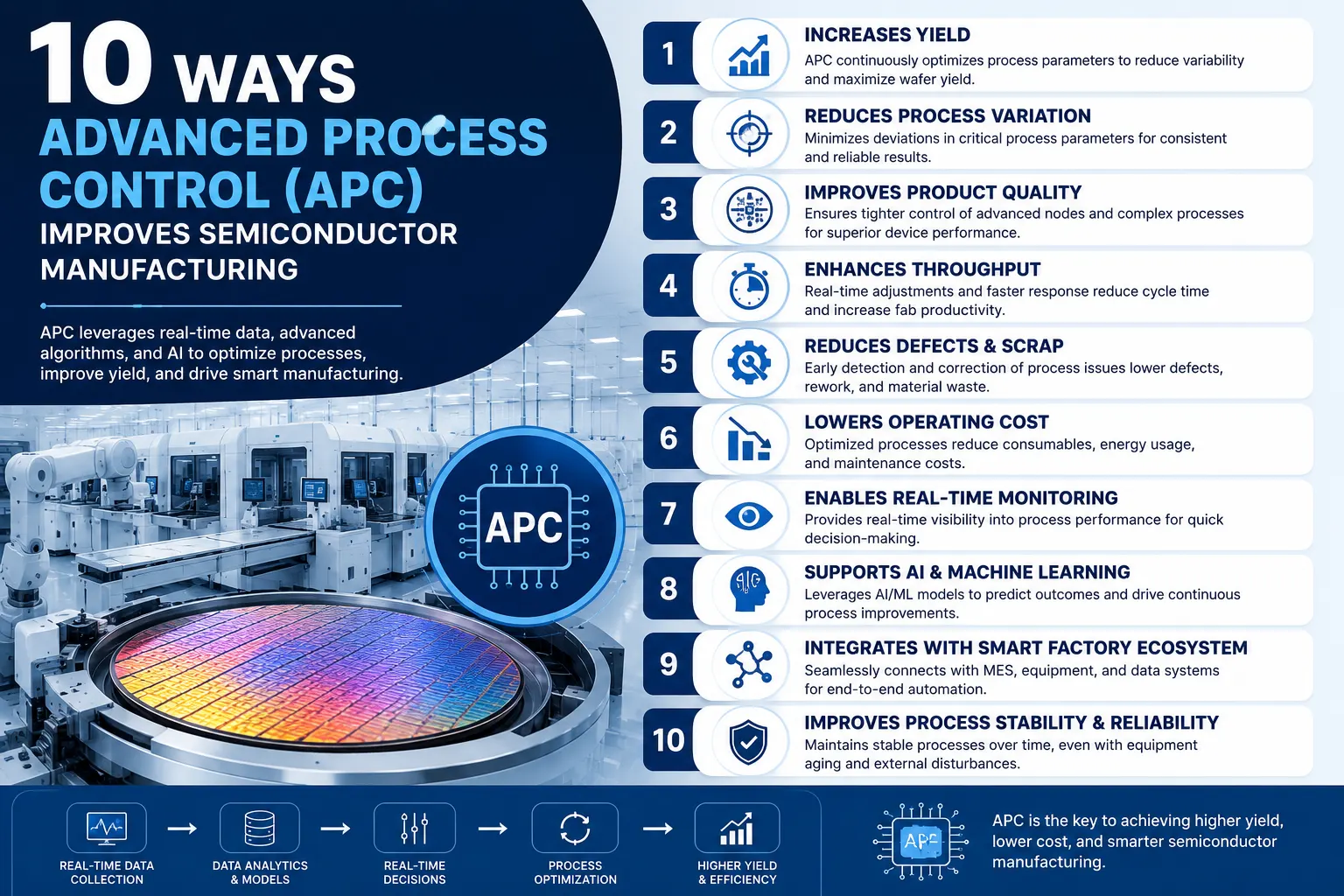
Chip geometries keep shrinking, tolerances keep tightening, and fabs are under constant pressure to push more good die out the back door without adding headcount. Advanced Process Control (APC) in semiconductor manufacturing has become the backbone that makes this possible — not a nice-to-have layered on top of the fab, but the control system that keeps hundreds of interdependent process steps inside spec, wafer after wafer, lot after lot.
For fab managers, process engineers, and automation leads evaluating where to invest next, the question usually isn’t whether APC matters — it’s where it delivers the fastest, most measurable return. The pressure isn’t limited to leading-edge logic fabs, either. OSATs, specialty analog fabs, and equipment manufacturers building process modules for third-party lines are all wrestling with the same underlying challenge: more process steps, tighter tolerances, and less tolerance for the kind of manual, engineer-driven tuning that worked at older nodes and lower volumes.
Below are ten concrete ways Advanced Process Control improves semiconductor manufacturing, from yield and cycle time to the equipment communication layer that makes it all possible.
What Is Advanced Process Control (APC) in Semiconductor Manufacturing?
Advanced Process Control refers to the software, models, and feedback/feedforward loops that continuously monitor process data and automatically adjust equipment recipes to keep output within target specifications. Rather than relying purely on fixed recipes and after-the-fact inspection, APC systems ingest real-time data from process tools, metrology stations, and sensors, then use statistical models — from simple run-to-run adjustments to machine-learning-driven predictions — to correct drift before it produces scrap.
Classic APC focused on identifying a problem in a process chamber and nudging a recipe parameter, such as adjusting gas flow or exposure time. Today’s APC platforms go further, incorporating virtual metrology, fault detection, and AI-driven pattern recognition to catch problems that traditional statistical process control would miss entirely. That evolution matters because, as feature sizes shrink, the margin for error shrinks with them — every one of the ten benefits below builds on this foundation of real-time, closed-loop control.
APC is typically described using a handful of core techniques that work together rather than in isolation:
- Run-to-Run (R2R) control — adjusts recipe parameters between wafer or lot runs based on measurements from prior runs, compensating for tool drift and incoming material variation.
- Model Predictive Control (MPC) — uses a process model to predict how a change in one or more inputs will affect the output, allowing multivariate, forward-looking adjustments rather than single-variable reactive ones.
- Fault Detection and Classification (FDC) — monitors real-time sensor traces during a process step to flag anomalies as they happen, rather than after the fact.
- Virtual metrology — predicts a wafer’s measured properties from process data, reducing dependence on physical measurement steps that add cycle time.
Understanding these building blocks matters because the ten benefits that follow aren’t the product of a single algorithm — they come from how these techniques are combined, tuned, and fed with reliable equipment data.
1. Higher, More Consistent Yield
Yield is the metric every fab manager is judged on, and it’s the single biggest reason APC investments get approved. By continuously measuring process outputs and adjusting inputs before a deviation becomes a defect, APC narrows the distribution of results around the target specification instead of letting it drift toward the edges of the control limit. Case-level results back this up directly: at one wafer fab, an APC deployment delivered a 0.5% yield improvement — a figure that translates into real revenue at high-volume production scale, where even fractions of a percent represent thousands of additional good die per month.
The mechanism is straightforward. Traditional process control catches problems downstream, after wafers have already moved through several more steps. APC intervenes upstream, adjusting the next wafer’s recipe based on what the last wafer’s data revealed — which means fewer wafers ever drift far enough from target to become scrap in the first place.
2. Reduced Process Variability Across Tools and Chambers
No two process chambers behave identically, even when they’re the same model from the same OEM. Chamber-to-chamber and tool-to-tool variation is one of the most persistent sources of yield loss in semiconductor manufacturing, and it’s exactly what APC is designed to neutralize. Run-to-Run (R2R) control models track each chamber’s individual behavior and apply chamber-specific corrections, so a wafer processed in Chamber 3 ends up statistically indistinguishable from one processed in Chamber 7.
This matters increasingly as fabs scale horizontally, adding parallel tools to increase throughput. Without APC normalizing behavior across that expanding tool set, variability compounds with every additional chamber brought online — turning a scaling strategy into a yield risk instead of a capacity win.
3. Real-Time Fault Detection and Classification (FDC)
Fault Detection and Classification is the sensing layer that feeds APC’s decision-making, and it’s a benefit in its own right. Instead of waiting for end-of-line electrical test or optical inspection to reveal a problem — by which point dozens or hundreds of wafers may have been affected — FDC systems continuously monitor tool sensor traces (pressure, temperature, RF power, gas flow) during the process itself and flag anomalies as they occur.
This shifts fabs from a reactive to a predictive posture. A drifting RF match or a slowly degrading chamber seal shows up as a subtle signature in the trace data long before it produces a visible defect, giving engineers a window to intervene — whether that means an automatic recipe correction, a maintenance flag, or pulling a lot for inspection before it moves further downstream.
4. Lower Scrap Rates and Reduced Rework
Every wafer that gets scrapped mid-process represents sunk material, tool time, and labor that can never be recovered. APC directly reduces scrap by catching process excursions early enough to correct course rather than discovering them only after a batch is unrecoverable. Feedback and feedforward loops mean that data from an upstream measurement — say, film thickness after deposition — can automatically adjust the parameters of a downstream etch or planarization step, compensating for the upstream variation instead of letting it propagate into a defect.
Fewer scrapped wafers also means fewer pilot runs and re-runs consuming tool capacity that could otherwise go toward production volume — a second-order throughput benefit that’s easy to overlook when scrap reduction is framed purely as a cost story.
5. Precision Control of Critical Dimensions (CD) in Photolithography
Photolithography is where APC’s value is often most visible, because critical dimension control has such a direct line to device performance. In CD control applications, APC continuously measures the critical dimensions patterned onto the wafer and adjusts scanner exposure settings in near real time to keep those dimensions on target. As nodes shrink, the acceptable CD variation shrinks in lockstep, and manual or purely reactive adjustment simply can’t keep pace with the tolerances modern lithography demands.
The same closed-loop logic extends to Chemical Mechanical Planarization (CMP), where APC adjusts recipe parameters to maintain consistent wafer surface flatness — a prerequisite for every subsequent layer to pattern correctly. Get CMP wrong and the error doesn’t stay contained to one layer; it cascades into every layer built on top of it.
6. Faster Root-Cause Analysis When Problems Do Occur
Even with strong APC and FDC in place, excursions still happen — equipment ages, consumables degrade, incoming material varies. What changes with APC is how fast engineering teams can find the root cause. Because APC systems log high-frequency trace data, model residuals, and control actions for every wafer, engineers troubleshooting an issue have a rich, timestamped dataset to work from instead of relying on operator logs and end-of-line test results alone.
This is where the equipment communication layer becomes critical to APC’s effectiveness. APC platforms depend on high-frequency data collection from process tools via SECS/GEM, the standard protocol for equipment-to-host communication in semiconductor fabs. A well-implemented SECS/GEM integration lets APC software subscribe to equipment events and pull trace data at the frequency needed for meaningful root-cause analysis — without it, APC is working from sparse or delayed data, and root-cause investigations slow back down to manual detective work.
The practical difference shows up in how an engineering team spends its time. With rich trace data available, an engineer investigating a yield dip can filter by tool, chamber, recipe step, and time window in minutes, correlating a specific sensor signature with the wafers affected. Without that data granularity, the same investigation often falls back on interviewing operators, pulling maintenance logs, and testing hypotheses one at a time — a process that can stretch a same-day fix into a multi-week engineering project while the underlying issue continues to affect production.
7. Improved Overall Equipment Effectiveness (OEE) and Throughput
APC’s yield and quality benefits get most of the attention, but its effect on Overall Equipment Effectiveness and throughput is just as significant operationally. By reducing the frequency of unplanned tool stops for out-of-spec conditions, minimizing pilot-run cycles, and cutting the need for engineer-driven manual recipe tuning, APC keeps tools running productive wafers more of the time.
There’s also a direct staffing efficiency angle here. One documented APC deployment at a wafer fab resulted in cost savings equivalent to avoiding the hire of an additional process engineer, worth an estimated $120,000–$160,000 annually — value generated not by adding headcount to watch processes more closely, but by automating the watching and adjusting itself.
8. Scalability Across Multiple Tools, Process Steps, and Fab Sites
A modern APC framework isn’t built for a single chamber or a single process step — it’s architected to scale across dozens of tools and process modules within a fab, and increasingly across multiple fab sites reporting into a common data infrastructure. This scalability lets manufacturers apply consistent control strategies fab-wide rather than maintaining a patchwork of tool-specific, engineer-tuned adjustments that don’t transfer when a process moves to a new tool or a new site.
For OEMs and OSAT companies operating across multiple facilities, this scalability is often the deciding factor in whether an APC investment pays off: a framework that only works well on one tool type or one fab doesn’t generate the compounding returns that a scalable, standardized platform does.
Scalability also affects how quickly a fab can bring new process technology online. When a proven APC framework already exists, extending it to a new tool, a new process module, or an additional fab line is largely a configuration exercise — reusing existing models, control strategies, and data pipelines rather than rebuilding them from scratch. That reusability compresses the ramp-to-yield timeline for new capacity, which matters directly to the return on capital equipment spending.
9. A Foundation for AI and Machine Learning-Driven Manufacturing
Advanced Process Control has always been data-hungry, which makes it a natural on-ramp to AI and machine learning in the fab. Machine learning enhances APC by enabling more sophisticated real-time monitoring and control than classical statistical models alone can achieve — recognizing subtle multivariate patterns in sensor traces, predicting drift before it’s statistically detectable by conventional SPC limits, and continuously refining its own models as new wafer data accumulates.
Virtual metrology is one of the clearest examples of this evolution in practice: rather than waiting for a physical measurement, ML-based virtual metrology models predict a wafer’s measured properties directly from process sensor data, feeding that prediction back into the APC loop faster than a metrology tool could return a result. Combining big data, IoT connectivity, and AI with conventional APC gives fabs a genuinely more capable control system — not just a faster version of the same one.
10. Better Integration with MES and Factory-Wide Automation
APC doesn’t operate in isolation — its value compounds when it’s tightly integrated with the Manufacturing Execution System (MES) and the broader factory automation stack. Feeding APC decisions and outcomes back into MES means recipe adjustments, quality holds, and dispatching decisions are informed by the same real-time process intelligence, rather than APC and MES operating as separate systems working from different pictures of fab state.
That integration depends, again, on robust equipment communication. SECS/GEM and GEM300 connectivity is the layer that lets APC, FDC, and MES all draw from a consistent, high-frequency stream of equipment data — which is why fabs that treat their equipment communication infrastructure as a strategic asset, rather than a commodity checkbox, tend to get more reliable performance out of every layer built on top of it, APC included.
Why the Equipment Communication Layer Determines APC Success
It’s worth pausing on a theme that runs through nearly every benefit above: APC is only as good as the data it receives. Model predictive control, run-to-run adjustments, fault detection, and virtual metrology all depend on timely, complete, high-frequency data from the tools on the fab floor. When SECS/GEM communication between equipment and the host system is unreliable, slow, or incomplete, APC systems are forced to make decisions on stale or partial information — undermining every one of the ten benefits described here, no matter how sophisticated the control models themselves are.
This is why successful APC implementation requires more than good algorithms. It requires deep domain understanding of fab and assembly operations, combined with a communication and automation infrastructure engineered specifically for the demands of semiconductor manufacturing.
Building an APC Strategy That Delivers Results
The ten benefits above aren’t independent — they reinforce each other. Better fault detection feeds faster root-cause analysis. Reduced variability supports higher yield. Scalable frameworks make AI-driven APC viable across an entire fab rather than a single pilot line. The common thread is a control system built on reliable, real-time equipment data and implemented by a team that understands both the process engineering and the automation infrastructure underneath it.
For fab managers, process engineers, and automation decision-makers evaluating where to strengthen their process control strategy, the starting point is usually an honest look at the data foundation: is equipment communication fast and complete enough to support the level of control the fab actually needs? Getting that layer right is what turns an APC investment into measurable yield, throughput, and cost improvements rather than an underused software license.
To learn more about implementing Advanced Process Control tailored to your fab’s specific processes and equipment, visit eInnoSys’s Advanced Process Control solutions


