
Quick Summary
- The SECS GEM SDK significantly accelerates equipment integration, reducing development time by up to 70% (TechInsights, 2023).
- It offers pre-built, production-ready modules that handle the complex HSMS SECS GEM communication stack.
- An SDK ensures GEM300 Compliance, a critical requirement for modern factory automation software in the semiconductor industry.
- By abstracting low-level message handling, developers can focus purely on the equipment’s unique control logic.
- It drastically lowers the risk of communication errors and field issues through rigorous pre-validation.
- The SDK provides essential SECS GEM developer tools for logging, testing, and debugging.
- It supports various programming languages, offering flexibility for equipment integration SDK across different platforms.
- Implementing a robust, off-the-shelf solution future-proofs the equipment for evolving smart factory solutions standards.
The relentless pursuit of efficiency in manufacturing, particularly in the semiconductor and electronics industries, has made seamless equipment communication non-negotiable. Connecting manufacturing equipment to the host system is a complex, time-consuming process that often requires specialized domain knowledge. But what if there was a way to bypass much of the heavy lifting?
According to TechInsights (2023), the global semiconductor equipment market size is projected to grow at a Compound Annual Growth Rate (CAGR) of 6.3% between 2023 and 2028. This rapid expansion demands faster, more reliable, and more standardized methods for bringing new manufacturing tools online. A key enabler for this acceleration is the SECS GEM protocol, the bedrock of equipment-to-host communication.
Adopting a robust SECS GEM SDK (Software Development Kit) is the answer for software managers and senior software engineers looking to shorten their development cycles and enhance reliability. An SDK provides the production-ready framework to implement this critical communication standard quickly and correctly, transforming a potential multi-month project into a matter of weeks.
The Business Case for a SECS GEM SDK
Why reinvent the wheel when a perfectly engineered one is available? Building a full SECS GEM implementation from scratch is an expensive, high-risk endeavor. It demands deep understanding of SEMI standards E5 (SECS-II), E30 (GEM), E37 (HSMS), and E39 (Object Services), among others. Most engineering teams have core competencies in equipment control, not esoteric communication protocols.
Cutting Development Time and Cost
The most immediate benefit is the massive reduction in the software development lifecycle. By using a pre-validated SECS GEM SDK, engineering teams avoid spending months writing, debugging, and testing the intricate communication layer. The SDK handles the heavy lifting of message parsing, session management, and error handling, allowing developers to focus on integrating the equipment’s unique process data and control logic.
| Metric | In-House Development (Estimate) | Using SECS GEM SDK (Estimate) |
|---|---|---|
| Initial Setup Time | 6–10 Weeks | 1–3 Days |
| Full Implementation & Testing | 4–6 Months | 4–8 Weeks |
| Cost (Labor & Resources) | High | Medium (License + Integration) |
| Time to Market | Slow | Fast |
Ensuring Out-of-the-Box Compliance
GEM300 Compliance is the gold standard for equipment used in automated wafer fabrication facilities (fabs). Fabs will simply reject any equipment that doesn’t meet these stringent standards. A high-quality SECS GEM Software SDK is pre-engineered to meet standards like E40 (Processing Management), E90 (Substrate Tracking), and E94 (Control Job Management) without requiring your team to become SEMI standard experts. This drastically reduces the risk of expensive compliance failures down the line.
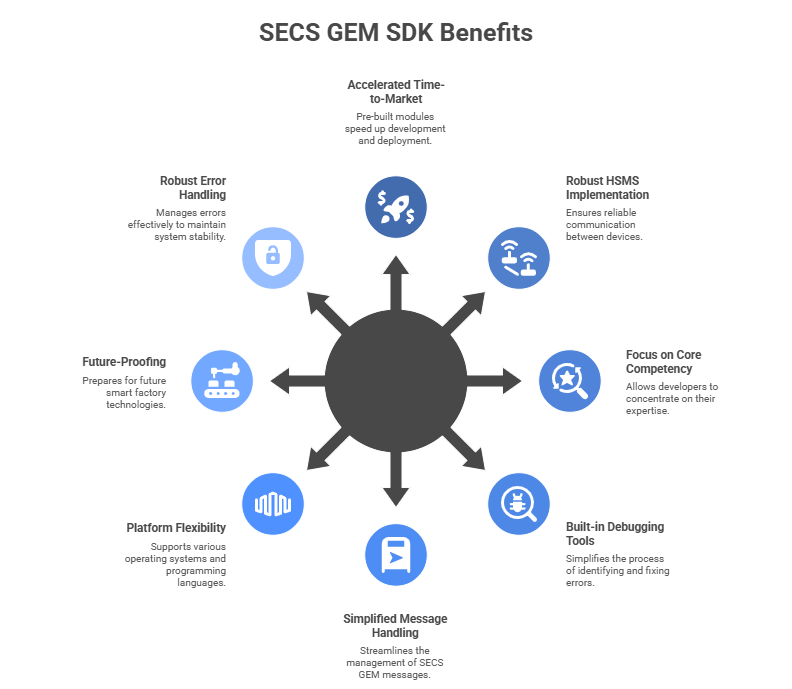
8 Essential Reasons to Choose a SECS GEM SDK
For software engineering managers and directors of technology, the decision to use a SECS GEM SDK is a strategic one, offering a clear path to faster time-to-market, higher reliability, and lower long-term maintenance costs.
1. Accelerated Time-to-Market with Pre-built Modules
A full-featured SDK isn’t just a library; it’s a production-ready framework. It includes pre-built state machines for the GEM state model, handling all required primary and secondary message pairs (e.g., S1F1/S1F2 for establishing communication). This means engineers skip the tedious work of standard implementation and move straight to defining the equipment’s specific Variables (ECVs), Events (CEIDs), and Alarms (ALIDs). This is the core of equipment integration SDK efficiency.
2. Robust and Reliable HSMS Implementation
The high-speed communication backbone is the HSMS SECS GEM protocol (SEMI E37). Implementing a reliable, persistent HSMS layer that correctly handles connection, disconnection, and message interleaving is notoriously difficult. A professional SDK has this communication stack battle-tested and optimized for performance, virtually eliminating low-level communication errors before they even reach the application layer.
3. Focus on Core Competency, Not Protocol Plumbing
Your team’s expertise is in the specific physics and control systems of your equipment, whether it’s a PVD tool or a chemical vapor deposition system. Do you really want your senior software engineer spending weeks debugging S5F1 (Alarm Report Send) messages? By utilizing a pre-built SECS GEM SDK , your valuable engineering talent is freed to optimize the core process, adding business value instead of fixing protocol plumbing. It’s a fundamental question of resource allocation, isn’t it?
4. Built-in Tools for Debugging and Validation
One of the most valuable aspects of an SDK is the associated SECS GEM developer tools. These often include:
- Log Viewers: Detailed logging of all SECS II Communication messages for easy tracing.
- Message Simulators: Tools to simulate the host or the equipment, enabling isolated testing.
- Compliance Testers: Utilities that automatically check if the equipment acts according to the GEM standard.
These tools are essential for SECS GEM Compliance Testing and dramatically shorten the debug cycle, especially when dealing with complex S9 (Exception) or S6 (Data Transfer) messages.
5. Simplified SECS GEM Message Handling
The SDK abstracts the complex S-F (Stream and Function) message structure into intuitive, developer-friendly methods. Instead of manually constructing a raw byte array for an S6F11 (Establish Communication Event), a developer can simply call a function like SendEquipmentEvent(eventID, data). This simplifies the SECS GEM Message Library interface, reducing the learning curve for new developers and lowering the chance of integration bugs. For more on cutting-edge integration solutions, check out the SECS GEM SDK available at Einnosys.
6. Platform and Language Flexibility
Good Equipment Controller Software development requires flexibility. A well-designed SDK supports multiple operating systems (Windows, Linux) and popular development languages (C#, Java, Python). This allows application engineering teams to integrate the protocol using their preferred environment, ensuring maximum compatibility and developer efficiency across the entire factory automation software landscape.
7. Future-Proofing for Smart Factory Solutions
The industry is rapidly moving towards Smart Factory Solutions and advanced analytics. Modern standards like E148 (Time Synchronization) and E164 (Specific Equipment Model) build upon a solid SECS GEM Protocol foundation. Implementing a commercial SDK means you are leveraging a product that is continually updated by domain experts to align with the latest SEMI standards, ensuring your equipment remains relevant and compliant for years to come. This provides a significant advantage in Semiconductor Equipment Communication.
8. Robust Error Handling and Session Management
A major headache in SECS GEM Host Communication is handling unexpected network drops, timeouts, and session management. The SDK’s built-in logic automatically manages these edge cases—reconnecting sessions, resuming data transfers, and notifying the host of communication errors according to the E30 standard. This level of autonomous reliability is nearly impossible to replicate perfectly in a DIY solution.
For software and technology leaders tasked with equipment integration, the choice is clear: attempting to build and maintain a proprietary SECS GEM implementation is a costly distraction. A professional SECS GEM SDK provides a vetted, reliable, and compliant framework, allowing your engineering team to focus their energy where it matters most—the unique value and functionality of your equipment. It accelerates development, ensures compliance, and offers the reliability necessary for the demanding world of automated manufacturing. Ready to fast-track your equipment integration?
To learn more about how a professional SECS GEM SDK can transform your automation software development process, contact our team for a demo today.


