
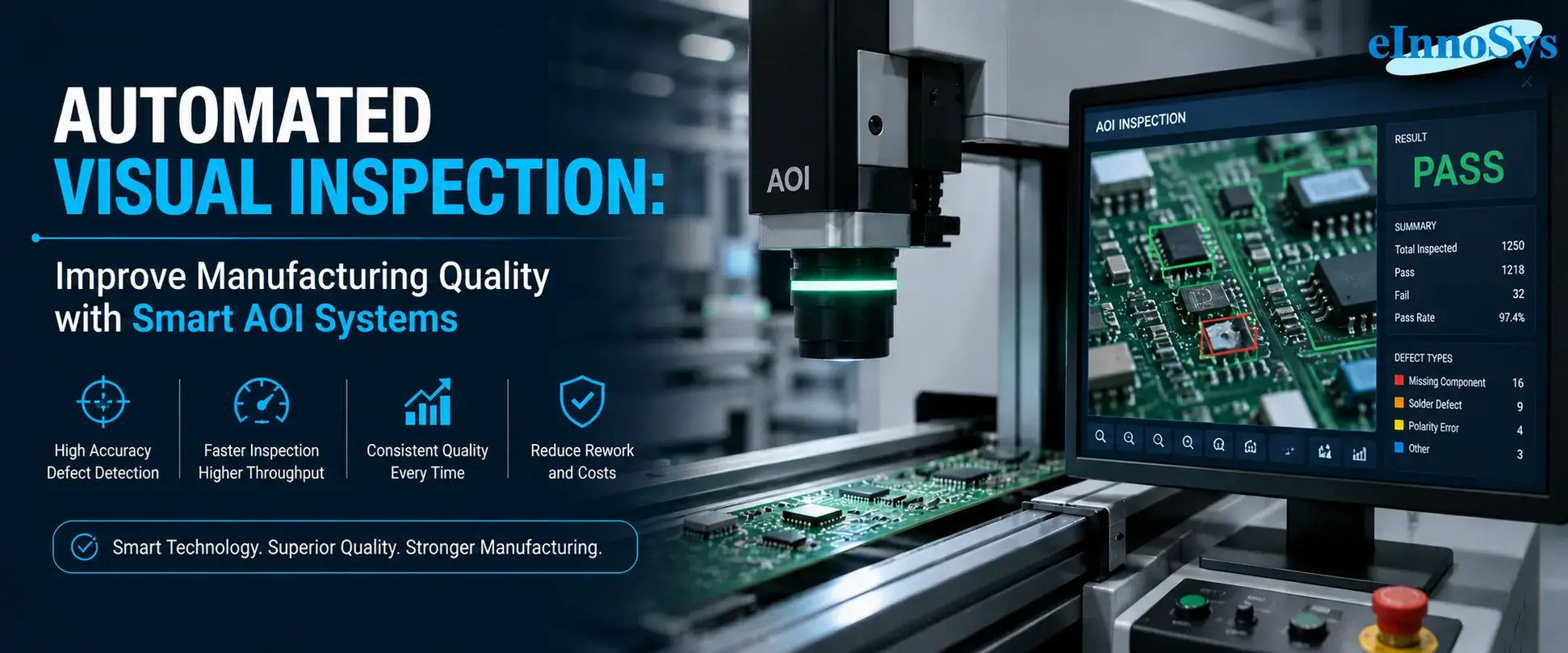
In today’s highly competitive manufacturing environment, quality control is no longer limited to manual inspection processes. Industries such as semiconductor manufacturing, electronics, automotive, medical devices, and precision engineering require faster, smarter, and more accurate inspection methods to maintain product quality and reduce production defects. This is where automated visual inspection technology is transforming modern manufacturing operations.
With the rise of AI-driven automation and Industry 4.0, manufacturers are increasingly adopting automated optical inspection systems to improve yield, minimize human error, and enable real-time defect detection. From wafer inspection to PCB quality checks, a modern automatic optical inspection system provides unmatched precision and consistency while reducing operational costs.
This blog explores how an automated optical inspection system improves manufacturing quality, the role of AI and machine vision, and why smart AOI solutions are becoming essential for future-ready factories.
What Is Automated Visual Inspection?
Automated visual inspection is a technology-driven process that uses cameras, sensors, AI algorithms, and image processing software to inspect products and identify manufacturing defects automatically. Unlike traditional manual inspection methods, automated systems can analyze thousands of components in real time with high accuracy and consistency.
Modern automated optical inspection systems combine machine vision technology with AI-powered analytics to inspect product surfaces, dimensions, solder joints, labels, and structural integrity. These systems are widely used in semiconductor fabs, SMT production lines, PCB manufacturing, automotive assembly, and pharmaceutical production.
An advanced automatic optical inspection system can detect:
- Surface scratches
- Missing components
- Alignment issues
- Cracks and contamination
- Soldering defects
- Packaging inconsistencies
- Pattern abnormalities
By integrating an automated optical inspection system into production lines, manufacturers can significantly reduce quality issues before products reach customers.
Why Manufacturers Are Moving Toward Smart AOI Systems
Traditional inspection methods rely heavily on human operators, which introduces limitations such as fatigue, inconsistency, and slower processing times. As production volumes increase, manual inspection becomes inefficient and costly.
This is why industries are adopting AI visual inspection systems and intelligent inspection technologies that provide faster and more reliable quality control.
Key Benefits of Automated Optical Inspection Systems
1. Improved Defect Detection Accuracy
Modern automated visual inspection solutions use AI algorithms and high-resolution cameras to identify microscopic defects that are difficult for humans to detect. This improves inspection precision and minimizes defective products.
An AI-powered machine vision inspection system continuously learns from production data, enabling better defect recognition over time.
2. Real-Time Quality Monitoring
An inline visual inspection system performs inspections directly on the production line without interrupting manufacturing operations. Real-time monitoring helps manufacturers identify issues immediately and take corrective actions before defects escalate.
This capability is especially valuable in semiconductor and electronics manufacturing where even minor defects can result in major yield losses.
3. Reduced Human Error
Manual inspections often vary between operators. An automatic optical inspection system delivers consistent inspection results regardless of production volume or working conditions.
By implementing automated optical inspection systems, manufacturers can standardize quality control processes across multiple production lines and facilities.
4. Higher Production Efficiency
Smart automated inspection systems significantly reduce inspection time while increasing throughput. Automated inspection enables faster product release cycles and improves operational efficiency.
AI-driven inspection tools can inspect products continuously without downtime, making them ideal for high-speed manufacturing environments.
Role of AI in Automated Visual Inspection
Artificial Intelligence is reshaping the future of manufacturing inspection systems. Traditional rule-based inspection software can identify only predefined defects, while AI-enabled systems can detect unknown anomalies and evolving defect patterns.
An AI-powered optical inspection platform uses deep learning and computer vision technologies to analyze product images and classify defects intelligently.
How AI Enhances Inspection Performance
- Detects complex and subtle defects
- Learns from historical inspection data
- Reduces false positives
- Improves predictive quality analysis
- Supports adaptive inspection models
- Enables real-time anomaly detection
Modern industrial visual inspection platforms combine AI with advanced analytics to provide smarter quality assurance solutions for semiconductor fabs and smart factories.
For example, semiconductor manufacturers use AI-enabled optical defect inspection systems to inspect wafers, IC packages, and precision components with extremely high accuracy.
Applications of Automated Optical Inspection Systems
Semiconductor Manufacturing
Semiconductor production requires microscopic-level inspection capabilities. A smart automated optical inspection system can detect wafer defects, contamination, and alignment issues during fabrication and packaging processes.
Manufacturers use intelligent visual inspection systems to improve yield and reduce costly failures in semiconductor fabs.
PCB and SMT Inspection
In electronics manufacturing, automated optical inspection systems are widely used to inspect PCB assemblies and SMT production lines.
Common inspection areas include:
- Solder joint quality
- Missing components
- Component polarity
- Misalignment detection
- PCB trace defects
An AI-based machine vision inspection system ensures reliable electronics manufacturing while reducing rework costs.
Automotive Industry
Automotive manufacturers use automated visual inspection technologies to inspect engine parts, assemblies, welds, and painted surfaces.
AI-enabled inspection systems improve production safety, consistency, and compliance with strict quality standards.
Medical Device Manufacturing
Medical products require extremely precise quality control. An automatic optical inspection system helps manufacturers maintain regulatory compliance while ensuring product reliability and patient safety.
Smart Manufacturing and Industry 4.0 Integration
Modern factories are rapidly adopting Industry 4.0 technologies, where connected machines, AI analytics, and real-time monitoring systems work together to optimize production processes.
An advanced automated optical inspection system integrates seamlessly with MES, SCADA, ERP, and factory automation platforms. This enables manufacturers to:
- Track production quality in real time
- Generate automated inspection reports
- Analyze defect trends
- Improve predictive maintenance strategies
- Optimize process parameters
By integrating AI visual inspection systems into smart factories, manufacturers gain valuable operational insights that improve overall equipment effectiveness (OEE) and productivity.
Choosing the Right Automated Optical Inspection System
Selecting the right automated optical inspection systems depends on several factors, including industry requirements, production speed, defect complexity, and integration capabilities.
- Important Features to Consider
- AI-powered defect recognition
- High-speed image processing
- Real-time inspection analytics
- Scalability for future expansion
- Integration with factory systems
- Cloud and edge deployment support
- User-friendly inspection dashboards
A reliable optical defect inspection system should provide accurate inspection results while minimizing false alarms and maintenance requirements.
Manufacturers should also consider vendors with deep industry expertise in semiconductor manufacturing, industrial automation, and AI-driven quality control solutions.
Future of Automated Visual Inspection
The future of automated visual inspection lies in AI, deep learning, and intelligent automation. As manufacturing becomes more data-driven, inspection systems will continue evolving toward predictive quality management and autonomous process optimization.
Emerging technologies such as edge AI, 3D vision systems, and advanced computer vision models will further enhance the capabilities of automated optical inspection systems.
Future-ready factories will increasingly rely on:
- AI-driven defect prediction
- Self-learning inspection systems
- Cloud-connected inspection platforms
- Autonomous quality control
- Digital twin integration
These innovations will help manufacturers achieve higher production quality, lower operational costs, and improved manufacturing agility.
Conclusion
In modern manufacturing, maintaining high product quality while increasing production efficiency is a major challenge. Traditional inspection methods can no longer meet the speed, accuracy, and scalability requirements of advanced manufacturing environments.
By adopting automated visual inspection technologies, manufacturers can improve defect detection, reduce human error, and optimize quality control processes. Smart automated optical inspection systems powered by AI and machine vision provide real-time monitoring, intelligent analytics, and highly accurate inspection capabilities across industries.
Whether used in semiconductor fabs, electronics manufacturing, automotive production, or medical device assembly, a modern automatic optical inspection system plays a critical role in enabling smart manufacturing and Industry 4.0 transformation.
As AI technology continues to evolve, the future of automated optical inspection system solutions will become even more intelligent, predictive, and efficient — helping manufacturers deliver superior quality products while remaining competitive in the global market.