
Introduction
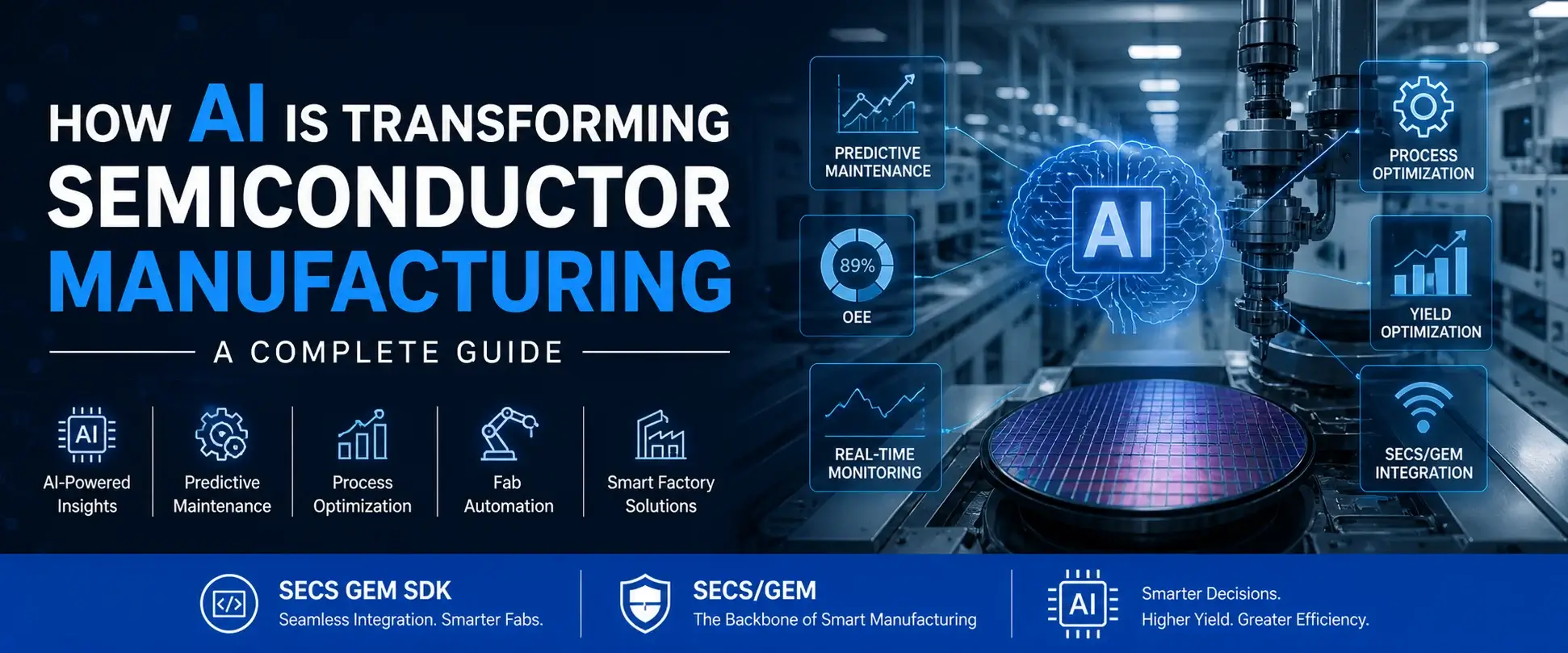
As the semiconductor industry continues to evolve, embracing AI-driven technologies has become essential for manufacturers aiming to stay competitive in an increasingly complex landscape. From predictive maintenance and process optimization to seamless equipment communication enabled by standards like SECS/GEM and powerful tools like SECS GEM SDKs, AI is transforming fabs into smart, efficient, and autonomous factories. This complete guide has highlighted how integrating artificial intelligence not only enhances operational efficiency and yield but also paves the way for a more innovative and resilient semiconductor future. By leveraging these advancements, manufacturers can unlock new levels of performance and set the stage for the next generation of technological breakthroughs.
The Role of AI in Semiconductor Manufacturing
AI is fundamentally changing how semiconductor fabs operate by enabling data-driven decision-making. Traditional manufacturing relied heavily on manual monitoring and rule-based systems. Today, machine learning in semiconductor industry applications allows fabs to analyze massive datasets in real time.
By integrating AI with SECS/GEM communication protocols, fabs can collect structured data from equipment and feed it into intelligent models. A robust SECS GEM SDK simplifies this integration, allowing faster deployment of AI-powered systems.
Key Benefits:
- Real-time data visibility across tools
- Faster decision-making using predictive analytics
- Reduced human intervention and errors
This combination of AI and fab automation software solutions is enabling a new era of autonomous manufacturing.
AI-Powered Predictive Maintenance
One of the most impactful applications of AI is AI-based predictive maintenance for fabs. Semiconductor equipment is highly sensitive, and unexpected failures can lead to significant production losses.
AI models analyze data from a semiconductor equipment monitoring system, including vibration, temperature, pressure, and historical performance trends. Using this data, the system can predict failures before they occur.
With SECS/GEM, equipment data can be collected in real time, while a SECS GEM SDK ensures smooth integration with monitoring platforms.
Advantages:
- Reduced unplanned downtime
- Lower maintenance costs
- Improved equipment lifespan
This approach to semiconductor predictive maintenance shifts maintenance strategies from reactive to proactive, significantly improving fab efficiency.
Enhancing Yield with AI
Yield optimization is a critical challenge in semiconductor manufacturing. Even minor defects can result in significant financial losses. AI helps address this by identifying patterns and anomalies that are difficult for humans to detect.
Using semiconductor yield optimization using AI, fabs can:
- Detect process variations early
- Identify root causes of defects
- Optimize process parameters in real time
When combined with SECS/GEM data streams, AI models gain access to high-quality, real-time equipment data. A well-implemented SECS GEM SDK ensures that this data is structured and accessible for analysis.
This enables manufacturers to achieve higher yields while maintaining consistent quality.
AI for Fab Automation
Automation is a cornerstone of modern semiconductor fabs. However, traditional automation systems often lack intelligence. AI introduces adaptability and learning capabilities into these systems.
With AI for fab automation, fabs can:
- Automate complex decision-making processes
- Optimize production schedules dynamically
- Improve equipment utilization
By leveraging SECS/GEM, AI systems can communicate directly with equipment, enabling real-time control and feedback. A SECS GEM SDK accelerates the development of such integrated systems, making it easier to deploy scalable solutions.
This synergy between AI and fab automation software solutions leads to smarter, more efficient manufacturing environments.
Semiconductor Process Optimization with AI
Process optimization is another area where AI is making a significant impact. Semiconductor manufacturing involves hundreds of process steps, each requiring precise control.
Using semiconductor process optimization AI, manufacturers can:
- Analyze process data across multiple tools
- Identify inefficiencies and bottlenecks
- Adjust parameters automatically for optimal performance
Integration with SECS/GEM ensures continuous data flow from equipment, while a SECS GEM SDK enables seamless connectivity between process tools and AI platforms.
This results in improved consistency, reduced variability, and enhanced overall performance.
Smart Factory Transformation
The concept of a smart factory is becoming a reality in the semiconductor industry. AI plays a central role in enabling smart factory semiconductor solutions, where all systems are interconnected and intelligent.
Key components include:
- Real-time monitoring systems
- AI-driven analytics platforms
- Automated decision-making systems
Through SECS/GEM, equipment across the fab can communicate in a standardized way, ensuring interoperability. A SECS GEM SDK simplifies the integration of legacy and modern equipment into a unified ecosystem.
This transformation enables fabs to operate with greater agility, scalability, and efficiency.
Challenges and Considerations
While AI offers significant benefits, implementing it in semiconductor manufacturing comes with challenges:
- Data Quality: AI models require accurate and consistent data
- Integration Complexity: Connecting legacy equipment can be difficult without tools like SECS GEM SDK
- Scalability: Ensuring AI systems can handle large-scale operations
Standards like SECS/GEM play a crucial role in overcoming these challenges by providing a reliable framework for equipment communication and data exchange.
Conclusion
AI is revolutionizing semiconductor manufacturing by enabling smarter, faster, and more efficient operations. From semiconductor predictive maintenance to yield optimization and process control, AI is driving significant improvements across the industry.
The integration of AI with standards like SECS/GEM and tools such as a SECS GEM SDK is critical for unlocking the full potential of these technologies. Together, they provide the foundation for real-time data access, seamless communication, and intelligent decision-making.
As the industry continues to evolve, manufacturers that embrace AI in semiconductor manufacturing and invest in fab automation software solutions will be better positioned to stay competitive in a rapidly changing landscape.
The future of semiconductor manufacturing is not just automated—it is intelligent, connected, and driven by AI.


