
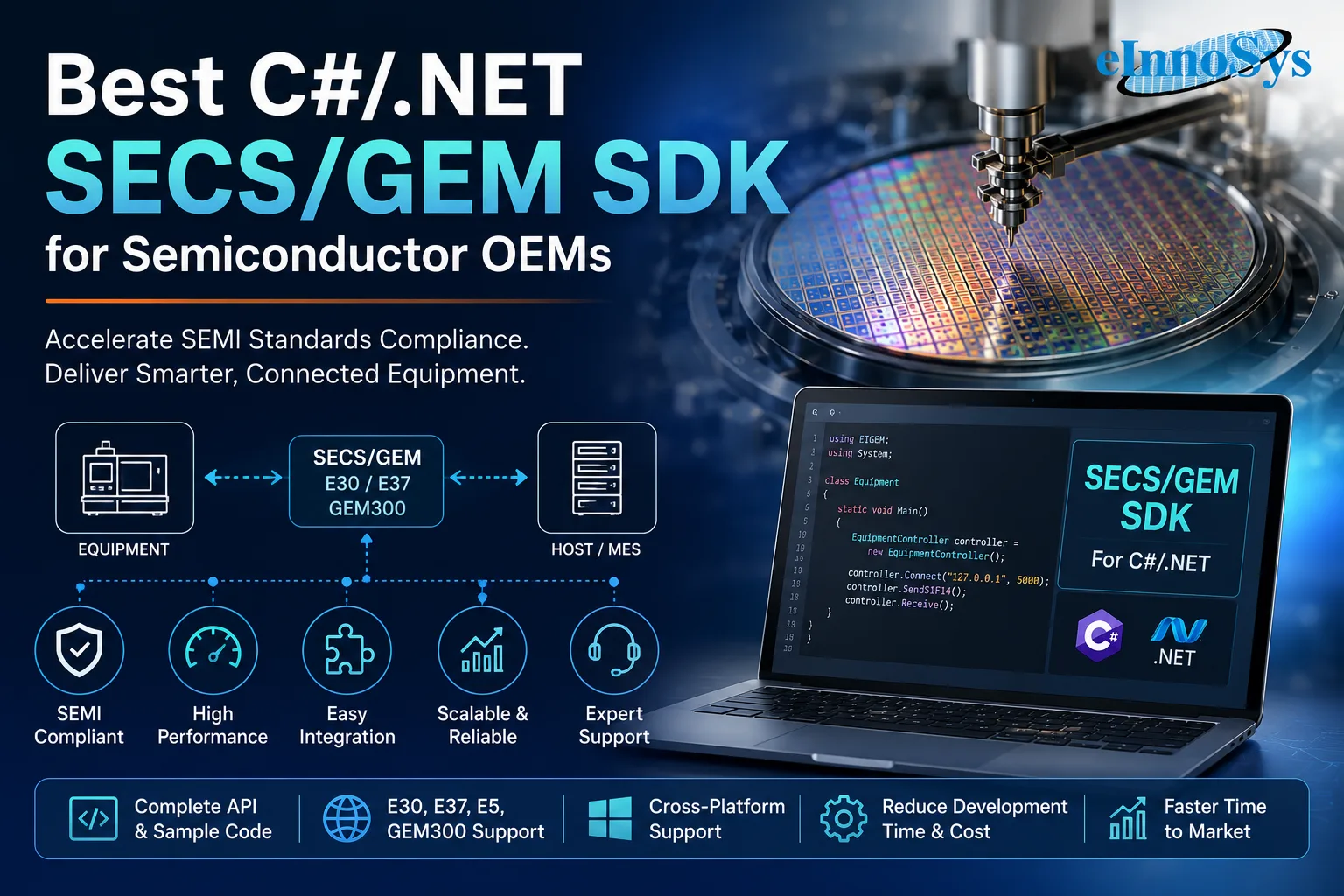
If you’re building equipment control software for a fab or OSAT, sooner or later you hit the same wall: the machine needs to talk to the host, and it needs to talk to it in SECS/GEM. For teams standardized on C#/.NET, the question quickly becomes less “should we build this” and more “which SDK do we build on.”
This guide walks through what actually matters when evaluating a C#/.NET SECS/GEM SDK, the build-vs-buy tradeoffs OEMs run into, and how to shortlist a vendor without wasting months on a proof of concept that goes nowhere.
Why SECS/GEM Still Trips Up Equipment OEMs
SECS/GEM (SEMI E30, built on SECS-II/E5 and HSMS/E37) isn’t a hard protocol to describe. It’s a hard protocol to implement correctly, because compliance isn’t really about parsing messages — it’s about state machine behavior. Getting the GEM state model right (equipment states, control states, communication states, event/alarm/report handling, remote commands) is where most in-house builds bog down.
For an OEM, this shows up as a few recurring problems:
- Compliance risk. Fabs increasingly require SEMI E30/E37/E4/E5 conformance before equipment even gets on the floor. A homegrown implementation that “mostly works” can fail acceptance testing at a customer site.
- Engineering opportunity cost. Every month spent on SECS/GEM plumbing is a month not spent on the equipment’s actual differentiating logic — process control, motion, recipe execution.
- Maintenance burden. SECS/GEM isn’t static. GEM300 (E40, E87, E90, E94, E116) adds substantial complexity for 300mm fab integration, and host-side requirements evolve per customer.
- Fragmented expertise. SECS/GEM knowledge is a narrow specialty. When the one engineer who understands the state machine leaves, the codebase becomes a liability.
This is why most equipment OEMs — even ones with strong internal software teams — eventually evaluate a commercial SECS/GEM API or SDK rather than maintaining a bespoke stack indefinitely.
Who This Decision Usually Falls To
The SECS/GEM SDK decision rarely sits with one role. In most OEM organizations, it touches:
- Automation engineers and embedded software engineers, who own the equipment controller code and have to live with the API day-to-day.
- Factory automation architects, who need the integration architecture to fit the broader equipment software stack, not just one tool.
- MES integration engineers, who care most about how cleanly the equipment-side implementation talks to the factory host — since a poorly behaved GEM state machine on the equipment side becomes their support ticket later.
- Engineering managers and CTOs, who are ultimately weighing build-vs-buy against schedule, budget, and long-term maintenance ownership.
If you’re reading this as one of those roles, the sections below are organized to let each stakeholder find what they need: technical evaluation criteria for the engineers doing the implementation, and a build-vs-buy framework plus vendor landscape for the people signing off on the decision.
What to Look for in a C#/.NET SECS/GEM SDK
Not all SECS/GEM C# libraries are built the same way, and the differences matter more once you’re past the demo stage. Here’s the criteria that separates a usable SDK from one that quietly becomes its own maintenance project.
1. Genuine SEMI Standards Compliance
Look for explicit conformance to SEMI E30 (GEM), E5 (SECS-II), E4 (SECS-I), and E37 (HSMS) — not just “SECS/GEM support” in marketing copy. If you’re targeting 300mm fabs, GEM300 SDK capability (E40, E87, E90, E94, E116) needs to be part of the roadmap or already available.
2. Native C#/.NET Implementation (Not a Wrapper)
A true .NET-native SECS/GEM library gives you managed memory handling, async/await support for message flows, and integration that feels like normal C# rather than fighting a C++ interop layer or COM+ marshalling. Wrapped or bridged libraries tend to leak complexity back into your codebase exactly where you were trying to avoid it.
3. API Ergonomics
The best SECS/GEM APIs expose concepts — events, alarms, remote commands, data collection plans — through clear, readable methods rather than requiring your team to hand-craft raw Stream-Function (S-F) message structures. This matters most for teams without a dedicated SECS/GEM specialist, since it lowers the domain-knowledge bar for day-to-day development. Some vendors go further with visual configuration tools for defining GEM services and data items, which can meaningfully shorten onboarding for engineers new to the protocol.
4. Integration Architecture Flexibility
Equipment software architectures vary a lot. A good SDK should support multiple integration patterns:
- Embedded in the same process as your equipment controller (tightest integration, full source access)
- Running as a separate process on the same PC (better isolation, minimal changes to existing controller code)
- Running on a dedicated PC within the equipment (for resource-constrained controllers)
- A REST API or gRPC layer, for teams that want SECS/GEM functionality without embedding a native SDK at all
If an SDK only supports one architecture, it may not fit equipment you haven’t designed yet.
5. Cross-Platform and Cross-Language Reach
Windows is still dominant on fab-floor equipment, but Linux and even Raspberry Pi–class controllers are increasingly common on newer platforms. If your organization has mixed teams or legacy code in other languages, check whether the same vendor also offers C++, Java, Python, or Delphi bindings alongside the .NET library — it reduces the risk of maintaining two unrelated toolchains for the same protocol.
6. GEM300 and Growth Path
Even if your current tools are 200mm-class, ask whether the vendor has a clear upgrade path to GEM300 support. Retrofitting GEM300 into an SDK that wasn’t designed for it is a bigger lift than starting with one that already has the extended object model.
7. Testing and Simulation Tools
A built-in SECS/GEM simulator — something that lets you test event reports, alarms, and remote commands without a live host connection — meaningfully shortens development and debugging cycles, especially for teams without easy access to a fab host for testing.
8. Real Support, Not Just Documentation
SECS/GEM issues tend to surface during customer acceptance testing — exactly when you have the least time to debug a protocol-level edge case. Vendor support responsiveness (and whether they’ve actually solved this problem for OEMs before) matters as much as the SDK’s feature list.
9. Track Record with OEMs, Not Just Fabs
There’s a real difference between an SDK built for host-side (fab/MES) use and one built for equipment-side (OEM) use. Make sure the vendor has shipped equipment-side implementations for OEMs specifically — the state machine responsibilities differ meaningfully between host and equipment roles.
Build vs. Buy: The Real Tradeoff
| Criteria | In-House Build | Commercial SECS/GEM SDK |
|---|---|---|
| Time to First Working Integration | Months of development and testing | Weeks with pre-built components |
| SEMI Standards Compliance | Depends entirely on your team’s expertise | Built-in compliance with SEMI standards |
| Development Cost | High upfront engineering investment | Lower implementation cost and faster ROI |
| Ongoing Maintenance | Managed by your engineering team indefinitely | Vendor-maintained with regular updates |
| GEM300 & Future Standards | Requires continuous re-investment | Included in SDK enhancements and releases |
| Customer Acceptance Testing (FAT/SAT) | Internal support only | Vendor technical support available |
| Implementation Risk | Higher due to custom development | Lower with proven production-ready SDK |
| Time-to-Market | Longer product launch cycles | Faster deployment and product release |
| Technical Support | Limited to internal resources | Dedicated vendor support and troubleshooting |
| Scalability | Requires additional development effort | Designed to scale across multiple equipment models |
| Documentation & Samples | Must be created internally | Comprehensive documentation, APIs, and sample projects |
| Long-Term Total Cost of Ownership (TCO) | Higher due to ongoing maintenance and upgrades | Lower with continuous vendor support and updates |
The build path can make sense if SECS/GEM connectivity is a core differentiator for your company, or if you already have deep in-house protocol expertise. For most semiconductor equipment OEMs, though, SECS/GEM compliance is a requirement to ship, not a competitive advantage — which tilts the calculus toward a proven SDK.
The C#/.NET SECS/GEM SDK Landscape
If you search around, you’ll find a handful of established options for .NET-based SECS/GEM development, each with a different orientation. Here’s a fair, high-level look at the main categories you’ll run into during evaluation (always verify current specs directly with each vendor, since SDKs evolve):
Long-running native .NET libraries (e.g., SECSGEM.NET/GEM300) have typically been in the market for years and emphasize being a true .NET library rather than a wrapper, with per-connection licensing and support for both host and equipment roles. These tend to appeal to teams that want a mature, code-first library and are comfortable working close to the protocol layer.
Model-builder-oriented SDKs (e.g., NxSphere GEM, formerly known under a different product name) lean into visual configuration tooling — a GUI for defining GEM services, data items, and events — alongside the underlying .NET library, plus a bundled simulator for offline testing. These can lower the ramp-up time for teams without in-house SECS/GEM specialists.
Full-service SDK-plus-implementation providers (e.g., eInnoSys’s EIGEMEquipment) pair the SDK itself with integration services, multiple language bindings (C#/.NET, C++, Java, REST API), multiple integration architectures (embedded, separate process, dedicated PC, PLC/HMI bridge), and direct engineering support through compliance validation and deployment. This model tends to suit OEMs who want compliance and a working integration delivered on a timeline, not just a library to build against.
None of these categories is objectively “best” independent of your situation — a small team with deep protocol expertise might prefer a lean, code-first library; a team under schedule pressure with limited SECS/GEM background often gets more value from a vendor that also brings integration services and support. The evaluation checklist below is designed to help you figure out which category actually fits.
Where EIGEMEquipment Fits
eInnoSys’s EIGEMEquipment SECS/GEM SDK is built specifically for the OEM side of this problem. A few specifics worth checking against the criteria above:
- Standards coverage: Full compliance with SEMI E30 (GEM), E4 (SECS-I), E5 (SECS-II), and E37 (HSMS), with GEM300 capability included.
- Language and OS support: Available in C#/.NET, C++, Java, and as a REST API, running on Windows, Linux, and Raspberry Pi — useful if your equipment lineup spans more than one platform or your engineering team isn’t fully standardized on one language.
- Out-of-the-box coverage: eInnoSys states roughly 80% of typical SECS/GEM functionality is available without custom integration work, which is where most of the schedule savings comes from.
- Architecture flexibility: Supports embedding the SDK directly in your controller process, running it as a separate process on the same PC, running it on a dedicated PC, or bridging through PLC/HMI-based options (EIGEMHMI, EIGEMLink) for equipment where you don’t have full controller source access.
- API design: Positioned around plain, readable APIs specifically so teams without a dedicated SECS/GEM specialist can implement and maintain the integration.
- Legacy equipment path: For older 150mm/200mm tools that were never built with SECS/GEM in mind, eInnoSys also offers EIGEMBox, a plug-and-play interface that adds SECS/GEM connectivity without touching the existing controller software — relevant if your OEM portfolio spans both new and legacy tool generations.
Whether EIGEMEquipment or another SDK is the right fit depends on your equipment architecture, platform targets, in-house SECS/GEM expertise, and how much of your controller source you’re willing to expose to a third-party dependency — but it’s a reasonable starting point for a shortlist if you’re evaluating C#/.NET options with engineering support attached.
MES Integration: What Happens After the SDK Is In
Choosing a SECS/GEM SDK isn’t just about getting equipment to speak the protocol — it’s about what happens once your equipment is sitting on a fab floor talking to a real MES. A few things worth planning for before you pick an SDK, not after:
Data collection plans (DCP) and trace requests: Fabs will define their own Stream 2/6 data collection needs per tool. Your SDK’s API for handling dynamic event reports and trace data matters more in production than it does in a demo.
Recipe management: If your equipment supports downloadable recipes, check how the SDK handles Stream 7 (Process Program Management) and whether it supports large recipe transfer (relevant if your recipes exceed a single message’s practical size).
Alarm and event customization per customer: Different fabs configure different alarm sets and enable/disable different collection events. An SDK that makes this configuration-driven rather than code-driven will save you rework across customer deployments.
Multi-tool and multi-connection scaling: If your OEM ships equipment with multiple sub-modules or handles clusters of tools, confirm the SDK’s licensing and architecture support simultaneous connections cleanly, without per-connection instability.
None of this shows up on a feature comparison chart, but it’s where SDK choice actually gets tested — during customer qualification, not during your internal proof of concept.
A Practical Evaluation Checklist
Before committing to an SDK, it’s worth running a short technical evaluation rather than relying on a spec sheet:
- Confirm SEMI E30/E5/E37/E4 compliance with a real conformance test, not just a claim.
- Ask whether GEM300 support exists today or is on a roadmap — and when.
- Build a small proof-of-concept using your actual equipment’s event/alarm set, not a generic demo.
- Check which integration architecture options exist, and whether they match your controller’s current design.
- Verify OS and language support against your actual equipment lineup and team skillset, including anything planned for the next 1–2 years.
- Ask about support response times during customer acceptance testing windows specifically — this is when problems surface.
- Test any bundled simulator or model-builder tooling against a realistic event/alarm/recipe scenario, not just the sample app.
- Talk to references who’ve used the SDK in OEM (not just fab-side) deployments, ideally on equipment similar to yours.
Final Thought
The “best” C#/.NET SECS/GEM SDK isn’t a universal answer — it’s the one that fits your equipment architecture, your compliance timeline, your team’s SECS/GEM expertise, and your willingness to own protocol-level maintenance long-term. But for most semiconductor equipment OEMs, a mature, standards-compliant SDK will get you to a compliant, supportable integration faster than a from-scratch build — and free up engineering time for the parts of your equipment that actually differentiate it.
If you’re evaluating options, a technical consultation on SECS/GEM SDK integration is a low-cost way to pressure-test your architecture against real implementation experience before you commit engineering months to either path.


