
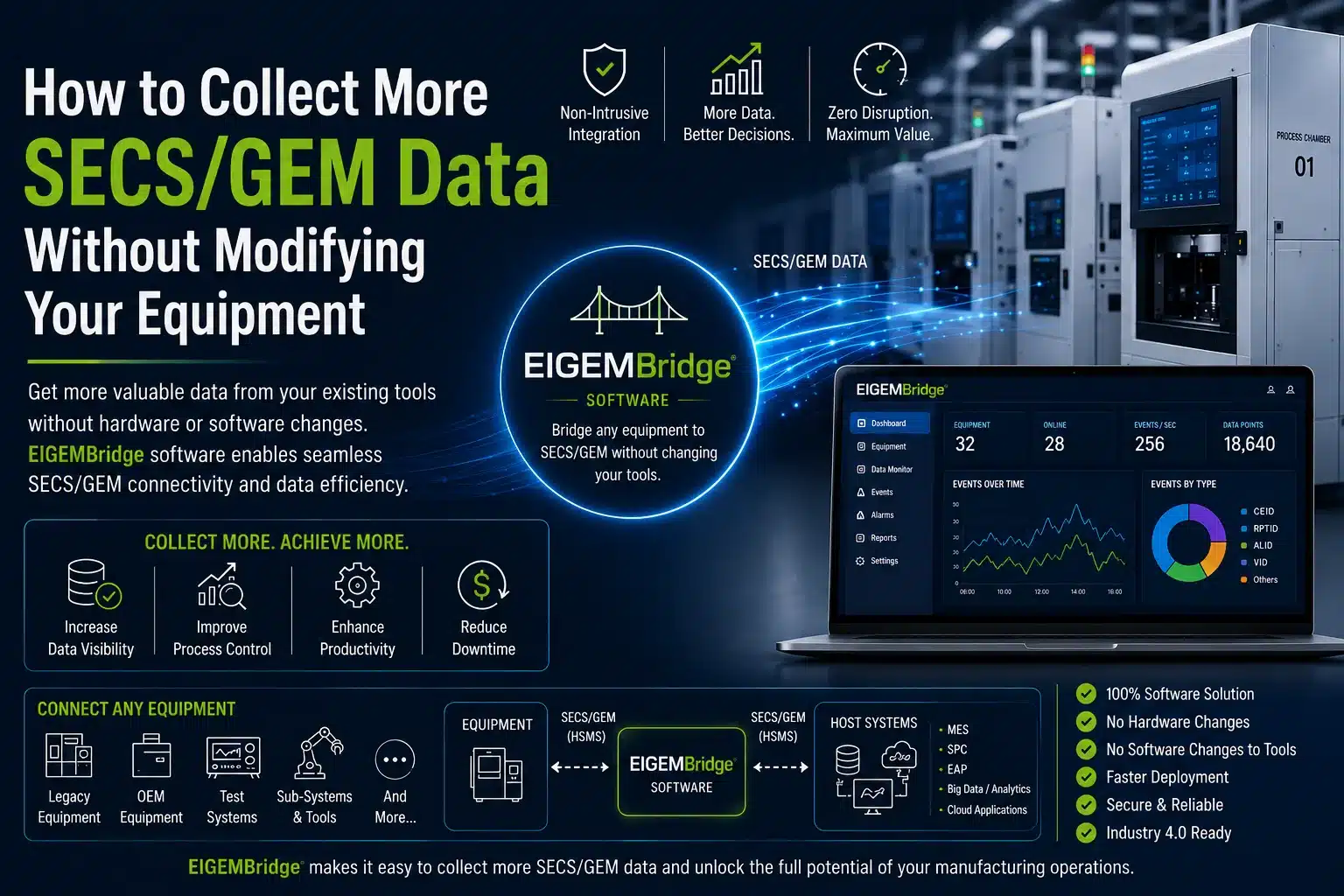
Semiconductor fabs run on data. Yield engineers need trace parameters. FDC systems need real-time sensor values. MES teams need lot, recipe, and event data flowing without interruption. Yet in almost every fab, there’s a familiar bottleneck: the equipment supports SECS/GEM, but it only exposes a fraction of the data engineers actually need.
For equipment engineers, automation teams, and MES integration specialists, this creates a frustrating dilemma. The obvious fixes — reprogramming the equipment controller, renegotiating the host interface, or asking the OEM for a firmware update — are slow, expensive, and risky. Any change to a qualified tool can trigger requalification, void warranties, or introduce downtime nobody can afford. So the data gap stays open, and decisions get made with less visibility than they should have.
The good news is that you don’t need to touch the equipment or the host to close that gap. This article walks through why SECS/GEM data collection hits a ceiling on legacy and limited-data tools, and how a non-intrusive communication bridge lets you pull additional data safely — without disrupting the connection that’s already working.
Why SECS/GEM Data Collection Runs Into Limits
SECS/GEM (SEMI Equipment Communications Standard / Generic Equipment Model) was designed to standardize how fab hosts and equipment exchange status, events, and data. In practice, though, the amount of data an equipment exposes over SECS/GEM depends entirely on how the equipment supplier implemented the interface.
Several common scenarios limit what engineers can actually collect:
- Legacy equipment integration with an older or minimal GEM implementation that was built to satisfy a checklist, not support advanced analytics.
- OEM-defined data sets that only report a narrow slice of available parameters, leaving trace data, sub-recipe steps, or diagnostic events unreported.
- Host-equipment connections that are already live in production, where any change to the host or the equipment’s SECS/GEM configuration risks breaking a stable, qualified interface.
- Multiple stakeholders needing different data — MES wants standard event data, while process engineers want additional trace parameters, and neither wants to touch the same live connection twice.
The instinct is often to modify the host application or ask the OEM to expand the GEM interface. Both routes take time, require re-testing, and put a working system at risk for the sake of getting more visibility. For teams under Industry 4.0 and smart factory pressure to instrument every tool, that’s not a sustainable path.
What “Non-Intrusive” Equipment Data Collection Actually Means
The alternative is to add a layer between the host and the equipment that observes and extends SECS/GEM communication without becoming part of the primary control path. This is the idea behind a SECS/GEM communication bridge.
Instead of modifying either endpoint, the bridge sits logically in the middle of the existing HSMS communication. The host and the equipment continue talking to each other exactly as before — same messages, same timing, same behavior. The bridge intercepts a copy of that traffic, analyzes or forwards it, and can optionally inject additional messages of its own, all without interrupting the original session.
This approach directly answers the core pain points fab and equipment engineers run into:
- Equipment supports SECS/GEM but exposes limited data — the bridge can request or extract additional data points beyond what the host currently collects.
- No visibility into pass-through SECS messages — the bridge gives you a real-time, analyzable copy of message traffic without inserting itself as a required hop.
- Need for more data without modifying host or equipment — because it operates transparently, there’s no requalification of the tool and no rework of host logic.
- Risk of disrupting existing communication — the primary host-equipment channel keeps functioning exactly as it did before the bridge was introduced.
This is the model eInnoSys built into its EIGEMBridge solution: a purpose-built bridge that runs between the equipment and host, intercepting, forwarding, analyzing, and optionally handling SECS/GEM messages in real time, while leaving the primary communication channel untouched.
How a SECS/GEM Bridge Fits Into Your Architecture
A bridge like this generally supports two operating modes, which map to how most fabs actually want to work:
Pass-through messaging. SECS/GEM messages flow between host and equipment exactly as they do today. The bridge simply forwards traffic transparently, giving teams a foundation for observability without changing any existing behavior.
Pass-through with data handling. Messages still pass through unmodified, but the bridge also captures and processes them — filtering, prioritizing, and logging data as needed, or forwarding it into an MES, historian, MQTT broker, or analytics platform. This is where most of the value shows up for equipment monitoring and factory automation initiatives, because it turns raw SECS traffic into structured, usable data without asking the host or equipment to do anything different.
In practice, this kind of bridge typically offers:
- Intelligent filtering — so only relevant messages reach downstream systems, instead of flooding your MES or historian with noise.
- Smart prioritization — ensuring time-sensitive events aren’t delayed behind lower-priority traffic.
- Custom message insertion — the ability to request specific data or trigger equipment responses beyond the base GEM interface, when the equipment allows it.
- Logging and diagnostics — a full record of intercepted and forwarded messages for troubleshooting and audit purposes.
- Low resource footprint — designed to run continuously alongside production traffic without adding meaningful load.
Because it works at the protocol level, this kind of bridge is largely platform-independent — it fits into environments built around GEM protocol interfaces regardless of the specific host software, MES platform, or equipment vendor already in place.
When This Approach Makes Sense
A non-intrusive SECS/GEM bridge is a strong fit when:
- You need more data than the equipment currently reports, but changing the equipment’s SECS/GEM configuration isn’t realistic in the near term.
- The host-equipment connection is stable and qualified, and any downtime or reconfiguration carries real production risk.
- Multiple teams (MES integration, FDC, yield, maintenance) need different views of the same equipment data stream without each building a separate integration.
- You’re extending data collection to support Industry 4.0 initiatives — feeding MQTT brokers, cloud analytics, or predictive maintenance models — without re-architecting existing fab automation.
- You want to pilot expanded equipment connectivity on a subset of tools before committing to a broader semiconductor MES integration project.
It’s also a practical option for OEMs and OSATs supporting fielded equipment where the installed base spans multiple GEM implementations, and a one-size-fits-all data collection layer needs to sit on top of, rather than inside, each tool’s native interface.
Common Questions Engineering Teams Ask
Does this require any change to the equipment’s SECS/GEM configuration? No. The bridge is designed to sit between the existing host and equipment connection, observing and extending communication rather than replacing any part of it. The equipment’s GEM interface, state model, and existing message set stay exactly as configured today.
Will it affect the performance of the existing host-equipment link? A well-built bridge is designed for low resource usage and continuous industrial operation, so it shouldn’t introduce noticeable latency or load on the primary communication channel. Because it operates as a pass-through, the original session behaves as if the bridge weren’t there.
Can it work with equipment that only exposes standard, minimal SECS/GEM data? Yes — this is one of the main reasons the approach exists. Equipment that reports only a limited standard data set is exactly the case where a bridge can help extract or request additional information without needing the OEM to rebuild the equipment’s GE
Where does the collected data go? That depends on your architecture. Some teams route it straight into an existing MES or historian; others use it to feed MQTT brokers, cloud dashboards, or predictive maintenance models as part of a broader smart factory rollout. Because the bridge filters and structures data before forwarding it, downstream systems typically don’t need to change to consume it.
Is this only useful for legacy equipment? Not exclusively. While legacy equipment integration is a common use case, the same approach applies to newer tools where the OEM’s default GEM implementation simply doesn’t expose everything a fab wants to monitor. Any equipment with a functioning SECS/GEM interface and an incomplete data set is a candidate.
What to Evaluate Before You Commit
Before rolling out a bridge-based approach fab-wide, it’s worth validating a few things during a pilot:
- Message coverage. Confirm the bridge can see and correctly parse the full range of SECS/GEM messages your equipment and host already exchange, including any vendor-specific extensions.
- Filtering accuracy. Test that filtering rules route only the intended data downstream, so MES and analytics systems aren’t overwhelmed with irrelevant traffic.
- Failover behavior. Understand what happens to the primary host-equipment connection if the bridge itself has an issue — a properly designed pass-through architecture shouldn’t take the primary link down with it.
- Logging depth. Make sure the logging is detailed enough to support troubleshooting and, where relevant, audit or traceability requirements common in semiconductor manufacturing.
These checks are quick to run on one or two tools and give automation managers and MES integration engineers the confidence to expand the approach across the fab or across an OSAT’s fielded equipment base.
Getting Started
If your team is evaluating how to expand SECS/GEM data collection without touching qualified equipment or a live host connection, the practical first step is to map out exactly what’s missing: which parameters, events, or trace data aren’t currently reported, and which downstream systems (MES, historian, analytics platform) would use that data if it were available.
From there, a non-intrusive bridge can typically be piloted on one or two tools to validate that message interception, filtering, and forwarding work as expected in your environment — before it’s rolled out more broadly across the fab or OSAT floor.
eInnoSys built EIGEMBridge specifically for this use case: a SECS/GEM communication bridge that runs between host and equipment, extracting additional data or unlocking hidden insights without disrupting the connection that’s already in production. If your equipment supports SECS/GEM but isn’t giving you the full picture, it’s worth a conversation with a SECS/GEM integration expert to see whether a bridge architecture fits your fab.


