
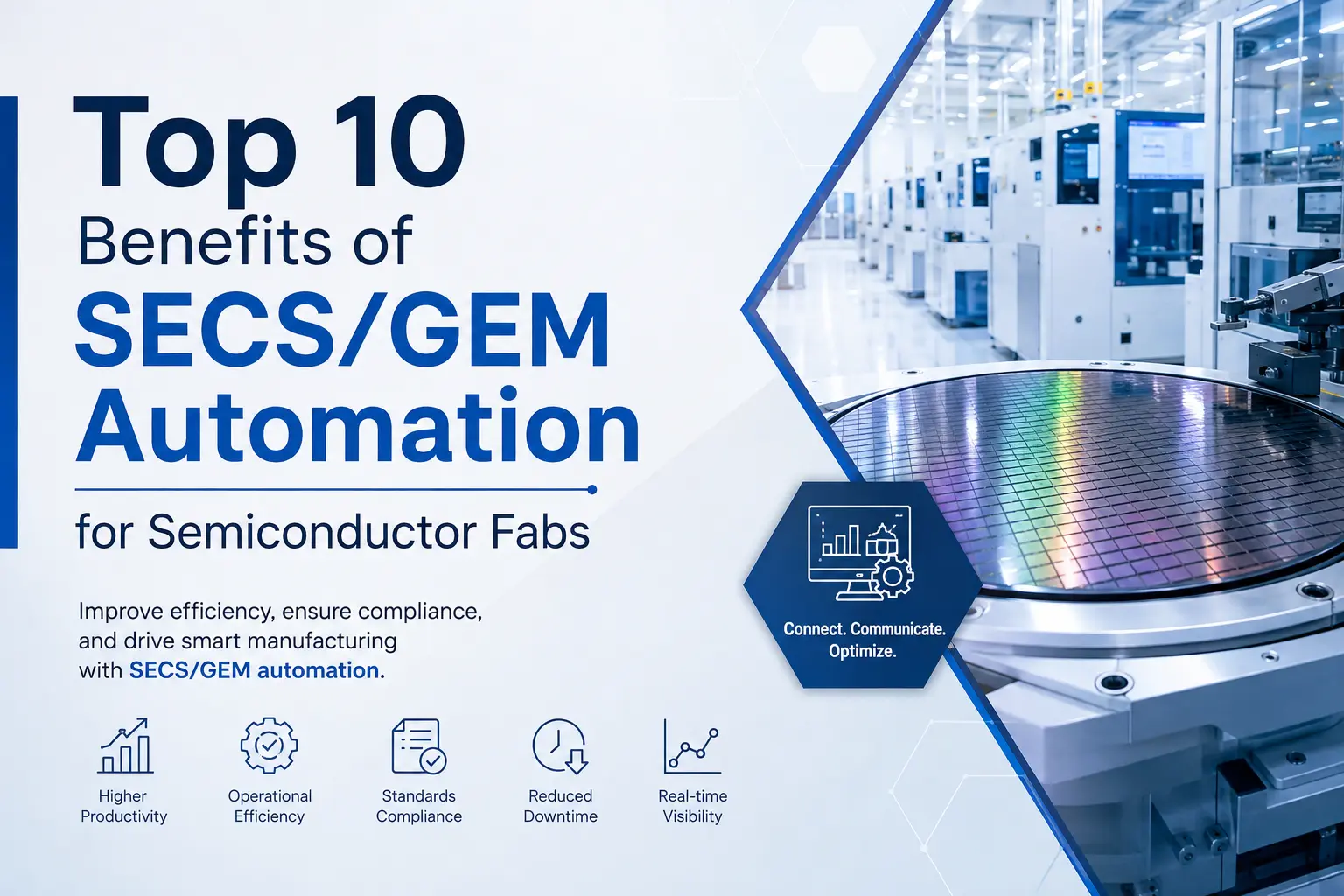
The semiconductor industry is under constant pressure to increase production efficiency, improve product quality, and reduce manufacturing costs. As chip designs become more advanced and customer demand continues to grow, manufacturers need smarter ways to connect equipment, automate workflows, and gain real-time visibility into production.
One of the most effective technologies enabling this transformation is SECS/GEM automation.
SECS/GEM has become the global communication standard for semiconductor manufacturing equipment, allowing machines from different vendors to communicate seamlessly with Manufacturing Execution Systems (MES), factory automation platforms, and data analytics applications.
Whether you’re operating a wafer fabrication plant (Fab), an OSAT facility, or manufacturing semiconductor equipment as an OEM, implementing SECS/GEM can significantly improve productivity, equipment utilization, traceability, and operational efficiency.
In this article, we’ll explore the top 10 benefits of SECS/GEM automation and explain why it has become a cornerstone of modern semiconductor manufacturing.
What is SECS/GEM Automation?
SECS/GEM stands for SEMI Equipment Communications Standard / Generic Equipment Model.
It combines two industry standards developed by SEMI (Semiconductor Equipment and Materials International):
- SECS-II (SEMI E5): Defines message formats exchanged between manufacturing equipment and host systems.
- GEM (SEMI E30): Defines standardized equipment behavior and communication.
Together, these standards create a common language that enables semiconductor equipment to communicate with MES, factory automation software, and host computers.
Instead of relying on manual operator input or proprietary communication protocols, SECS/GEM enables automated data exchange, remote equipment control, and standardized production monitoring.
Why SECS/GEM Matters in Modern Semiconductor Manufacturing
Modern semiconductor fabs contain hundreds or even thousands of process tools from multiple equipment vendors.
Without a standardized communication protocol:
- Equipment operates independently.
- Data is stored in separate systems.
- Manual data collection increases errors.
- MES integration becomes complex.
- Real-time monitoring is difficult.
SECS/GEM solves these challenges by creating a unified communication framework across the entire manufacturing environment.
Top 10 Benefits of SECS/GEM Automation
Real-Time Equipment Communication
One of the biggest advantages of SECS/GEM automation is real-time communication between manufacturing equipment and host systems.
Instead of waiting for operators to manually record equipment status, SECS/GEM continuously exchanges information such as:
- Equipment status
- Alarm notifications
- Process parameters
- Recipe information
- Production events
- Lot information
Real-time communication enables manufacturing teams to react immediately to production issues, minimizing downtime and improving operational efficiency.
Key Benefits:-
- Faster decision-making
- Instant equipment monitoring
- Reduced production delays
- Improved manufacturing visibility
Faster MES Integration
Manufacturing Execution Systems (MES) depend on accurate equipment data to coordinate production activities.
SECS/GEM provides standardized communication that simplifies integration between equipment and MES platforms.
Instead of developing custom interfaces for every machine, manufacturers can implement a standardized communication framework.
This significantly reduces engineering effort while improving long-term maintainability.
Business Impact
- Reduced implementation time
- Lower integration costs
- Simplified equipment onboarding
- Faster production deployment
Increased Equipment Utilization
Idle equipment directly impacts fab productivity and profitability.
SECS/GEM enables continuous monitoring of:
- Equipment availability
- Production status
- Downtime reasons
- Idle conditions
- Maintenance events
By analyzing this information, manufacturers can identify bottlenecks and maximize equipment utilization.
Improved utilization leads to increased throughput without purchasing additional equipment.
Higher Overall Equipment Effectiveness (OEE)
OEE is one of the most important KPIs in semiconductor manufacturing.
SECS/GEM automatically collects production data required to calculate:
- Availability
- Performance
- Quality
Instead of manually collecting production reports, manufacturers receive real-time OEE dashboards.
This allows production teams to identify losses and continuously improve manufacturing performance.
Benefits include:
- Higher production efficiency
- Better asset utilization
- Continuous improvement
- Data-driven decision-making
Reduced Human Errors
Manual data collection introduces mistakes that can affect production quality.
Examples include:
- Incorrect lot information
- Manual recipe selection
- Missing production data
- Delayed alarm reporting
SECS/GEM automates equipment communication, reducing reliance on manual processes.
Automation ensures consistent, accurate, and reliable production data throughout the manufacturing lifecycle.
Better Production Traceability
Traceability is essential for semiconductor manufacturing, particularly when producing high-value chips for automotive, aerospace, medical, and consumer electronics industries.
SECS/GEM records:
- Equipment events
- Process history
- Lot movement
- Recipe changes
- Alarm history
- Operator actions
This detailed audit trail helps manufacturers investigate quality issues, comply with customer requirements, and improve process control.
Legacy Equipment Modernization
Many semiconductor facilities continue to operate older equipment that lacks modern communication capabilities.
Replacing these machines is often expensive and disruptive.
SECS/GEM automation enables manufacturers to modernize legacy equipment by adding standardized communication without replacing the machine.
This extends equipment life while enabling integration with modern MES and factory automation systems.
Benefits include:
- Lower capital expenditure
- Improved equipment connectivity
- Extended machine lifespan
- Better return on investment
AI and Predictive Analytics Enablement
Artificial Intelligence requires high-quality production data.
SECS/GEM continuously collects structured equipment data that can be used for:
- Predictive maintenance
- Process optimization
- Fault detection
- Yield improvement
- Energy optimization
With AI-powered analytics, manufacturers can identify equipment issues before failures occur, reducing unexpected downtime.
Easier Regulatory Compliance
Semiconductor manufacturers must comply with strict customer and industry requirements.
SECS/GEM helps organizations maintain detailed production records, including:
- Equipment history
- Process parameters
- Recipe management
- Alarm logs
- Audit trails
Automated record collection simplifies compliance and supports quality management initiatives.
Foundation for Industry 4.0 and Smart Manufacturing
ndustry 4.0 relies on connected equipment, intelligent automation, and data-driven decision-making.
SECS/GEM provides the communication foundation required to build:
- Smart factories
- Digital twins
- AI-based analytics
- Cloud manufacturing
- Advanced scheduling systems
- Automated material handling
Without standardized equipment communication, achieving Industry 4.0 goals becomes significantly more challenging.
Common Challenges During SECS/GEM Implementation
Although SECS/GEM offers significant benefits, successful implementation requires careful planning.
Common challenges include:
- Legacy equipment without communication support
- Vendor-specific protocol variations
- Complex MES integration
- Limited internal expertise
- Inconsistent equipment documentation
- Production downtime during deployment
Working with experienced implementation partners can help overcome these challenges while minimizing project risks.
Best Practices for Successful SECS/GEM Automation
To maximize the value of your SECS/GEM investment, consider these best practices:
- Conduct a comprehensive equipment connectivity assessment.
- Standardize communication using SECS-II (E5), GEM (E30), and HSMS (E37).
- Prioritize integration with your MES and factory automation platform.
- Validate communication through rigorous testing before deployment.
- Train operators and engineers on SECS/GEM functionality.
- Monitor communication performance and continuously optimize data quality.
- Build a scalable architecture that supports future equipment additions and Industry 4.0 initiatives.
Why Choose eInnoSys for SECS/GEM Automation?
Implementing SECS/GEM requires expertise in semiconductor manufacturing, equipment communication standards, and factory automation. eInnoSys provides comprehensive SECS/GEM solutions designed to help semiconductor manufacturers modernize operations with minimal disruption.
Our capabilities include:
- SEC
- S/GEM Consulting and Implementation
- Custom Equipment Integration
- MES to Equipment Connectivity
- HSMS (SEMI E37) Communication
- GEM300 Implementation
- Legacy Equipment Modernization
- OEM Software Development
- Equipment Simulation and Testing
- Factory Automation Integration
- Global Deployment and Technical Support
Our EIGEMEquipment solution simplifies the implementation of SECS/GEM communication across both new and legacy equipment, enabling manufacturers to accelerate digital transformation and improve factory performance.
Learn more about our solution: https://www.einnosys.com/eigemequipment/
Conclusion
SECS/GEM automation has become a critical enabler of modern semiconductor manufacturing. By standardizing equipment communication, manufacturers can improve equipment utilization, streamline MES integration, enhance traceability, reduce manual errors, and build a scalable foundation for Industry 4.0.
Whether you’re operating a greenfield fab, expanding an existing facility, or modernizing legacy equipment, investing in SECS/GEM automation can deliver measurable improvements in productivity, quality, and operational efficiency.
Partnering with an experienced implementation provider such as eInnoSys ensures a smooth deployment, faster return on investment, and a future-ready semiconductor manufacturing environment.


