
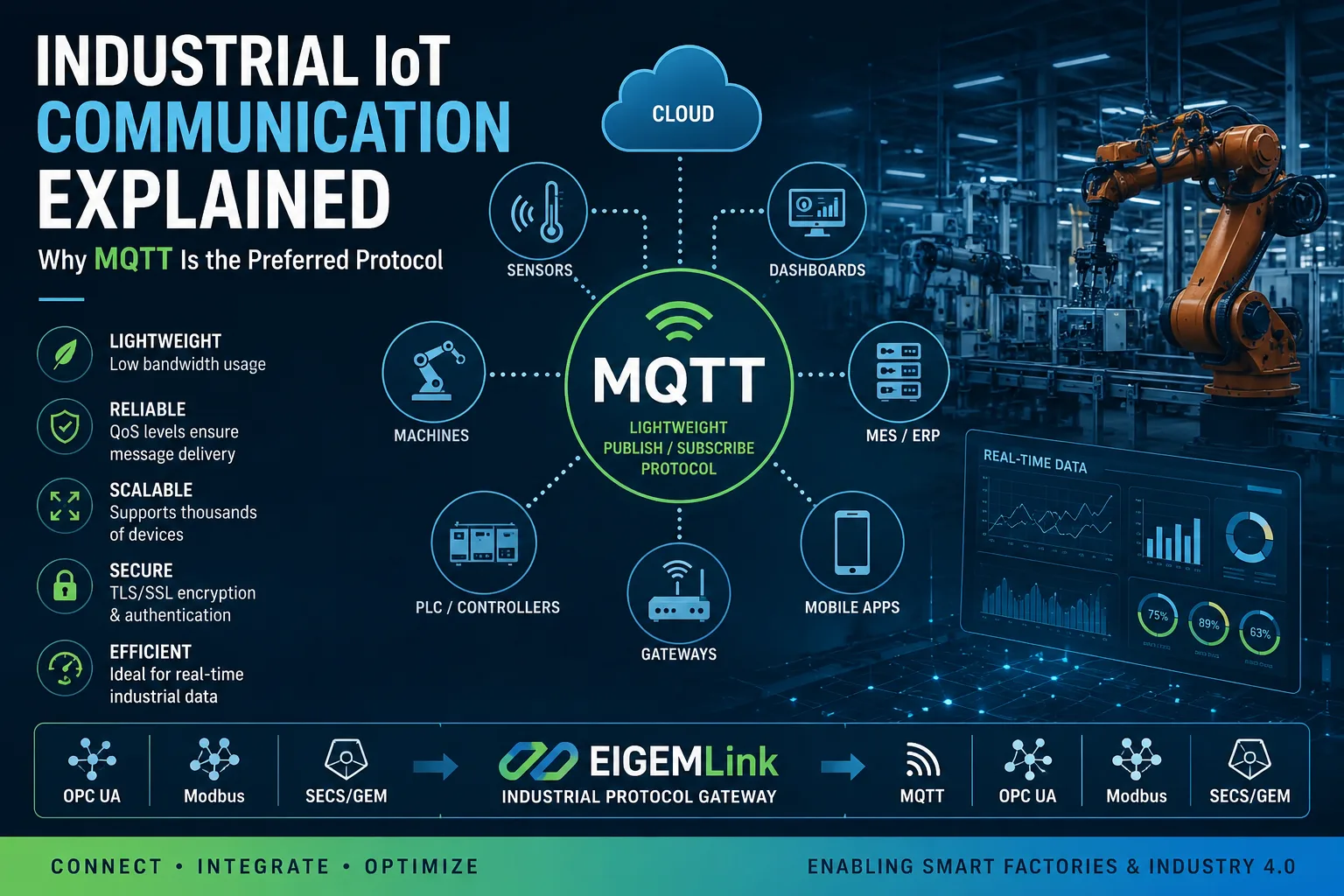
Semiconductor fabs run on data. Every etch chamber, wafer handler, and MES terminal is constantly generating telemetry that engineers need in near real time to keep yield high and downtime low. The challenge isn’t generating this data — it’s moving it reliably, securely, and efficiently across a plant floor that mixes decades-old PLCs with modern edge gateways and cloud analytics platforms.
This is where MQTT (Message Queuing Telemetry Transport) has become the de facto standard for industrial IoT communication. Originally designed in 1999 for monitoring oil pipelines over unreliable satellite links, MQTT has evolved into the backbone protocol for Industry 4.0 deployments — including some of the most demanding environments in manufacturing: semiconductor fabs.
This article breaks down what MQTT is, why it fits industrial and semiconductor use cases so well, how it compares to alternatives like OPC UA and Modbus, and where it fits into a modern protocol gateway strategy.
What Is MQTT and Why Does It Matter for Industrial IoT?
MQTT is a lightweight, publish-subscribe messaging protocol built for constrained networks and devices. Instead of devices talking directly to each other, they communicate through a central MQTT broker, which routes messages between publishers (sensors, PLCs, gateways) and subscribers (SCADA systems, historians, MES platforms, cloud dashboards).
This publish-subscribe model is fundamentally different from the request-response pattern used by older industrial protocols. A temperature sensor on a diffusion furnace doesn’t need to know which systems care about its readings — it simply publishes to a topic like fab1/furnace3/temperature, and any authorized subscriber (a dashboard, an alarm system, a cloud analytics engine) receives that data instantly.
For semiconductor manufacturing environments — where hundreds of tools generate continuous parametric data — this decoupled architecture removes the tangle of point-to-point integrations that traditionally made plant-floor connectivity brittle and expensive to maintain.
Why MQTT Fits Semiconductor and Industrial Automation So Well
1. Minimal Bandwidth and Overhead
MQTT headers are as small as two bytes, making it ideal for edge devices, wireless sensors, and bandwidth-constrained fab networks where hundreds of tools are streaming data simultaneously.
2. Built-In Quality of Service (QoS)
MQTT offers three QoS levels — from “fire and forget” to guaranteed exactly-once delivery. Fab engineers can assign higher QoS to critical alarms (chamber over-temperature, gas leak detection) while using lightweight QoS for routine telemetry, balancing reliability with network load.
3. Resilience on Unstable Networks
MQTT’s “last will and testament” feature notifies subscribers automatically if a device disconnects unexpectedly — critical for detecting a failed sensor or gateway before it becomes a yield or safety issue.
4. Natural Fit for Edge Computing
MQTT brokers can run at the edge — inside a fab, on a local gateway — filtering, aggregating, and forwarding only relevant data upstream to MES or cloud systems. This reduces cloud ingestion costs and latency while keeping raw data available locally for real-time control decisions.
5. Scales From One Sensor to Thousands
Because MQTT decouples publishers from subscribers, adding a new tool, sensor, or analytics consumer doesn’t require rewiring existing integrations — a major advantage as fabs expand automation and add new equipment over time.
MQTT vs OPC UA: Which Should You Use?
This is one of the most common questions from controls engineers and automation teams. The honest answer: they solve different problems, and most mature architectures use both.
- OPC UA excels at semantic data modeling — it describes not just a value, but what that value means, its data type, its relationships to other objects, and often includes built-in security and discovery services. It’s commonly used for structured, contextualized data exchange between PLCs, HMIs, and MES systems.
- MQTT excels at lightweight, high-volume, distributed messaging — especially across WANs, cloud connections, and edge-to-cloud pipelines.
In practice, many Industry 4.0 architectures use OPC UA at the machine/PLC level for rich, structured data, and MQTT to transport that data efficiently across the plant and up to enterprise or cloud systems. The two protocols are increasingly used together rather than as competitors, particularly through the OPC UA PubSub over MQTT specification.
MQTT vs Modbus: Legacy Meets Modern
Modbus remains widely deployed on legacy PLCs and instrumentation, especially older fab tools. But Modbus is a request-response protocol with no native security, no publish-subscribe model, and limited scalability for large sensor networks.
The common pattern in brownfield semiconductor facilities is to use a protocol gateway that polls legacy Modbus (or SECS/GEM) equipment and republishes that data as MQTT topics — giving old equipment a modern, scalable data interface without costly hardware replacement.
MQTT in Semiconductor Manufacturing: A Practical Example
Consider a fab running SECS/GEM-based equipment alongside newer MQTT-native sensors and edge devices. A typical data flow looks like this:
- Equipment layer — Wafer processing tools communicate via SECS/GEM, Modbus, or proprietary protocols.
- Gateway layer — A protocol gateway translates SECS/GEM, OPC UA, and Modbus data into standardized MQTT topics.
- Broker layer — An MQTT broker (on-prem or cloud) manages topic routing, security, and QoS enforcement.
- Consumption layer — MES systems, SPC dashboards, predictive maintenance models, and cloud analytics platforms subscribe to the relevant topics.
This architecture allows fab engineers, MES teams, and automation engineers to unify data across legacy and modern equipment without ripping out working tools — a critical requirement in an industry where equipment lifecycles often exceed a decade.
Choosing the Right MQTT Broker and Gateway Strategy
Selecting an MQTT broker (HiveMQ, EMQX, Eclipse Mosquitto, or a cloud-native option like AWS IoT Core) is only part of the equation. The harder problem for most semiconductor OEMs and fab engineering teams is getting legacy and mixed-protocol equipment onto MQTT in the first place — without custom-coding a translator for every tool on the floor.
This is exactly the gap a dedicated industrial protocol gateway is designed to close: translating between MQTT, OPC UA, Modbus, and SECS/GEM in a single, configurable layer, so engineering teams can standardize on MQTT for downstream consumption without re-engineering their equipment layer.
Security Considerations for MQTT in a Fab Environment
Bringing plant-floor data onto an IP-based, publish-subscribe network raises legitimate security questions for manufacturing IT managers and controls engineers, especially in semiconductor environments where IP protection is as critical as uptime. A production-grade MQTT deployment should include:
- TLS encryption for all broker connections, both from edge devices and downstream consumers.
- Client authentication via certificates or credentials, rather than open/anonymous broker access.
- Topic-level access control (ACLs) so a given client can only publish or subscribe to the topics relevant to its role — a wafer-handling robot shouldn’t be able to read MES scheduling data, for example.
- Network segmentation, keeping the MQTT broker and OT equipment isolated from general corporate IT traffic, typically via an industrial DMZ.
- Broker-level auditing and logging, so security and IT teams can trace who published or subscribed to what, and when.
These aren’t optional extras — they’re the difference between a pilot project and a production deployment that a global fab’s IT and security teams will actually approve.
Final Thoughts
MQTT has become the preferred communication protocol for industrial IoT because it solves the core problem manufacturers actually have: moving high volumes of equipment data efficiently, reliably, and securely across mixed, distributed, and often unreliable networks. For semiconductor fabs specifically — where legacy SECS/GEM tools, Modbus instrumentation, and modern OPC UA-enabled equipment all coexist — MQTT provides the connective tissue that makes Industry 4.0 initiatives practical rather than theoretical.
The real unlock, however, isn’t picking MQTT in isolation — it’s building a gateway strategy that lets MQTT, OPC UA, Modbus, and SECS/GEM work together across your equipment fleet. That’s where a purpose-built industrial protocol gateway like EIGEMLink fits in, giving fab and automation engineers a single integration layer to unify their plant-floor communication without disrupting existing operations.


