
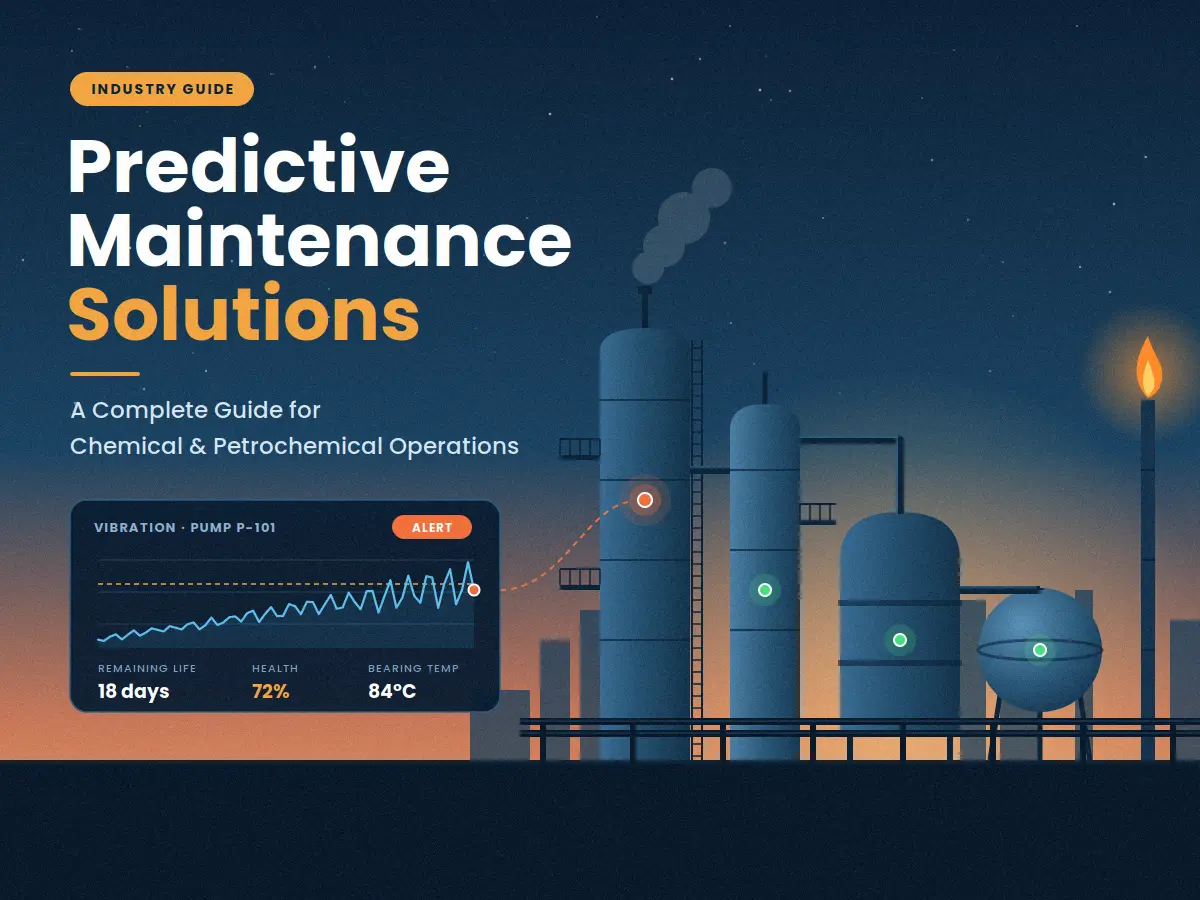
Petrochemical predictive maintenance helps plants spot equipment problems before they turn into shutdowns. In a refinery or chemical plant, one failed pump or compressor can stop production, create safety risks, and drive up costs quickly. Traditional maintenance often misses the early warning signs. Predictive maintenance solutions close that gap with sensors, AI, and analytics. This guide explains how the approach works, where it delivers value, and how to get started.
What Is Petrochemical Predictive Maintenance?
Petrochemical predictive maintenance is a data-driven strategy. It tracks the real condition of equipment and predicts when a fault is likely to occur. Teams can then schedule repairs at the right time, not too early and not too late.
It differs from two older approaches. Reactive maintenance fixes assets after they fail. Preventive maintenance follows a fixed calendar, whether or not the asset needs service. Predictive maintenance, by contrast, relies on live condition data. As a result, work happens only when the evidence supports it.
For plant managers and reliability engineers, this means fewer surprises and better use of limited maintenance hours.
Why Petrochemical Predictive Maintenance Matters for Chemical Plants
Chemical and petrochemical plants run under tough conditions. Equipment faces high pressure, extreme temperatures, corrosive fluids, and continuous duty cycles. Moreover, many sites operate around the clock, so every hour of downtime is costly.
Several pressures make predictive maintenance especially relevant:
- Safety and compliance: Failures can cause leaks, fires, or environmental incidents. Regulators in the USA and Europe expect strong asset integrity programs.
- Unplanned downtime: One failed asset can halt an entire process line.
- Ageing assets: Many facilities still run equipment that is decades old.
- Skills gap: Experienced technicians are retiring, so teams need data to support decisions.
- Cost control: Time-based servicing often replaces healthy parts and wastes budget.
Because of these factors, predictive maintenance analytics have become a core reliability tool rather than a nice-to-have. You can also explore how einnosys supports chemical and petrochemical operations.
How Petrochemical Predictive Maintenance Works
The process follows five clear steps.
- Collect data. Sensors measure vibration, temperature, pressure, flow, current, and acoustic signals on critical equipment.
- Connect and store. Data moves from the plant floor to a central platform. Historians, SCADA, and CMMS systems often feed the same platform.
- Analyze patterns. Algorithms compare live readings with healthy baselines and detect anomalies.
- Predict failures. Machine learning models estimate the remaining useful life of a component.
- Take action. The system sends alerts and recommends maintenance tasks to the right team.
Each step matters. For example, poor data quality leads to weak predictions, so plants should validate their sensors early.
Core Technologies Behind AI Predictive Maintenance
Four building blocks power a modern program.
- Sensors and IoT
Condition monitoring sensors capture the raw signals. Wireless options make it easier to monitor hard-to-reach assets and hazardous areas. - AI and Machine Learning
AI predictive maintenance learns the normal behavior of each asset. Then it flags subtle changes that people might overlook. Furthermore, AI-based predictive maintenance improves over time as models see more failure patterns. - Analytics and Dashboards
Predictive maintenance analytics turn raw data into health scores, trends, and alerts. Clear dashboards let managers see risk across the whole plant at a glance. - Predictive Maintenance Software
Predictive maintenance software ties everything together. It manages data, runs models, and connects to work-order systems. Plants that already use chemical manufacturing software can often integrate it for a unified view.
Which Equipment Benefits Most From Industrial Predictive Maintenance?
Industrial predictive maintenance works best on critical rotating and process equipment, such as:
- Pumps
- Compressors
- Motors and fans
- Turbines and gearboxes
- Heat exchangers and valves
Predictive maintenance for industrial equipment delivers the highest return on assets that are costly, dangerous, or slow to repair. Pumps are a strong starting point. They appear throughout petrochemical plants, and they show clear failure signs such as bearing wear, cavitation, and misalignment. Equipment predictive maintenance on pumps therefore often serves as the first pilot.
Key Benefits of Petrochemical Predictive Maintenance
When plants apply petrochemical predictive maintenance well, they typically see these gains:
- Less unplanned downtime: Early alerts give teams time to plan repairs.
- Lower maintenance costs: Crews service assets based on condition, not the calendar.
- Longer asset life: Small faults get fixed before they cause secondary damage.
- Improved safety: Fewer sudden failures mean fewer hazardous events.
- Better planning: Teams order spare parts and schedule labor with more confidence.
In short, the approach moves maintenance from firefighting to planning.
Common Challenges and How to Overcome Them
Adoption is not always simple. However, most obstacles have practical fixes.
- Data silos: Connect historians, SCADA, and maintenance systems on one platform.
- Limited sensor coverage: Start with the most critical assets, then expand.
- Low trust in alerts: Run a pilot, validate each alert, and share the results with technicians.
- Change resistance: Involve maintenance teams early and show quick wins.
- Cybersecurity: Use secure architectures that respect OT network boundaries.
Success depends as much on people and process as on technology.
How xPump Supports Pump Reliability
Pumps are the backbone of most petrochemical processes, so pump health deserves special attention. xPump is an AI-driven pump monitoring solution built to detect early signs of pump degradation. It analyzes condition data, highlights abnormal behavior, and helps teams plan maintenance before a failure occurs. As a result, reliability teams gain earlier warnings and clearer priorities.
Ready to see it in action? Discover xPump and learn how it fits your operation.
Conclusion
Petrochemical predictive maintenance gives plants a smarter way to protect critical assets. By combining sensors, AI, and analytics, teams reduce downtime, improve safety, and control costs. The best results come from a focused pilot, clean data, and strong team buy-in.
einnosys helps chemical and petrochemical operators put these ideas into practice with proven predictive maintenance solutions and xPump. Ready to take the next step? Explore Predictive Maintenance Solutions or talk to our team to build a more reliable plant.


