
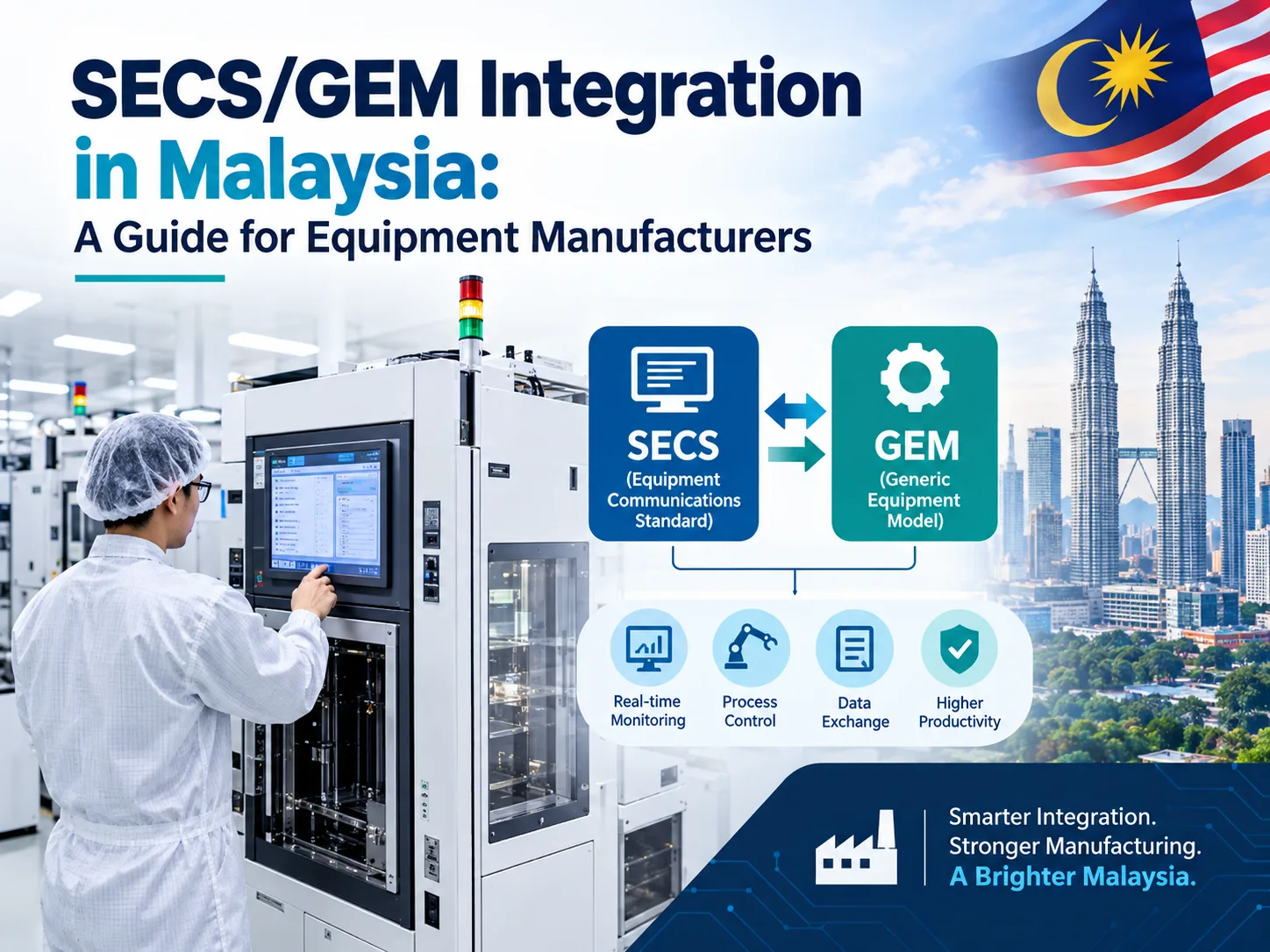
Semiconductor fabs and back-end facilities expect every tool to talk to the factory. They want equipment status, alarms, events, and recipes to flow into host systems without manual transcription. An OEM that cannot offer standardized equipment-to-host communication may struggle to qualify tools for these environments.
SECS/GEM is the communication framework most semiconductor factories use for this purpose. Implemented well, it helps OEMs meet the integration requirements their customers specify. This guide explains how SECS/GEM integration in Malaysia works for equipment manufacturers, which approaches exist, and how to choose between them.
Why SECS/GEM Integration Matters for Equipment Manufacturers in Malaysia
Customer factories increasingly specify host connectivity in purchase requirements. An OEM that prepares equipment early can avoid late-stage rework during commissioning.
Standardized communication supports:
- Communication between equipment and factory host systems
- Equipment status and event reporting
- Alarm monitoring
- Recipe transfer, where supported
- Integration with MES
- Easier connection into automated manufacturing workflows
Together, these capabilities make equipment easier to integrate into a customer’s production environment.
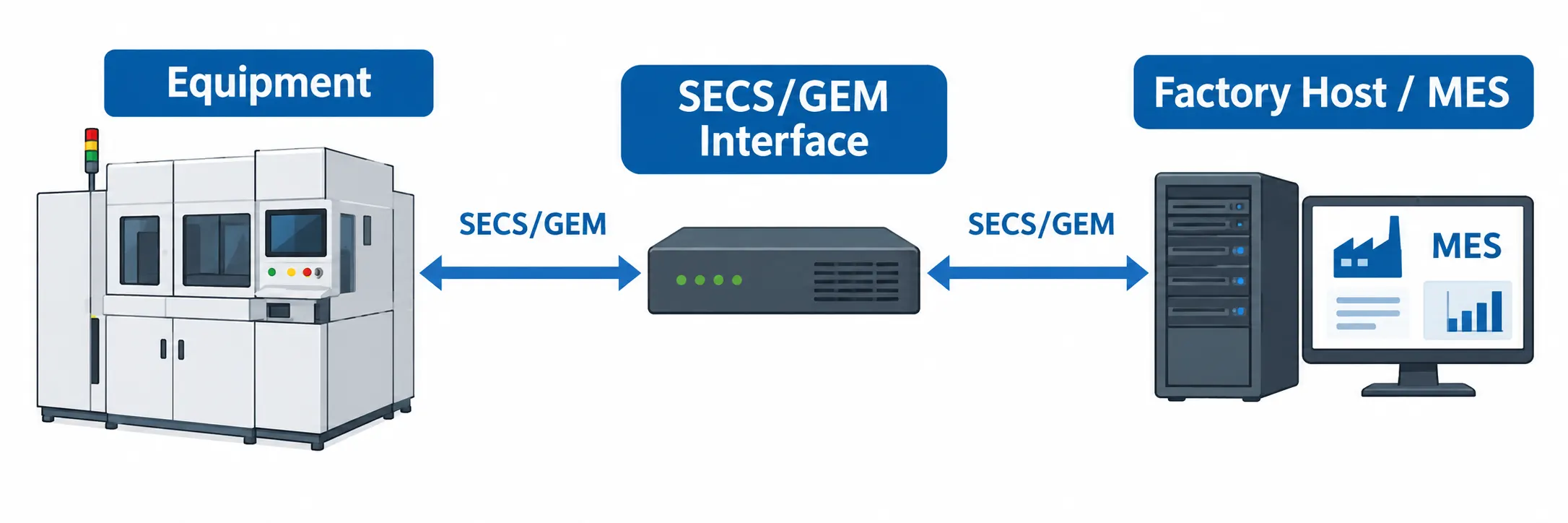
Understanding SECS/GEM, SECS-II, and HSMS
Three terms often appear together, but each does a different job:
- SECS-II defines the messages exchanged between equipment and host systems.
- HSMS carries SECS messages over TCP/IP.
- GEM defines equipment behavior, including status reporting, events, alarms, and remote-control capabilities.
Which parts you must implement depends on the applicable SEMI standards and your customer’s specification.
Common SECS/GEM Integration Challenges for Equipment OEMs
Requirements differ by equipment design, customer expectations, and factory architecture. OEMs commonly face these challenges:
- Developing SECS/GEM functionality for new equipment
- Connecting PLC/HMI-based equipment
- Integrating legacy tools with limited interfaces
- Handling different customer host requirements
- Validating communication before delivery
- Supporting alarms, events, status variables, and recipes
- Maintaining integration across multiple equipment models
Software-Based vs. Hardware-Based SECS/GEM Integration
A software-based approach embeds an SDK or software layer in the equipment’s own software. A hardware-based approach adds an external connectivity unit. Neither suits every machine.
| Factor | Software-Based Integration | Hardware-Based Integration |
|---|---|---|
| Implementation | Uses an SDK or software layer integrated into equipment software. | Uses an external connectivity unit connected to the equipment. |
| Suitable Equipment | New equipment and tools with accessible controllers or PLC/HMI data. | Existing equipment where software modifications are impractical. |
| Legacy Integration | Depends on access to controller software and available interfaces. | Depends on the hardware unit and available equipment interfaces. |
| Development Effort | May require software development, configuration, and testing. | Requires installation, configuration, and communication testing. |
| Maintenance | Managed alongside the equipment software. | Managed separately for each connected unit and deployment. |
| Selection Criteria | Software access, flexibility, and OEM development resources. | Equipment interfaces, installation constraints, and integration requirements. |
Software-based integration usually fits when you control the controller software. Hardware-based integration usually fits when changing that software is impractical or the tool is already in the field.
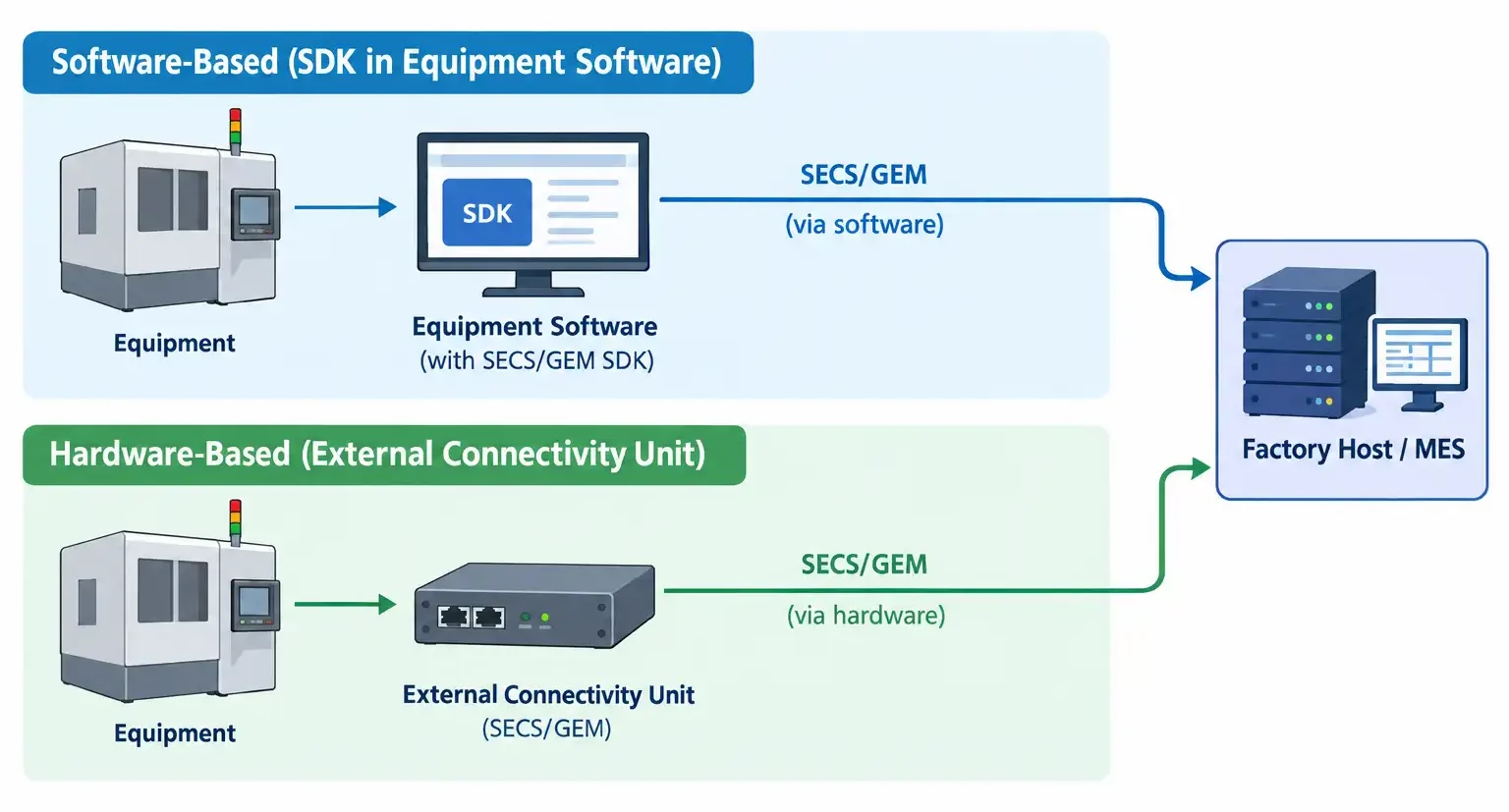
Two eInnoSys options map to these paths. EIGEMEquipment is an SDK for new equipment. EIGEMBox is a plug-and-play unit for legacy tools.
Step-by-Step SECS/GEM Integration Process
A structured process reduces surprises at commissioning:
- Assess the equipment: Identify the controller, operating software, PLC/HMI interfaces, and existing communication capabilities.
- Define host requirements: Confirm applicable SEMI standards, customer specifications, and required host functions.
- Select the integration approach: Evaluate software-based integration, an external hardware solution, or another suitable interface.
- Configure communication: Set up the supported SECS/GEM messages, communication parameters, and required equipment functions.
- Test host communication: Validate message exchange, events, alarms, status variables, and supported remote commands.
- Validate integration: Confirm that communication meets agreed requirements before deployment.
- Plan ongoing support: Document the implementation and set up a maintenance and update process.
Actual steps vary with equipment architecture and customer acceptance criteria. A SECS/GEM simulator such as EIGEMSim can help with the testing steps.
How SECS/GEM Integration Supports MES and Smart Fab Automation
Once equipment speaks a standard language, factory systems can use its data. Equipment communication can support:
- Automated equipment data collection
- Production monitoring
- Host-based alarm visibility
- Recipe management, where supported
- Factory-level equipment integration
- Clearer visibility into equipment status
SECS/GEM provides the equipment communication layer. The MES and other factory systems manage the broader manufacturing workflow. For background, see eInnoSys’s introduction to SECS/GEM.
Common Integration Challenges and Practical Solutions
| Integration Challenge | Impact | Potential Approach |
|---|---|---|
| Equipment Lacks a Host Interface | Manual data collection and limited equipment visibility. | Assess suitable external connectivity or software-bridging options. |
| PLC/HMI-Only Equipment | Equipment data may remain limited to local screens. | Bridge accessible controller data into supported SECS/GEM messages. |
| Different Equipment Configurations | Inconsistent integration requirements across equipment models. | Define reusable communication specifications where appropriate. |
| Host Communication Issues | Delays during commissioning and integration testing. | Test message exchange and equipment behavior before deployment. |
| Alarm and Event Gaps | Limited host awareness of equipment status and issues. | Configure and validate supported event and alarm reporting. |
How eInnoSys Supports SECS/GEM Integration
eInnoSys develops SECS/GEM and GEM300 software and integration solutions for semiconductor equipment manufacturers and factories. Its SECS/GEM solution for non-GEM equipment page covers tools that lack native host communication.
Conclusion
SECS/GEM integration helps equipment manufacturers prepare tools for semiconductor factory connectivity. Whether you build communication into new controllers or retrofit existing tools, the right approach follows from your equipment architecture, host requirements, and customer specifications.
For OEMs weighing SECS/GEM integration in Malaysia, start by assessing the tool and the customer requirements. Then choose the approach that fits and validate it before shipment.


