
In semiconductor manufacturing, reliable communication between equipment and factory systems is non-negotiable. The SECS/GEM protocol—based on SEMI standards such as E5 (SECS-II), E30 (GEM), and E37 (HSMS-SS)—is the backbone of this connectivity. But implementing SECS/GEM isn’t enough; proper testing is essential to ensure equipment behaves as expected and integrates seamlessly with Manufacturing Execution Systems (MES) or automation platforms. This blog explores the tools and best practices that make SECS/GEM protocol testing straightforward and effective.
Why SECS/GEM Protocol Testing Matters
SECS/GEM defines how equipment communicates process data, alarms, events, and recipes to host systems. Without rigorous testing, mismatches in CEIDs (Collection Event IDs), SVIDs (Status Variables), or message formatting can disrupt production. Testing ensures:
- Compliance with SEMI standards.
- Reliable equipment-to-host communication.
- Faster MES and factory automation integration.
- Prevention of costly downtime during production.
In short, testing reduces risk and builds confidence that both OEMs and fabs can achieve smooth SECS/GEM equipment connectivity.
Challenges in SECS/GEM Testing
Before diving into solutions, it’s important to recognize common pitfalls:
Message Parsing Errors – Incorrectly formatted SECS-II messages that fail host validation.
Alarm/Event Issues – CEIDs or alarms not triggered or mapped properly.
Timing & Latency – Delays in HSMS message exchanges.
Legacy Equipment – Older tools may not support GEM fully, requiring additional validation layers.
A structured approach to testing helps overcome these hurdles.
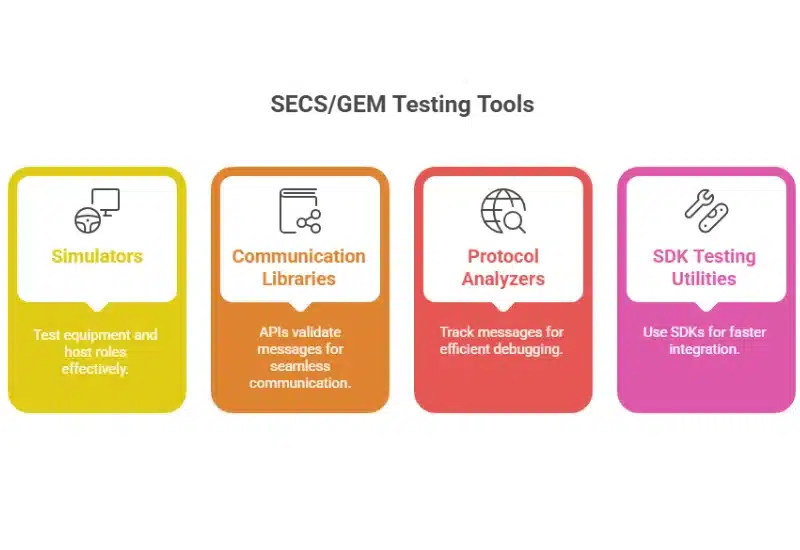
Essential Tools for SECS/GEM Protocol Testing
Testing is simplified with the right set of tools. Key categories include:
SECS/GEM Simulators
- Allow developers to emulate both equipment and host behavior.
- Useful for validating new equipment before deployment.
SECS/GEM Communication Libraries
- Provide APIs for building and validating SECS-II messages.
- Support integration with test automation frameworks.
Protocol Analyzers & Loggers
- Capture SECS-II/HSMS traffic in real time.
- Help debug communication mismatches between host and equipment.
SECS/GEM SDKs & Development Toolkits
- Offer utilities, drivers, and sample applications.
- Enable rapid SECS GEM protocol implementation and validation.
These tools ensure engineers can replicate both normal and abnormal operating conditions, reducing surprises during factory integration.
Best Practices for SECS/GEM Testing
To make SECS/GEM testing efficient, follow these proven practices:
Validate Standards Compliance
Confirm the equipment adheres to SEMI E5, E30, and E37 requirements before moving forward.
Test Both Happy Paths and Error Conditions
Simulate disconnects, timeouts, and invalid message formats to ensure resilience.
Verify Core Data Structures
Check CEIDs, SVIDs, PPIDs (process program IDs), and alarm handling thoroughly.
Automate Regression Tests
Use scripting with a SECS/GEM integration SDK or SECS GEM driver to repeat test cases consistently.
Perform Stress & Load Testing
Ensure the system can handle high-volume SECS-II messages without performance degradation.
By combining manual validation with automated scripts, engineers can cover both depth and breadth of testing. Consider a fab preparing to connect new etching equipment to its MES. Using a SECS/GEM interface software with simulator and analyzer tools, the automation team tested CEIDs, alarms, and recipe transfers weeks before deployment. As a result, integration took only days instead of weeks, saving time and reducing production risk.
This case highlights how SECS GEM development toolkits and testing utilities accelerate factory automation projects.


