
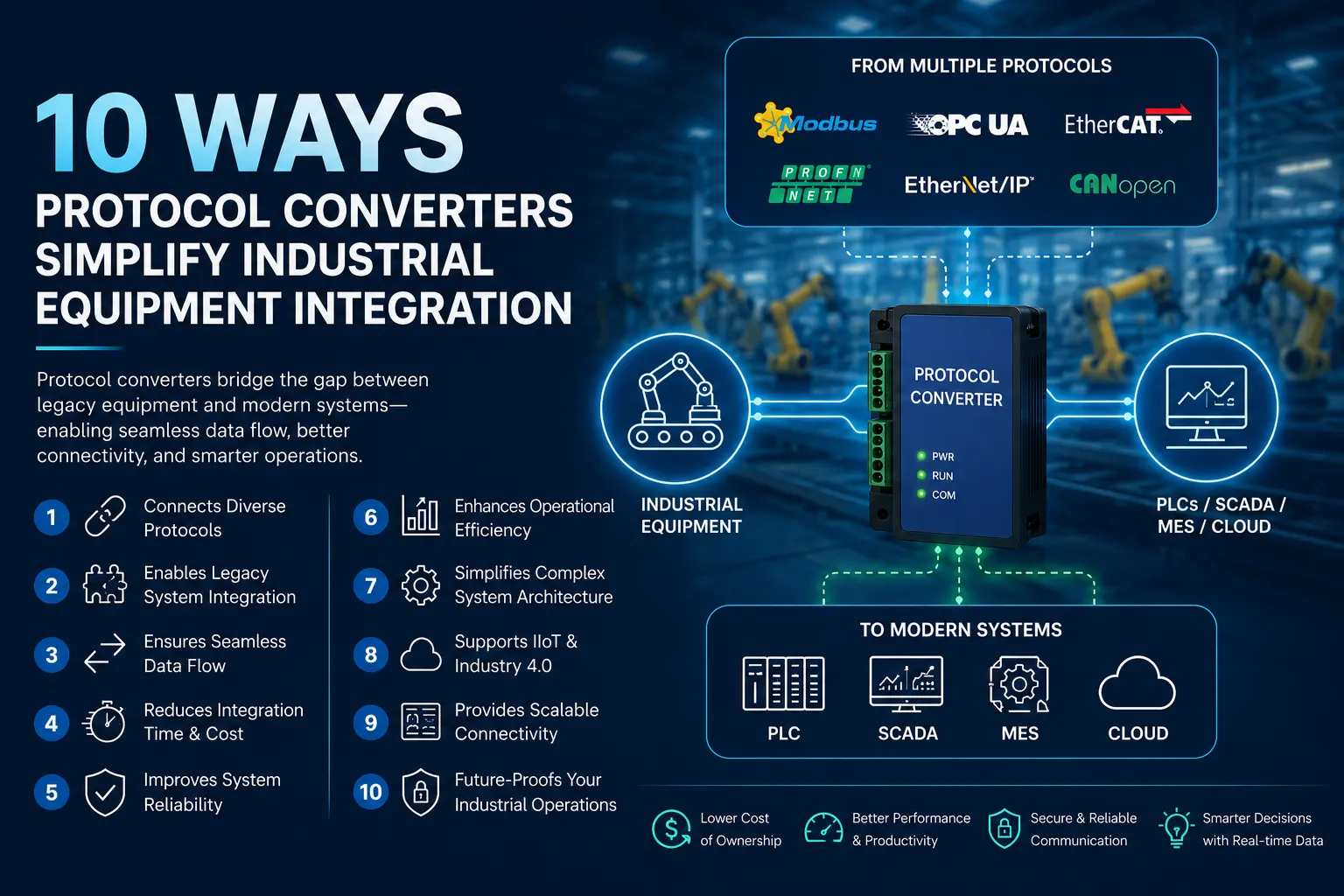
Walk onto almost any semiconductor fab floor, OSAT line, or SMT facility today and you’ll find a patchwork of communication protocols running underneath the equipment: OPC UA on one tool, Modbus TCP on another, EtherCAT on a robotic handler, Profinet on a legacy PLC-driven station. Each protocol was a reasonable choice for the controller it was built around — but none of them, on their own, speak the language a fab host or MES actually needs: SECS/GEM.
This is the integration problem that industrial protocol converters exist to solve. Rather than re-engineering equipment controllers or writing bespoke communication code for every tool on the floor, a protocol converter sits between the equipment’s native interface and the factory’s SECS/GEM-based host system, translating data, events, and commands in both directions. For fabs, OSATs, and equipment OEMs trying to hit Industry 4.0 and smart-manufacturing goals without a multi-year software rebuild, that translation layer has become indispensable.
Below are ten concrete ways a well-built protocol converter — such as EIGEMLink, a multi-protocol-to-SECS/GEM conversion platform — simplifies industrial equipment integration in practice.
Walk onto almost any semiconductor fab floor, OSAT line, or SMT facility today and you’ll find a patchwork of communication protocols running underneath the equipment: OPC UA on one tool, Modbus TCP on another, EtherCAT on a robotic handler, Profinet on a legacy PLC-driven station. Each protocol was a reasonable choice for the controller it was built around — but none of them, on their own, speak the language a fab host or MES actually needs: SECS/GEM.
This is the integration problem that industrial protocol converters exist to solve. Rather than re-engineering equipment controllers or writing bespoke communication code for every tool on the floor, a protocol converter sits between the equipment’s native interface and the factory’s SECS/GEM-based host system, translating data, events, and commands in both directions. For fabs, OSATs, and equipment OEMs trying to hit Industry 4.0 and smart-manufacturing goals without a multi-year software rebuild, that translation layer has become indispensable.
Below are ten concrete ways a well-built protocol converter — such as EIGEMLink, a multi-protocol-to-SECS/GEM conversion platform — simplifies industrial equipment integration in practice.
1. It Eliminates the Need for Custom Protocol Development
The traditional path to SECS/GEM connectivity for a non-native tool is custom software: an engineer maps the equipment’s OPC tags, Modbus registers, or PLC data blocks to SECS/GEM variables by hand, then builds and tests a bespoke bridge. That work is slow, expensive, and has to be repeated for every new equipment type.
A dedicated protocol converter replaces that from-scratch effort with a configurable platform that already understands both sides of the conversation. Instead of writing a translator, integration engineers configure one — mapping data points through a structured interface rather than through custom code. The result is the same SECS/GEM compliance outcome, achieved without the engineering overhead of a one-off build.
2. It Bridges Multiple Protocols Through a Single Platform
Most fabs don’t have a single-protocol problem — they have a protocol sprawl problem. One tool speaks OPC DA, another streams data over MQTT, a third relies on Modbus RTU, and a fourth uses EtherCAT for high-speed motion control. Historically, each of these required a separate integration effort.
A universal protocol converter consolidates this into one platform capable of handling OPC DA/UA, MQTT, Modbus RTU/TCP, EtherCAT, Profinet, and standard Ethernet connections simultaneously. Rather than maintaining five different point solutions (and five different sets of institutional knowledge), integration teams manage one system with a consistent configuration approach across every protocol it supports.
3. It Extends the Life of Legacy Equipment
Semiconductor and electronics manufacturing equipment often stays in production for 10–20 years — far longer than the software ecosystem around it. A tool built with an older PLC or a proprietary Modbus interface isn’t obsolete on the process side; it’s simply speaking a language the modern factory network doesn’t natively understand.
Protocol converters let that equipment participate in a SECS/GEM-based factory without a controller replacement or a capital equipment swap. Legacy PLCs, older HMIs, and equipment with fixed native protocols gain a path into modern MES and host systems, which turns “replace the tool” into “connect the tool” — a materially different cost equation for fab operations teams.
4. It Shrinks Integration Timelines from Months to Minutes
Custom SECS/GEM interface development — particularly for equipment that wasn’t designed with SECS/GEM in mind — commonly takes weeks to months per tool: protocol analysis, mapping, coding, testing, and factory acceptance validation all stack up before a machine is host-ready.
A configuration-driven protocol converter compresses this dramatically. With pre-built protocol handlers already in place, the remaining work is largely limited to data-point mapping and equipment-model configuration — a process that a well-designed platform can walk an engineer through in well under an hour for a straightforward tool, rather than the multi-week cycle a from-scratch build would require.
5. It Reduces the Need for Deep SECS/GEM Expertise on Every Project
SECS/GEM (built on SEMI E5, E30, and E37, among other standards) has a steep learning curve. State models, collection events, alarm handling, and message structures (SxFy) take real time to master, and equipment integration engineers are not always SECS/GEM specialists — many come from a controls, PLC, or automation background instead.
A mature protocol converter absorbs that specification-level complexity into the platform itself. The engineer configuring the system works with source-side concepts they already know — OPC tags, Modbus registers, MQTT topics — while the SECS/GEM compliance layer is handled behind the interface. That doesn’t eliminate the value of SECS/GEM expertise, but it does mean a project doesn’t stall waiting for a specialist to be available.
6. It Supports Real-Time, Bidirectional Data Exchange
Factory host systems don’t just collect data — they issue recipe downloads, remote commands, and equipment control instructions that need to reach the tool reliably and quickly. A protocol converter needs to handle both directions of this conversation: equipment status, alarms, and event data flowing up to the host, and recipe or control commands flowing back down to the equipment.
Protocol-specific capabilities matter here — OPC’s subscription-based data access, MQTT’s publish/subscribe model and QoS handling, Modbus’s register read/write functions, EtherCAT’s cyclic synchronization — and a well-built converter handles each protocol’s native mechanics while presenting a consistent SECS/GEM interface on the host side.
7. It Enables GEM300 and 200mm/300mm Compliance Without a Rebuild
Advanced fabs increasingly require GEM300-level compliance (SEMI E40, E87, E90, and related standards) covering carrier management, substrate tracking, and equipment performance data — a considerably more demanding standard than baseline GEM. Retrofitting an existing tool to meet these requirements through custom development is a significant undertaking.
A protocol conversion platform built with GEM300 support in mind lets equipment meet these deeper compliance requirements through configuration rather than a ground-up software project, which matters enormously for fabs standardizing 200mm or 300mm operations across a mixed equipment fleet from multiple vendors and vintages.
8. It Lowers Long-Term Maintenance Overhead
Every custom-built protocol bridge is, in effect, a small software product that someone now owns indefinitely — patched when a SEMI standard revision lands, updated when a host interface spec changes, debugged when an edge case surfaces on the floor. Multiply that across a dozen custom bridges for a dozen different tool types, and maintenance becomes a standing tax on engineering capacity.
Consolidating onto a single protocol conversion platform concentrates that maintenance burden in one place instead of many. Updates, compliance changes, and bug fixes apply once, across the platform, rather than requiring a separate maintenance cycle for every bespoke integration a facility has accumulated over the years.
9. It Creates Vendor Independence Across a Mixed Equipment Fleet
Fabs and OSATs rarely run equipment from a single OEM. A protocol converter that supports multiple industrial protocols means the factory network doesn’t care whether a given tool’s controller came from one automation vendor or another — the conversion layer normalizes all of it into consistent SECS/GEM communication.
That vendor independence gives operations and automation teams more flexibility in equipment purchasing decisions going forward. Instead of integration cost being a hidden factor that favors one controller ecosystem over another, connectivity becomes a solved problem regardless of which vendor’s hardware sits on the floor.
10. It Future-Proofs the Factory Network as Protocols Evolve
Industrial communication standards are not static. MQTT and OPC UA usage keeps expanding as IIoT and cloud-connected analytics platforms mature; new equipment increasingly ships with different native interfaces than the fleet already installed. A factory that has built its SECS/GEM connectivity around a single hard-coded protocol assumption is poorly positioned when the next generation of tools arrives speaking something new.
A protocol converter designed to add new source protocols over time gives the factory a growth path instead of a wall. As automation platforms evolve, the conversion layer absorbs new protocol support without requiring the host-side SECS/GEM architecture to change at all — insulating the MES and host investment from churn on the equipment side.
Where This Fits in a Broader Integration Strategy
Protocol converters aren’t a replacement for SECS/GEM expertise or a substitute for a real integration strategy — they’re an accelerant. They work best as part of a broader approach that includes proper equipment-model design, host interface specification review, and validation against real fab conditions rather than simulator-only testing.
They’re also not the only path to equipment connectivity. Fabs bringing in truly non-GEM equipment, equipment OEMs building SECS/GEM in at the design stage, and facilities managing complex GEM300 carrier flows may combine a protocol converter with other tools — a native SECS/GEM SDK, a station controller, or a recipe management layer — depending on what the equipment fleet actually needs.
The Practical Case for a Platform Approach
The common thread across all ten points above is that protocol conversion turns a recurring custom-engineering problem into a repeatable, configurable one. Every tool a facility connects through a single conversion platform is one less bespoke software project, one less maintenance obligation, and one less specialist dependency standing between the equipment and a compliant, reliable connection to the factory host.
EIGEMLink was built around exactly this idea: a configurable, no-code platform that converts OPC (DA/UA), MQTT, Modbus (RTU/TCP), EtherCAT, Profinet, and standard Ethernet sources into SEMI-standard SECS/GEM communication — covering both 200mm and 300mm compliance requirements — without requiring equipment teams to write custom protocol code or become SECS/GEM specialists themselves.
For fabs, OSATs, and equipment OEMs evaluating how to connect a mixed, multi-protocol equipment fleet without a multi-year integration backlog, a protocol conversion platform is worth putting on the shortlist alongside — or ahead of — a fully custom build.
Learn more about multi-protocol SECS/GEM conversion at EIGEMLink by eInnoSys, or reach out to eInnoSys’s integration team to evaluate the right connectivity approach for your equipment fleet.


