
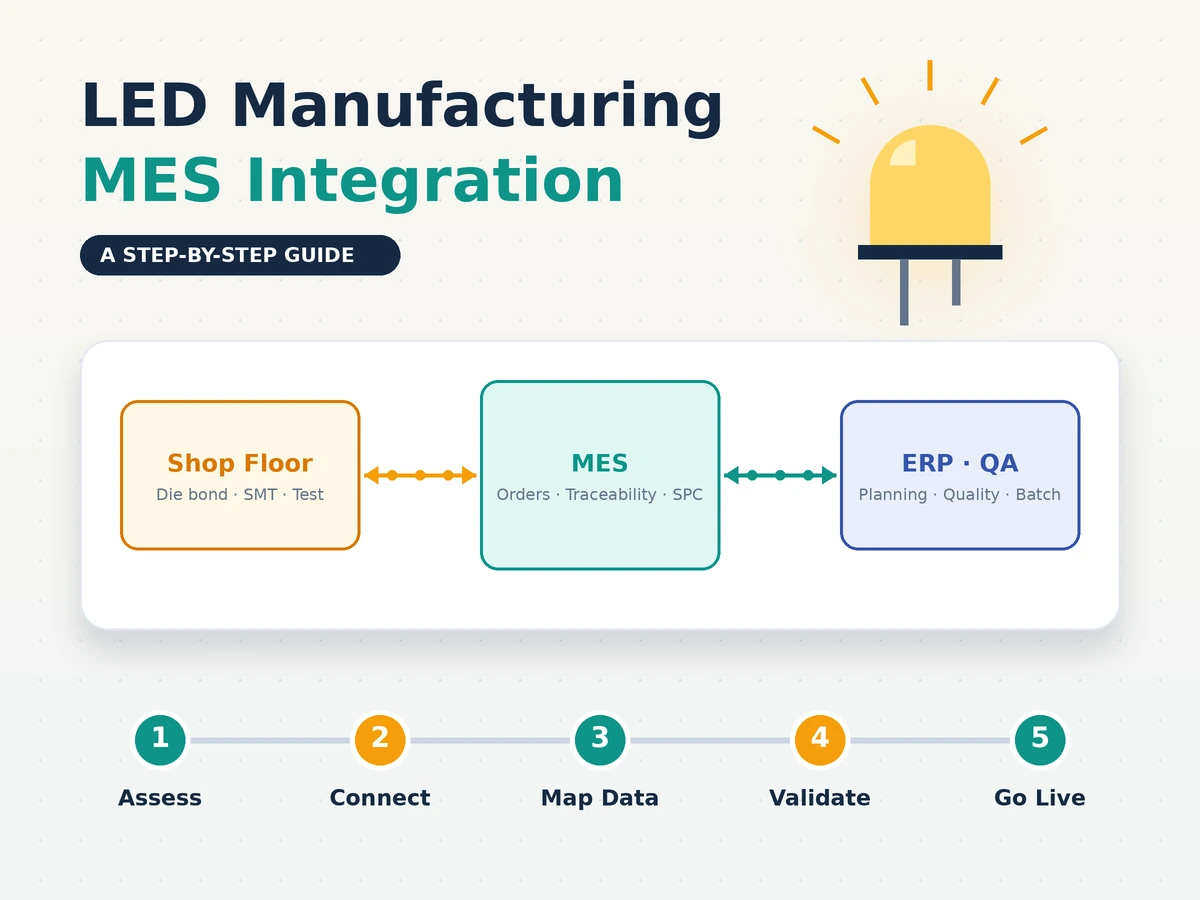
LED manufacturing MES integration connects your production equipment, quality systems and business software into one real-time data flow. For LED manufacturers competing on yield, brightness consistency and delivery speed, that connection is no longer optional. Paper logs, isolated machines and manual spreadsheets cannot keep up with tight binning tolerances, customer traceability demands and rising costs.
This guide explains what an MES does in an LED fab, why integration matters, and how to implement it in clear, practical steps.
Introduction to LED Manufacturing MES Integration
LED production is a multi-stage process: epitaxy, wafer fabrication, die sorting, die bonding, wire bonding, phosphor coating, encapsulation, testing and binning. Each stage uses specialized equipment, often from different vendors, speaking different protocols.
A LED manufacturing execution system sits between the shop floor and enterprise systems such as ERP. It tracks every lot, controls process steps and records what happened, when, and on which machine. Integration is the work of linking your equipment and software so the MES receives accurate, real-time data automatically, rather than relying on operators to key it in.
Common Challenges in LED Manufacturing
Before choosing technology, it helps to name the problems it must solve. Most LED factories face a similar set:
- Disconnected equipment: Tools from multiple generations and vendors that do not share data.
- Binning and quality variation: Small process shifts change color temperature and luminous flux, creating costly rework or scrap.
- Limited traceability: Difficulty tracing a failed LED back to the wafer, material lot, recipe or tool.
- Manual data entry: Errors, delays and gaps in production records.
- Slow root-cause analysis: Engineers spend hours collecting data instead of fixing problems.
- Compliance pressure: Automotive, lighting and display customers expect documented, auditable processes.
These issues share one root cause: data that is late, incomplete or stuck on individual machines.
What Is MES and How Does It Support LED Production?
A Manufacturing Execution System manages and monitors work-in-progress on the factory floor in real time. In LED production, an MES typically supports:
- Work order and lot management across every process step
- Recipe and process control so the right parameters run on the right tool
- Material tracking for wafers, phosphors, lead frames and substrates
- Equipment status and OEE monitoring
- Quality data collection and statistical process control (SPC)
- Genealogy and traceability from raw material to finished LED
In short, the MES turns your factory into a measurable, controllable system, which is the foundation of smart LED manufacturing.
Benefits of MES Integration in LED Manufacturing
An MES delivers its full value only when it is connected to your equipment. Integrated factories commonly aim for:
- Higher yield: Early detection of process drift reduces defective output.
- Faster throughput: Automated lot tracking removes waiting and paperwork.
- Full traceability: Instant genealogy for audits and customer complaints.
- Better equipment utilization: Real-time visibility into downtime and bottlenecks.
- Lower operating costs: Less manual effort, less rework, fewer errors.
- Data-driven decisions: Engineers and managers work from one trusted source of truth.
Results vary by factory, so set baseline metrics before you begin and measure improvement against them.
Role of Equipment Connectivity and Factory Automation
Equipment connectivity is the layer that makes LED factory automation possible. Without reliable machine data, even the best MES is blind.
The SECS/GEM standard, widely used in semiconductor and LED-related production, defines how equipment communicates status, events, alarms and recipes with a host system. Solutions that support it make integration faster and more consistent across vendors.
Einnosys offers a connected portfolio for this layer:
- Plug-and-Play Equipment Integration with EIGEMBox for fast connection of tools without deep software changes
- SECS/GEM Equipment Integration with EIGEM Equipment for standard-compliant equipment interfaces
- GEM300 Equipment Integration with EIGEM300 for advanced 300 mm style automation needs
- Equipment Connectivity Solutions with EIGEMLink for linking diverse machines to your host systems
- HMI Integration Solutions with EIGEMHMI for operator interfaces that work with the MES
- AMHS Integration Solutions with EIGEM84 for automated material handling
- SECS/GEM Simulation Software with EIGEMSim for testing interfaces before go-live
Key Features of LED Manufacturing Software
Whether you build or buy, LED manufacturing software and LED production software should offer:
- Real-time equipment data collection and event handling
- Lot genealogy and traceability across every process step
- Recipe management with version control and approvals
- SPC and quality dashboards for binning and yield analysis
- Alarm management and downtime tracking
- Open interfaces (APIs, SECS/GEM, OPC UA) for ERP and analytics tools
- Scalability from one line to multiple plants
- Security and audit trails to support customer and regulatory expectations
How to Choose the Right MES Integration Solution
Use this checklist when evaluating vendors and partners:
- Industry experience: Do they understand equipment-level integration, not just software?
- Standards support: SECS/GEM, GEM300 and common industrial protocols.
- Legacy compatibility: Can they connect older tools without replacing them?
- Testing capability: Simulation and validation tools to reduce go-live risk.
- Flexibility: Works with your chosen MES rather than locking you in.
- Support and documentation: Clear onboarding, training and long-term service.
- Total cost of ownership: Consider integration effort, maintenance and scalability, not just license price.
Conclusion
Successful LED manufacturing MES integration is a structured journey: define goals, audit your equipment, connect it reliably, integrate with enterprise systems, and improve continuously. Factories that make machine data trustworthy and available in real time gain better yield, stronger traceability and faster decisions.
Einnosys helps LED and electronics manufacturers connect equipment and enable smart factory automation through proven SECS/GEM and connectivity solutions. With the right partner, your path to a connected, data-driven LED factory becomes faster and far less risky.


