
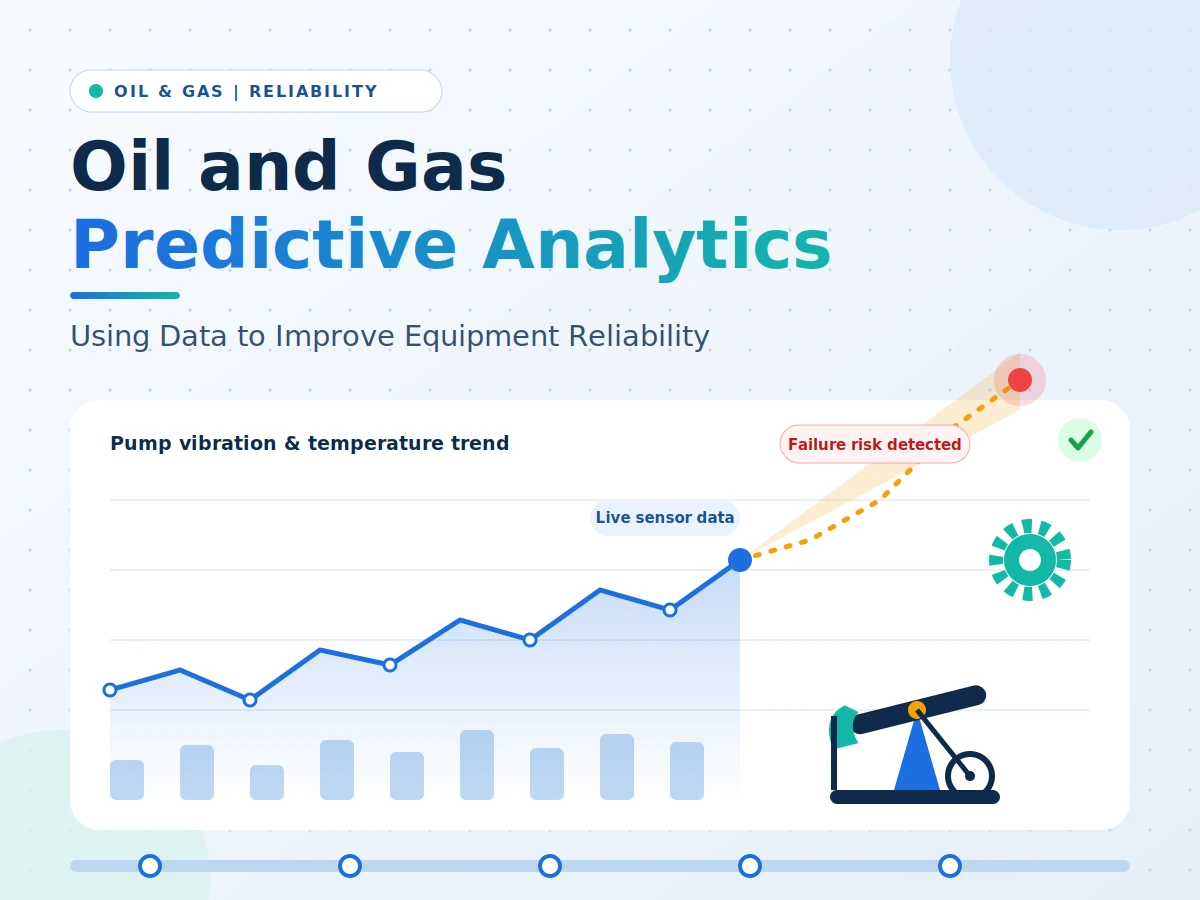
Oil and gas predictive analytics helps facilities spot equipment problems before they cause a shutdown. It combines real-time equipment data, historical records, and AI models to forecast failures early. For refinery managers and reliability engineers, that means fewer surprises and more stable operations.
Unplanned downtime is costly in this industry. A failed compressor or pump can halt production, create safety risks, and strain maintenance teams. This guide explains how predictive analytics works, where it delivers value, and how connected equipment makes it possible.
What Is Predictive Analytics in the Oil and Gas Industry?
Predictive analytics in oil and gas is the use of data and AI models to forecast equipment failures and performance issues before they happen.
It draws on three main data sources:
- Real-time sensor data such as vibration, temperature, pressure, and flow
- Historical maintenance records that show past failures and repairs
- Operating conditions such as load, speed, and runtime
AI models learn what normal equipment behavior looks like. When readings drift away from that baseline, the system raises an alert. Teams can then act while the problem is still small.
This approach differs from traditional maintenance models:
| Maintenance Approach | How It Works | Main Drawback |
|---|---|---|
| Reactive Maintenance | Repairs equipment after failure occurs. | High downtime and repair costs. |
| Preventive Maintenance | Services equipment at fixed intervals. | May replace healthy parts unnecessarily. |
| Predictive Maintenance | Uses equipment condition and data to predict failures. | Requires reliable data and connectivity. |
How AI Predictive Maintenance Improves Equipment Reliability
AI predictive maintenance improves reliability by detecting early warning signs of wear, then guiding maintenance to the right asset at the right time.
AI predictive maintenance in oil and gas follows a simple cycle:
- Collect data. Sensors and controllers capture equipment readings continuously.
- Clean and organize. The system filters noise and standardizes the data.
- Detect anomalies. Models flag patterns that differ from normal behavior.
- Predict failure. Algorithms estimate how likely a fault is and how soon it may occur.
- Recommend action. Teams receive alerts and can plan repairs before failure.
This cycle replaces guesswork with evidence. Maintenance managers no longer rely only on calendars or operator instinct. They see which assets need attention and which can keep running safely.
Reliability also improves over time. Each failure and repair adds to the data, so the models become more accurate.
Predictive Maintenance for Compressors, Pumps, and Motors
Rotating equipment is a strong starting point for predictive maintenance for oil and gas equipment. These assets run continuously, fail in costly ways, and give off clear warning signals.
Predictive Maintenance for Compressors
Compressors are central to gas processing and pipeline operations. Predictive maintenance for compressors typically monitors:
- Vibration levels and shaft behavior
- Discharge and suction pressure
- Bearing and lubricant temperature
- Efficiency trends over time
A slow rise in vibration or temperature often signals bearing wear or misalignment. Catching it early allows a planned repair instead of an emergency stop.
Pumps
Pumps suffer from cavitation, seal leaks, and impeller wear. Flow, pressure, and vibration data help models recognize these conditions early. Teams can schedule seal replacement or inspection at a convenient time.
Motors
Electric motors show trouble through current, temperature, and vibration changes. Predictive models can flag insulation problems or bearing faults before the motor trips.
These same methods apply to predictive maintenance solutions for oilfield equipment, including wellsite pumps, separators, and remote assets.
How Equipment Connectivity Enables Failure Prediction
Equipment failure prediction in oil and gas depends on reliable, real-time access to machine data. Without connectivity, even the best AI model has nothing to learn from.
Many facilities run equipment from different vendors and different eras. Each machine may speak a different protocol. This creates data silos that block analytics.
Connectivity solves this in several ways:
- Data collection: Gateways read data from controllers and equipment interfaces.
- Standardization: Data from mixed equipment is converted into a common format.
- Real-time delivery: Readings reach analytics platforms without delay.
- Remote visibility: Teams can monitor assets from a control room or off site.
Operators also need clear visibility. A good HMI (human-machine interface) shows live equipment status, alarms, and trends in one view. It turns raw data into decisions that operators can act on quickly.
Simulation adds another layer of value. Teams can test connectivity and analytics setups in a safe environment before they go live. That reduces commissioning risk and speeds up deployment.
Key Benefits of Predictive Analytics for Oil and Gas Operations
Predictive analytics supports both reliability and efficiency goals. The main benefits include:
- Less unplanned downtime. Early warnings let teams repair equipment before it stops production.
- Better safety. Catching faults early lowers the risk of dangerous failures.
- Smarter maintenance spending. Work is based on equipment condition, not fixed schedules.
- Longer asset life. Fixing small issues early prevents larger damage.
- Improved planning. Teams can order parts and schedule crews ahead of time.
- Stronger decisions. Data replaces assumptions across operations and maintenance.
Results vary by site, equipment, and data quality. The strongest outcomes come from starting with critical assets and expanding step by step.
How eInnoSys Supports Oil and Gas Equipment Connectivity and Automation
Predictive analytics only works when equipment data is accessible and trustworthy. eInnoSys helps oil and gas teams build that foundation through connectivity and automation software.
The Oil and Gas Software Solutions offering is the main entry point for industry-specific needs. Several products support different parts of the data journey:
- EIGEMBox connects equipment and enables data collection.
- EIGEM-HMI gives operators clear, real-time visibility into equipment status.
- EIGEMEquipment and EIGEM300Equipment support equipment communication and integration.
- EIGEMLink helps link systems and move data between them.
- EIGEM84 supports connectivity for specialized equipment needs.
- EIGEMSim lets teams simulate equipment and test setups before deployment.
Together, these tools help teams move from isolated machines to connected, analytics-ready operations.
Conclusion
Oil and gas predictive analytics gives facilities a practical way to reduce unplanned downtime and improve equipment reliability. By combining real-time data with AI predictive maintenance, teams can predict failures in compressors, pumps, and motors, and act before small issues become major outages.
The key is reliable equipment connectivity. With the right data foundation, predictive maintenance becomes achievable at any scale. eInnoSys helps oil and gas organizations build that foundation through connectivity, HMI, and simulation solutions designed for industrial environments.


