
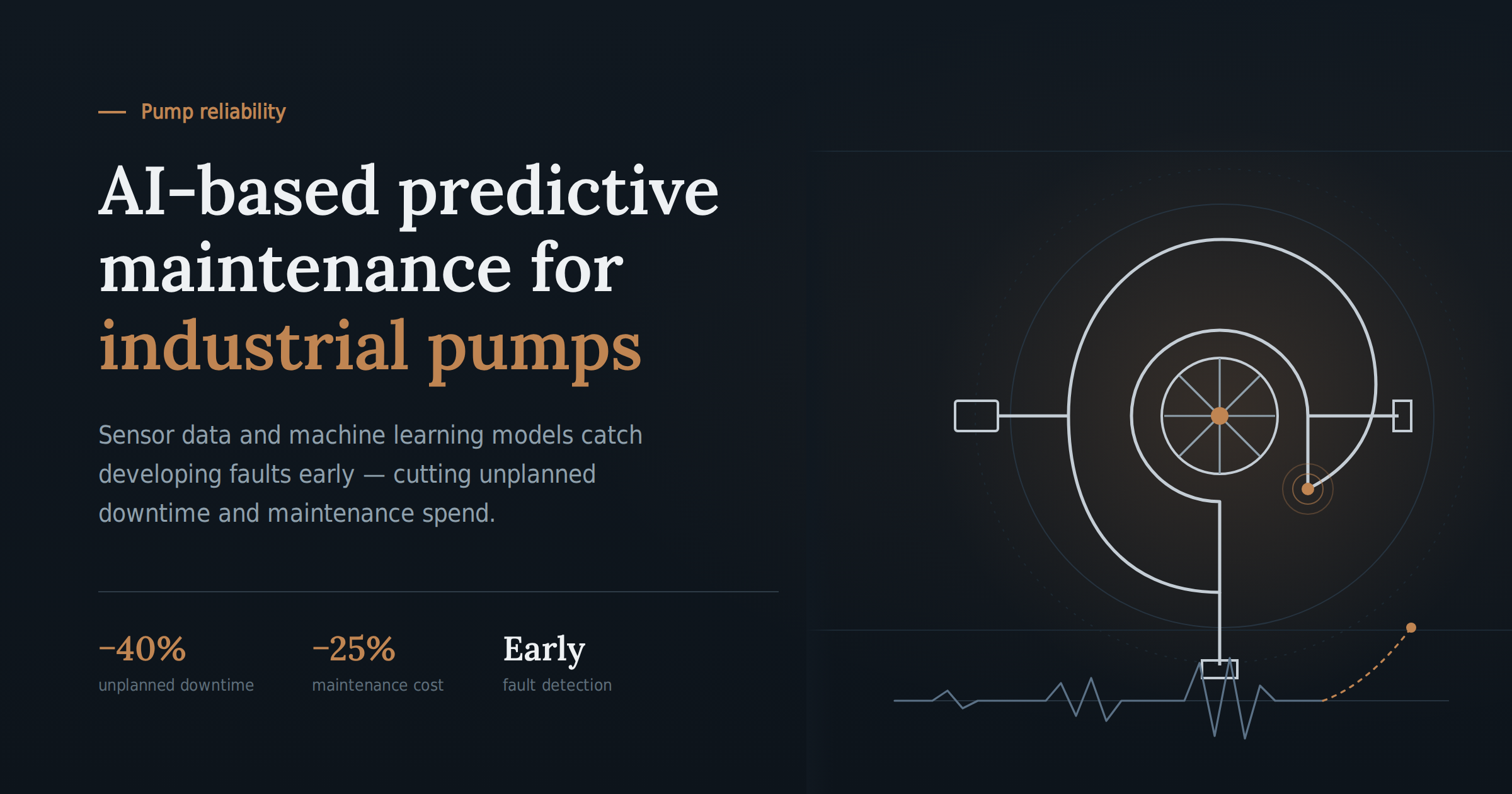
Unplanned pump failures are one of the costliest problems in industrial plants. A single seized bearing or cavitation event can halt production, damage downstream equipment, and trigger emergency repair costs. This is where AI-based pump predictive maintenance changes the game — replacing guesswork and calendar-based servicing with real-time, data-driven insight into pump health.
What Is AI-Based Pump Predictive Maintenance?
AI-based pump predictive maintenance uses machine learning models, IIoT sensors, and historical performance data to detect early signs of pump degradation — long before a breakdown occurs. Unlike traditional preventive maintenance, which follows fixed schedules regardless of actual equipment condition, predictive maintenance for pumps analyzes real operating data to flag anomalies as they emerge.
This approach relies on AI pump monitoring systems that continuously track parameters such as vibration, temperature, flow rate, pressure, and motor current. Advanced algorithms then compare live readings against normal operating baselines to identify patterns associated with impending failure.
How AI-Powered Pump Monitoring Works
- Sensor Data Collection – Vibration, temperature, and acoustic sensors capture continuous operational data from pumps.
- Edge & Cloud Processing – Data is processed in real time to detect deviations from healthy baselines.
- Machine Learning Analysis – Algorithms trained on historical failure patterns perform pump failure prediction, identifying issues like bearing wear, cavitation, misalignment, or seal degradation.
- Alerts & Diagnostics – Maintenance teams receive early warnings with root-cause insights, enabling targeted intervention.
- Continuous Learning – Models improve over time, refining accuracy through pump condition monitoring feedback loops.
Solutions like Einnosys XPump combine these steps into a unified platform purpose-built for industrial pump maintenance, giving reliability teams a single dashboard for fleet-wide pump health.
Key Benefits of AI-Based Predictive Maintenance for Pumps
- Reduced Unplanned Downtime: Early fault detection allows scheduled repairs instead of emergency shutdowns, directly supporting pump downtime reduction.
- Lower Maintenance Costs: Condition-based servicing avoids unnecessary part replacements and reduces labor costs tied to reactive repairs.
- Extended Asset Life: Catching issues like misalignment or cavitation early prevents cascading mechanical damage.
- Improved Safety: Predicting failures reduces the risk of catastrophic pump failures involving hazardous fluids.
- Better Resource Planning: Maintenance teams can plan spare parts, labor, and downtime windows in advance.
Industries Benefiting from AI Pump Predictive Maintenance
Predictive maintenance using AI is especially valuable in industries where pump reliability is mission-critical:
- Industrial Manufacturing
- Oil & Gas
- Chemical & Petrochemical
- Pharmaceutical
- Power Generation
- Water & Wastewater Treatment
In each of these sectors, pump downtime doesn’t just cost repair dollars — it disrupts entire production lines and can trigger compliance or safety issues.
Implementing AI Pump Predictive Maintenance: Where to Start
- Audit critical pumps and prioritize high-risk, high-impact assets.
- Install vibration, temperature, and flow sensors on priority pumps.
- Integrate sensor data with an AI-powered monitoring platform.
- Establish baseline “healthy” operating signatures for each pump.
- Train maintenance teams to act on AI-generated alerts and diagnostics.
Explore Einnosys’ broader predictive maintenance solutions to see how condition monitoring extends beyond pumps to your full rotating equipment fleet, and review industries served to find deployment examples relevant to your sector.
Why Choose Einnosys XPump?
Einnosys XPump is purpose-built for AI-powered pump monitoring, combining sensor hardware, machine learning diagnostics, and an intuitive dashboard to help maintenance and reliability teams move from reactive to predictive operations — reducing downtime, cutting costs, and extending pump life across the plant floor.
Conclusion
AI-based pump predictive maintenance is no longer a futuristic concept — it’s a practical, measurable way to protect uptime, reduce maintenance spend, and improve plant reliability. By adopting AI pump monitoring today, maintenance managers and reliability engineers can shift from costly reactive repairs to proactive, data-driven asset care.


