
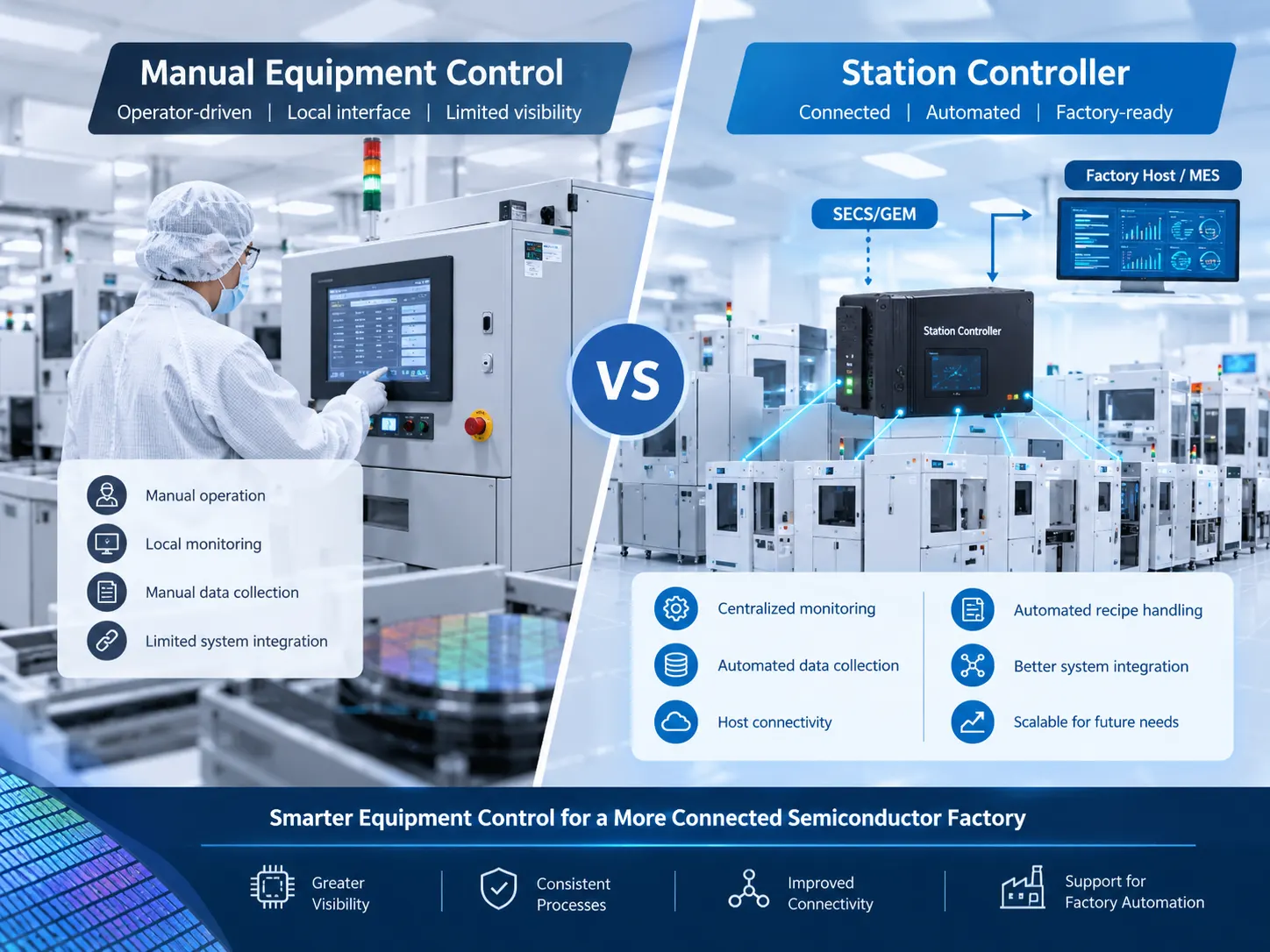
Imagine a recipe loaded on the wrong tool. An operator notices only after the first lot runs. In a fab that relies on manual equipment control, every start, stop, and recipe selection depends on someone at the equipment HMI. A station controller offers another path. It connects equipment to the factory host, collects status and alarm data, and can send commands remotely. However, the right choice depends on your equipment, your goals, and your integration needs. This article compares both approaches, explains where SECS/GEM fits, and shows when a station controller makes sense.
What Is Manual Equipment Control in Semiconductor Manufacturing?
In manual equipment control, operators run each machine through its local HMI and physical controls. They select recipes, start and stop processes, watch equipment status, and record results. Many fabs still work this way, especially with older tools or small production lines.
This approach has real benefits. It needs little upfront integration work, and experienced operators can respond quickly to what they see at the tool. For low-volume or highly specialized processes, that flexibility can be valuable.
On the other hand, manual control has limits. Operators may re-enter the same data at several points. Status information stays at each tool instead of reaching a central view. Recipe selection depends on people following procedures every time. These limits vary by equipment type and by factory, so each site should assess its own situation.
What Is a Station Controller?
A station controller sits between the equipment and the wider factory systems. It communicates with the equipment, gathers data, and exchanges information with a factory host or MES. Operators stay involved, but the controller handles selected communication and control tasks.
How a Station Controller Works
The exact behavior depends on the implementation. In general, a station controller supports four functions:
- Equipment communication: It connects to the tool through a supported interface, often SECS/GEM.
- Status monitoring: It tracks equipment state, alarms, and events.
- Command handling: It can send remote commands, such as recipe selection, start, stop, and abort, when the equipment supports them.
- Data exchange: It passes collected data to host systems, dashboards, or an MES.
Benefits of Station Controller-Based Equipment Automation
Station controller-based automation can help fabs and assembly plants in several ways. Results depend on the equipment and the implementation, so no productivity gain is guaranteed.
- Fewer repetitive manual tasks, because the controller handles routine data collection and commands.
- Better monitoring, since status, alarms, and events can appear in one place.
- More consistent workflows, because the same steps run the same way across tools.
- Integration opportunities, including links to MES and other factory systems.
Station Controller vs. Manual Equipment Control: Key Differences
The table below summarizes how the two approaches compare. Neither is better in every case. The right fit depends on equipment capabilities and factory goals.
| Factor | Manual Equipment Control | Station Controller |
|---|---|---|
| Operation | Operator-driven local control | Controller-assisted operation, depending on configuration |
| Monitoring | Often relies on local equipment interfaces | Can support centralized equipment status monitoring |
| Data Collection | May require manual data collection | Can automate data collection when interfaces permit |
| Host Integration | May require additional integration | Can support host connectivity through suitable interfaces |
| Recipe Handling | Often equipment-specific | May support automated recipe workflows |
| Scalability | Depends on equipment and operating procedures | Depends on system architecture and integration requirements |
| Implementation | May require fewer initial integration changes | Requires equipment interface assessment and configuration |
How Station Controllers Support Semiconductor Factory Automation
Semiconductor factory automation depends on equipment, hosts, and MES platforms exchanging information reliably. A station controller can act as the bridge. It collects equipment data, passes it upstream, and relays host commands back to the tool.
As a result, teams gain better equipment visibility. Engineers can see states, alarms, and events without walking to each tool. Moreover, a controller can help coordinate workflows, such as confirming the right recipe before a run starts. Because the logic lives in one platform, similar tools can follow similar rules.
Still, automation works best when planned. Each tool needs an interface assessment, and workflows need clear ownership between operators and the host.
The Role of SECS/GEM in Equipment Connectivity
SECS/GEM is the standard communication language between semiconductor equipment and a factory host. It defines how tools report status, send alarms and events, share data, and accept remote commands. For that reason, many station controllers use it as their main equipment interface.
However, SECS/GEM support is not automatic. It depends on the equipment interface, the controller or software in use, and the way the solution is implemented. Some tools support SECS/GEM natively. Others need an add-on or a gateway. A short compatibility check at the start prevents surprises later.
When Should Manufacturers Consider a Station Controller?
A station controller is worth evaluating when one or more of these needs apply:
- Connecting equipment to a factory host or MES
- Improving equipment status visibility
- Reducing repetitive manual data entry
- Standardizing equipment communication
- Modernizing selected legacy equipment
- Supporting future factory automation projects
If several items match your situation, a pilot on a few tools is a practical next step.
How eInnoSys Supports Equipment Connectivity
eInnoSys offers solutions for different points in the connectivity journey. Each one fits a specific use case, so match the product to the equipment and the goal.
- eIStationController: A ready-to-deploy station controller and factory host platform. It extracts data, alarms, and events from equipment and supports remote commands such as recipe selection, start, stop, and abort. It also supports SEMI E5 and E30 and can connect to existing MES or host systems through SEMI-compliant interfaces.
- EIGEMBox: A plug-and-play SECS/GEM solution for older or legacy equipment. Consider it when a tool lacks native SECS/GEM support.
- SECS/GEM SDK: A software development kit for equipment makers who want to build SECS/GEM into their own tools.
- SECS/GEM integration for non-GEM equipment: Integration guidance for tools that do not yet speak SECS/GEM.
Compatibility depends on each tool and its interface, so eInnoSys recommends an assessment before any rollout.
Conclusion
Manual equipment control keeps operators in charge of every action, with minimal integration work upfront. A station controller adds a connectivity layer that supports monitoring, data collection, and host integration. In short, the two approaches serve different needs, and many fabs use both across different tools.
Before choosing, evaluate equipment compatibility, connectivity requirements, and your factory automation goals. A clear assessment leads to a better station controller decision.


