
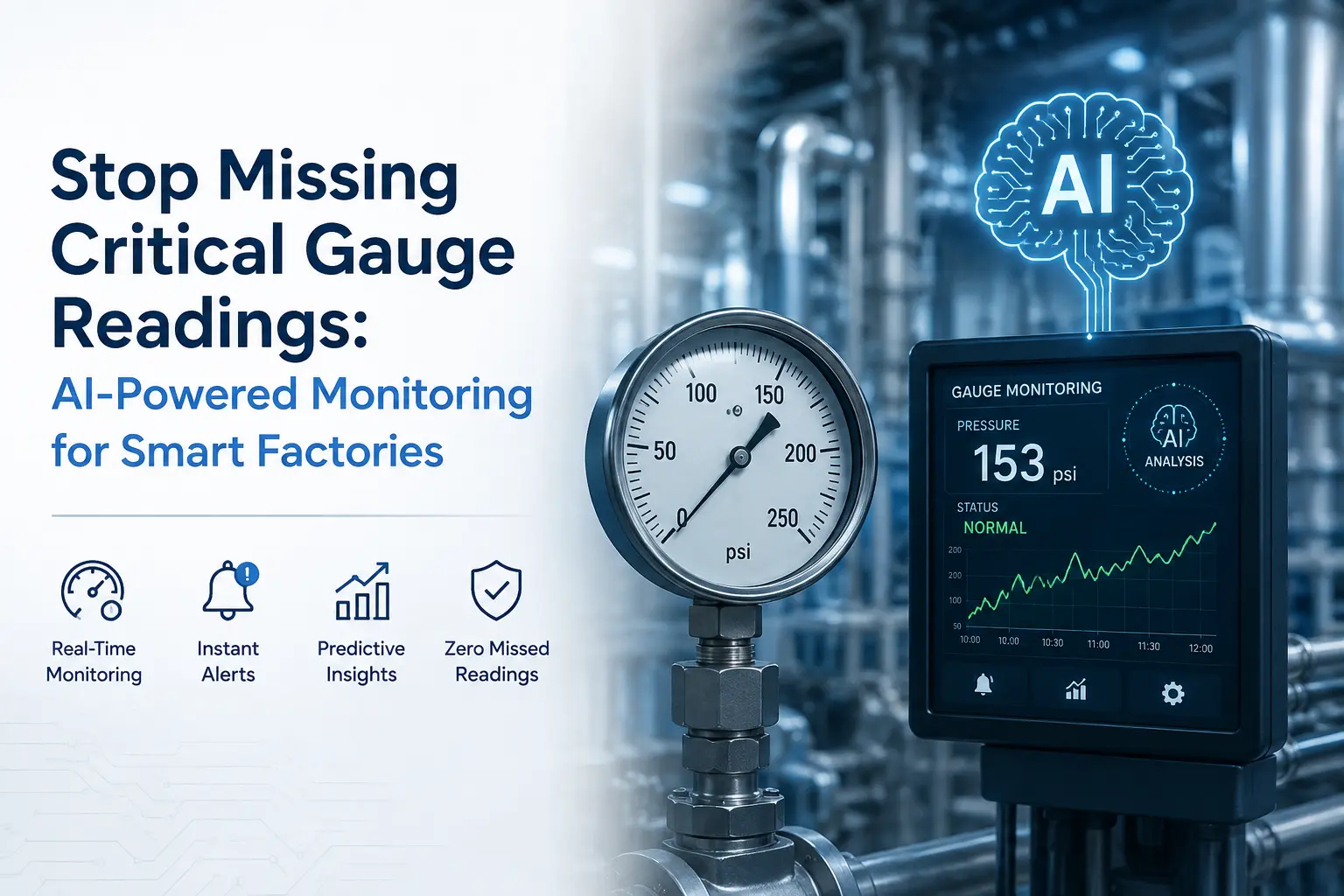
Every factory floor runs on data — pressure, temperature, flow, vibration, vacuum. Gauges are the quiet witnesses to whether a process is healthy or heading toward failure. Yet in most plants, someone still has to walk the floor, glance at a dial, and write a number on a clipboard. Miss one reading, misread one needle, or show up five minutes too late, and a small deviation can turn into unplanned downtime, scrap, or a safety incident.
AI-powered gauge monitoring is changing that. By combining computer vision, edge AI, and IoT connectivity, factories can now capture every gauge reading automatically, around the clock, and get alerted the moment something drifts out of range — no manual rounds required.
Why Manual Gauge Reading Causes Missed Critical Data
Manual gauge checks depend on people being in the right place at the right time. In a typical plant, operators walk fixed routes on fixed schedules — often once per shift or once every few hours. Between those checks, a gauge can spike, dip, or fail silently, and no one will know until the next round, or until the equipment itself fails.
Common problems with manual gauge reading include:
- Infrequent sampling – readings every 2–4 hours leave large blind spots.
- Human error – misreading analog dials, transcription mistakes, illegible handwriting.
- Inconsistent coverage – night shifts, remote areas, and hazardous zones get checked less often.
- No historical trend – paper logs and spreadsheets make it hard to spot slow drifts over time.
- Delayed response – by the time an abnormal reading is noticed and escalated, damage may already be done.
For industries like semiconductor manufacturing, where a few minutes of pressure or vacuum deviation can ruin an entire wafer batch, this lag isn’t just inefficient — it’s expensive.
What Is AI-Powered Gauge Monitoring?
AI-powered gauge monitoring uses cameras, image recognition, and machine learning to read analog and digital gauges automatically, in real time, without modifying the existing instrument. Instead of replacing every legacy gauge with a smart sensor, a camera captures the gauge face, and an AI model interprets the needle position or digital display, converts it into a usable data value, and pushes it into a monitoring dashboard.
This approach is especially valuable for factories with hundreds of legacy analog gauges that are expensive or impractical to rewire. AI gauge monitoring bridges the gap between old-world instrumentation and Industry 4.0 digitalization — no rip-and-replace required.
How AI Automatically Captures Gauge Readings
The core workflow behind automated gauge reading typically looks like this:
Image capture – A fixed camera or edge device continuously photographs the gauge face at defined intervals.
AI recognition – Computer vision models detect the gauge type, needle angle, or digital digits, and translate them into a precise numeric value.
Data validation – The system cross-checks readings against expected ranges and historical patterns to filter out noise (glare, vibration, dirt on the lens).
Digital logging – Every reading is timestamped and stored, building a continuous, tamper-proof digital record.
Dashboard visualization – Operators and engineers see live values, trends, and status indicators from a central screen or mobile device.
This turns thousands of manual, error-prone checks per month into a fully automated, continuous data stream.
Real-Time Alerts for Abnormal Readings
One of the biggest advantages of AI-powered gauge monitoring is speed of response. Instead of waiting for the next manual round, the system flags abnormal readings the instant they happen — whether that’s a pressure spike, a temperature that exceeds threshold, or a gauge reading that stops updating entirely.
Alerts can be routed to the right team instantly through:
- SMS or mobile push notifications
- Email escalation chains
- Integration with existing SCADA or MES alarm systems
- Visual dashboard indicators (red/yellow/green status)
This shortens the time between “something’s wrong” and “someone’s fixing it” from hours to minutes.
AI-Based Anomaly Detection
Beyond simple threshold alerts, AI models can learn what “normal” looks like for each gauge over time — accounting for seasonal variation, shift patterns, or equipment age. This makes it possible to catch subtle anomalies that a fixed threshold would miss, such as:
- A slow upward drift in pressure over several days
- Increased reading volatility that signals a failing seal or bearing
- Correlated abnormalities across multiple gauges tied to the same process line
Anomaly detection turns gauge monitoring from a simple pass/fail check into an early-warning system for equipment health.
Benefits for Predictive Maintenance
Continuous, accurate gauge data is one of the most valuable inputs for a predictive maintenance program. Instead of servicing equipment on a fixed calendar schedule, maintenance teams can act on actual condition data:
- Trend-based scheduling – service equipment based on real degradation patterns, not guesswork.
- Early fault detection – catch leaks, blockages, or wear before they cause a breakdown.
- Reduced unplanned downtime – fewer surprise failures on the production line.
- Lower maintenance costs – less over-maintenance, fewer emergency repairs, longer asset life.
Predictive maintenance backed by AI gauge monitoring data typically pays for itself through avoided downtime alone.
Improving Equipment Reliability and Uptime
When abnormal readings are caught and acted on immediately, equipment spends less time operating outside safe parameters. Over time, this reduces stress-related wear, prevents cascading failures, and extends the useful life of critical assets. For plant managers, this translates directly into:
- Higher overall equipment effectiveness (OEE)
- Fewer production stoppages
- More predictable output and scheduling
- Reduced safety incidents tied to pressure, temperature, or vacuum excursions
Integrating Gauge Data with Smart Factory Systems
Gauge readings are far more powerful when they don’t live in isolation. Modern AI gauge monitoring platforms are built to integrate with the broader smart factory stack, feeding data into:
- SCADA and MES systems for centralized process control
- Historian and analytics platforms for long-term trend analysis
- IoT monitoring dashboards alongside other sensor data (vibration, temperature, energy usage)
- ERP and CMMS systems to automatically trigger work orders and maintenance tickets
This integration turns individual gauge readings into part of a connected, real-time picture of overall plant health — a core pillar of any Industry 4.0 initiative.
Use Cases in Industrial and Semiconductor Environments
AI-powered gauge monitoring applies across a wide range of manufacturing environments:
- Semiconductor fabs – monitoring vacuum, gas pressure, and chemical delivery gauges where even brief deviations can scrap an entire wafer lot.
- Chemical and process plants – tracking pressure and flow gauges in hazardous zones where manual checks pose safety risks.
- Automotive and heavy manufacturing – monitoring hydraulic and pneumatic pressure gauges across large production lines.
- Utilities and energy – tracking boiler pressure, steam gauges, and tank levels across distributed sites.
- Pharmaceutical manufacturing – ensuring compliance-grade, continuous documentation of critical process parameters.
In each case, the common thread is the same: legacy analog gauges, high consequences for missed readings, and a need for continuous, auditable data.
How EINNOSYS EIGaugeMonitor Helps Automate Gauge Monitoring
EINNOSYS EIGaugeMonitor is purpose-built to bring AI-powered gauge monitoring to factories without replacing existing instrumentation. It uses camera-based AI recognition to read analog and digital gauges automatically, log every value, and trigger real-time alerts the moment a reading moves outside safe limits.
Key capabilities include:
- Non-intrusive installation on existing analog and digital gauges
- Continuous, automated readings with no manual rounds required
- Real-time alerting for abnormal or out-of-range conditions
- Historical data logging for trend analysis and audits
- Easy integration into existing smart factory and IoT monitoring systems
For factory managers and process engineers looking to close the gap between legacy gauges and full digital visibility, EIGaugeMonitor offers a fast, low-disruption path to automated gauge reading.
Conclusion
Manual gauge rounds simply can’t keep pace with the speed and precision modern factories need. Missed readings, delayed responses, and inconsistent logs create risks that are entirely avoidable with today’s technology. AI-powered gauge monitoring closes that gap — capturing every reading, catching anomalies early, and feeding real-time data into your smart factory systems.
Stop missing critical gauge readings. Automate your monitoring with AI-powered EINNOSYS EIGaugeMonitor and give your team the real-time visibility they need to keep production running safely and reliably.


