
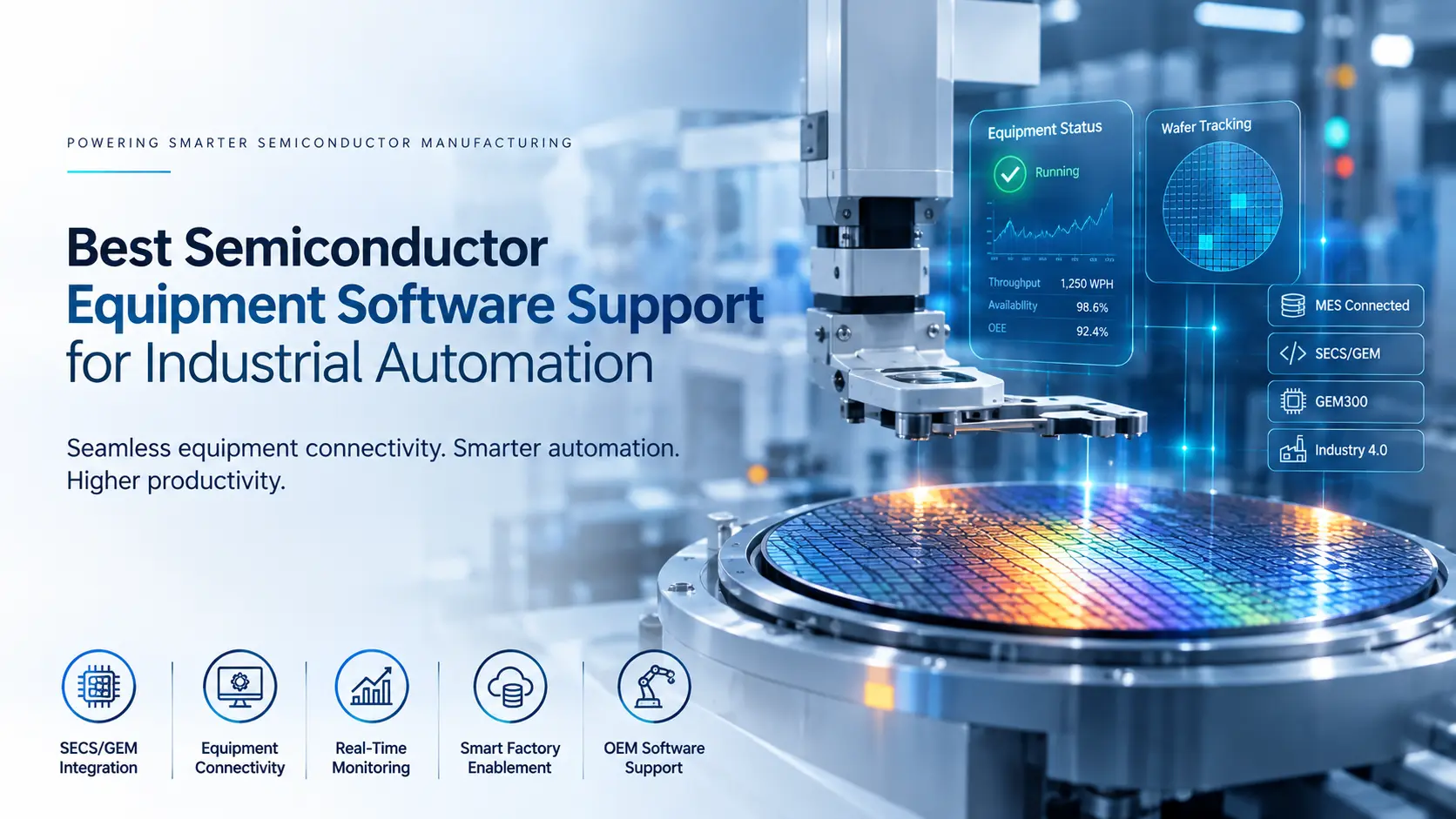
Semiconductor manufacturing runs on precision, speed, and uptime. A single hour of unplanned equipment downtime in a fab can cost tens of thousands of dollars and disrupt wafer flow across an entire production line. As fabs push deeper into Industry 4.0, the software layer that connects equipment to host systems has become just as critical as the hardware itself. This is why semiconductor equipment software support has become a top priority for OEMs, fab managers, and automation engineers looking to stay competitive.
In this guide, we’ll break down what semiconductor equipment software support actually involves, the challenges OEMs face, and what separates a truly capable support partner from the rest. If you’re evaluating providers for semiconductor equipment software integration, this breakdown will help you ask the right questions before you commit to one.
Why Software Support Matters in Semiconductor Manufacturing
Semiconductor fabs operate 24/7, and every tool on the floor needs to communicate reliably with host and MES/CIM systems. When that communication breaks down, the consequences ripple outward fast.
- Equipment uptime depends on stable, well-maintained software connections between tools and the factory host.
- Production continuity is only possible when data flows without interruption between equipment controllers and manufacturing execution systems.
- Integration with MES/CIM systems allows fabs to track lots, manage recipes, and maintain traceability across every process step.
- Compliance with fab communication standards (like SEMI’s SECS/GEM protocols) is non-negotiable for equipment entering most modern fabs.
Without dependable software support behind these systems, even the best hardware underperforms.
Key Features of Semiconductor Equipment Software Support
Not all software support is created equal. The strongest providers offer a full stack of capabilities built specifically for semiconductor environments:
- SECS/GEM communication — the backbone protocol connecting equipment to host systems.
- GEM300 compliance — required for most 300mm fab environments and increasingly expected across the industry.
- Recipe management — enabling consistent, repeatable process parameters across tools and lots.
- Alarm and event handling — real-time visibility into equipment states so issues are caught before they escalate.
- Remote diagnostics — reducing the need for on-site visits and speeding up issue resolution.
- Real-time equipment monitoring — giving engineers live insight into tool health, throughput, and performance trends.
Together, these features form the foundation of reliable equipment automation software.
Challenges Faced by Semiconductor OEMs
Semiconductor OEMs face a unique set of hurdles when it comes to equipment software:
- Legacy equipment integration — older tools often use outdated protocols that need to be bridged into modern host systems.
- Multi-vendor communication — fabs run equipment from dozens of vendors, each with different software architectures.
- Wafer tracking requirements — every wafer must be traceable through the entire process flow, demanding tight software-hardware coordination.
- E84/E87 implementation complexity — automated material handling protocols require precise, carefully tested software logic.
- Long fab qualification cycles — new equipment software often needs extensive testing before it’s approved for production use, slowing time to revenue.
These challenges are exactly why specialized semiconductor automation software expertise matters more than generic industrial automation experience.
What Makes a Software Support Provider the Best?
When evaluating providers, look beyond a checklist of services. The strongest partners typically bring:
- Semiconductor domain expertise — not just general industrial automation know-how, but specific fab process knowledge.
- Experience with 200mm and 300mm equipment — since requirements and standards differ significantly between the two.
- Proven SECS/GEM implementation — a track record of successful, production-ready deployments.
- Fast troubleshooting support — because every hour of downtime has a direct cost.
- Custom SDK and API capabilities — for OEMs that need tailored equipment communication solutions.
- Industry 4.0 readiness — support for modern data architectures, edge computing, and predictive analytics.
A provider that checks all these boxes can significantly shorten fab qualification timelines and reduce long-term engineering overhead.
How Einnosys Supports Semiconductor Equipment Automation
Einnosys works with semiconductor OEMs and fabs to deliver dependable semiconductor equipment software support across the full equipment lifecycle. Core capabilities include:
- SECS/GEM software development tailored to specific tool architectures.
- GEM300 implementation for fabs and equipment requiring 300mm compliance.
- E84 and E87 integration to support automated material handling systems.
- Equipment host connectivity that bridges tools reliably to MES/CIM platforms.
- Smart factory integration, connecting equipment data into broader Industry 4.0 architectures.
- OEM customization services, including SDK and API development for unique equipment requirements.
Benefits of Choosing Specialized Semiconductor Software Support
Partnering with a provider that understands semiconductor manufacturing specifically — rather than industrial automation broadly — pays off in measurable ways:
- Reduced downtime through faster diagnostics and proactive monitoring.
- Faster fab acceptance thanks to proven, standards-compliant software.
- Lower engineering effort by relying on pre-built, tested integration frameworks.
- Improved OEE (Overall Equipment Effectiveness) through better data visibility and control.
- Better traceability across wafers, lots, and process steps.
- Scalable automation architecture that grows with future equipment and fab expansions.
Industries That Benefit from Advanced Equipment Software Support
While wafer fabs are the most obvious beneficiaries, semiconductor equipment software support extends across several related sectors:
- Wafer fabrication facilities requiring precise process and recipe control.
- Inspection equipment manufacturers needing real-time defect data communication.
- Metrology systems that depend on accurate, high-frequency data exchange.
- Packaging and testing operations requiring tight equipment-to-host coordination.
- OSAT facilities managing high-mix, high-volume production environments.
- MEMS manufacturing, where specialized process requirements demand flexible software architectures.
Future Trends in Semiconductor Industrial Automation
The equipment software landscape is evolving quickly. Fabs and OEMs planning long-term automation strategies should keep an eye on:
- AI-driven predictive maintenance, using equipment data to anticipate failures before they happen.
- Digital twins, allowing engineers to simulate and optimize equipment performance virtually.
- Edge analytics, processing data closer to the equipment for faster decision-making.
- OPC UA integration, complementing SECS/GEM in broader Industry 4.0 architectures.
- Hybrid SECS/GEM + Industry 4.0 architectures, blending semiconductor-specific protocols with modern data platforms.
Providers who invest in these areas now will be better positioned to support fabs as automation requirements continue to grow more sophisticated.
Final Thoughts
The best semiconductor equipment software support combines deep semiconductor protocol expertise, industrial automation knowledge, and scalable Industry 4.0 integration capabilities. From SECS/GEM and GEM300 compliance to E84/E87 integration and smart factory connectivity, the right partner can reduce downtime, speed up fab qualification, and strengthen long-term automation strategy.
Einnosys brings this combination of semiconductor domain expertise and industrial automation experience to OEMs and fabs worldwide, offering SECS/GEM integration, GEM300 compliance, equipment connectivity, and full-scale industrial automation software support.
Need reliable semiconductor equipment software support? Explore Einnosys’s Equipment Software Services to see how our team can support your next equipment integration or fab qualification project.


