
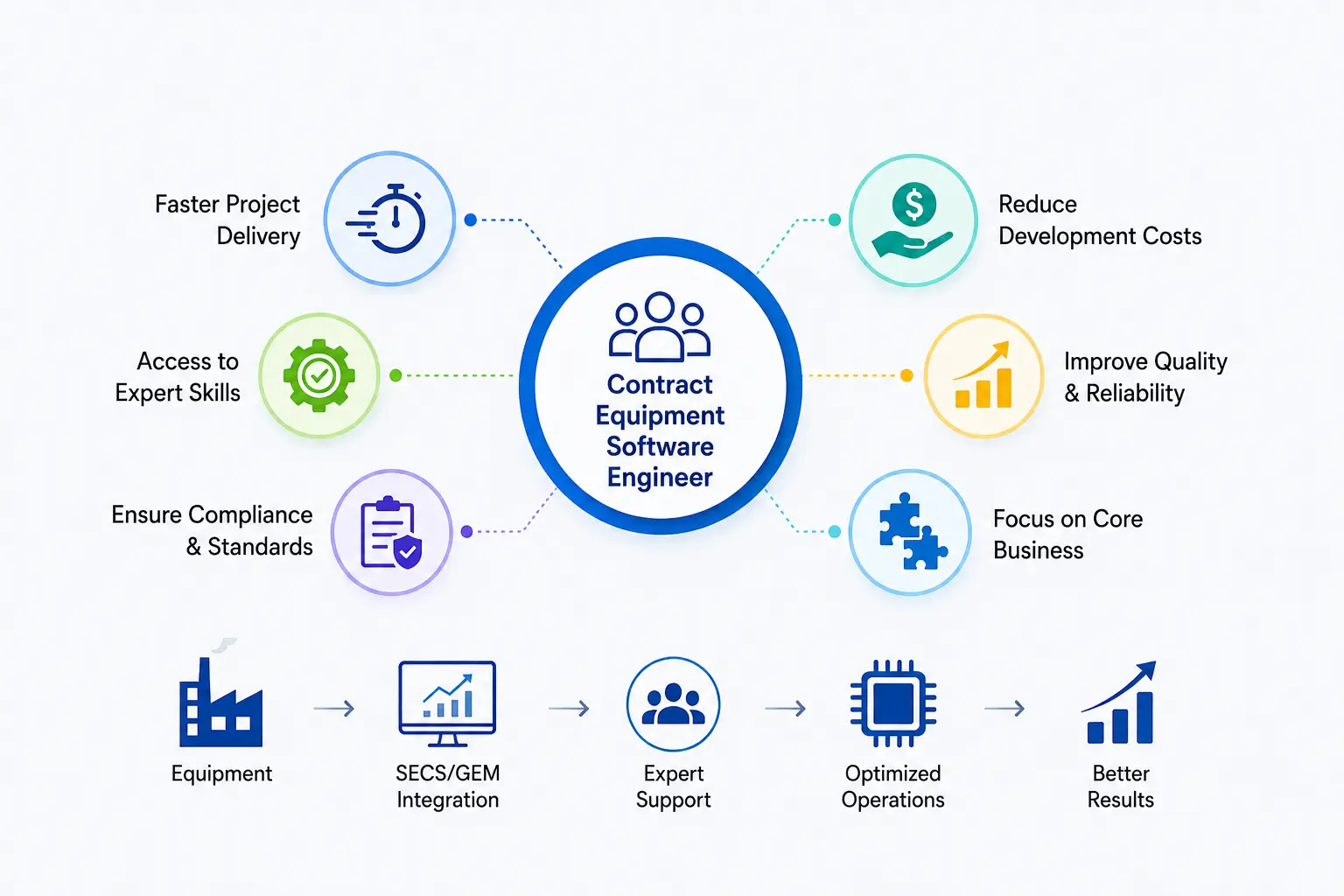
Semiconductor manufacturing runs on tight timelines. A new tool has to pass fab acceptance testing, integrate with the host system, and prove SECS/GEM compliance before it ever touches a wafer. But most engineering teams don’t have a bench of SECS/GEM specialists sitting idle, waiting for the next qualification project. That gap is exactly what SECS/GEM staff augmentation is built to close.
Instead of spending months recruiting a full-time SECS/GEM engineer — or discovering mid-project that no one on the team has touched GEM300 before — manufacturers and equipment OEMs can bring in contract specialists who already know the standards, the tools, and the fab acceptance process. This article breaks down what SECS/GEM staff augmentation actually looks like, the problems it solves, and how to evaluate whether it’s the right fit for your next project.
What Is SECS/GEM Staff Augmentation?
SECS/GEM staff augmentation is a staffing model where semiconductor manufacturers and equipment OEMs bring in contract engineers who specialize in SECS/GEM, GEM300, and related fab automation protocols, rather than hiring full-time employees for a fixed-duration need.
Instead of owning the entire hiring cycle — job posting, interviews, onboarding, ramp-up on SEMI standards — a company works with a contract SECS/GEM engineer who is already fluent in E5, E30, E37, E39, E40, E87, E90, E94, and E116, and can start contributing to integration or compliance work almost immediately.
This is different from a typical IT staffing agency. Semiconductor equipment software is a narrow, standards-heavy discipline, so semiconductor equipment software experts need direct experience with host communication, equipment models, and fab acceptance testing — not just general software engineering skills.
Why Semiconductor Manufacturers Turn to Staff Augmentation
1. SECS/GEM Talent Is Genuinely Scarce
SECS/GEM and GEM300 expertise sits at the intersection of semiconductor process knowledge and low-level protocol engineering. There simply aren’t many engineers who have shipped SECS/GEM-compliant equipment software, which makes semiconductor staff augmentation one of the fastest ways to access that skill set without a multi-month search.
2. Compliance Delays Are Expensive
Every week a tool spends failing fab acceptance testing is a week of delayed revenue. Bringing in a GEM300 integration engineer who has already been through E30/E40/E87 compliance reviews reduces the back-and-forth that typically stalls qualification.
3. Project Timelines Rarely Match Hiring Timelines
A staff augmentation engagement can start in weeks, not quarters. That matters most for fab automation engineers on contract who are needed for a defined project window — a new equipment launch, a GEM300 upgrade, or an MES migration — rather than a permanent role.
4. Headcount Flexibility Without Long-Term Risk
Adding a permanent engineer for a project that ends in six months creates a staffing problem later. Equipment software staff augmentation lets teams scale up for the project and scale back down afterward, without a layoff conversation.
5. Fills Specific, Narrow Skill Gaps
Not every project needs a full team. Sometimes it’s one engineer who understands E84 handoff for OHT/AGV/RGV material handling, or one who can own MES integration staffing for a host connectivity project. Staff augmentation lets you bring in exactly the skill you’re missing.
Where Contract SECS/GEM Engineers Add the Most Value
Equipment qualification and fab acceptance. Engineers who have already navigated SECS/GEM and GEM300 compliance reviews at other fabs bring pattern-recognition that shortens the qualification cycle.
GEM300 and E84 integration. GEM300 compliance and E84 OHT/AGV/RGV handoff logic are two of the most common bottlenecks in new equipment programs. A GEM300 integration engineer with prior implementations can move faster than a team learning the standard for the first time.
MES and host connectivity. Connecting equipment to a factory host or MES platform touches SECS/GEM messaging, recipe management, and data collection all at once. Dedicated MES integration staffing keeps this work moving without pulling process engineers off other priorities.
Legacy equipment modernization. Older tools running SECS-I or lacking GEM300 support need engineers who understand both the legacy protocol and the modern target state — a common use case for semiconductor software outsourcing rather than in-house hires.
Short-term surge capacity. When a program ramps up faster than hiring can keep pace, a dedicated development team brought in through staff augmentation absorbs the overflow without disrupting the core team’s roadmap.
Staff Augmentation vs. Full Project Outsourcing
It’s worth distinguishing staff augmentation from handing off an entire project. With staff augmentation, contract engineers work inside your existing team structure, reporting into your project leads and following your processes — you retain control over priorities and architecture decisions. With full outsourcing, an external team owns the deliverable end-to-end.
Most semiconductor manufacturers prefer staff augmentation for SECS/GEM work specifically because compliance and equipment communication touch proprietary process details that are easier to manage with engineers embedded in the internal team, rather than handed off entirely.
Onsite, Offshore, or Hybrid: Choosing an Engagement Model
Staff augmentation isn’t one-size-fits-all. Common models include:
- Onsite deployment — engineers work at your facility, useful when hands-on equipment access is required during fab acceptance testing.
- Offshore staff augmentation — offshore semiconductor engineers support integration, testing, and documentation remotely, often at lower cost and with round-the-clock coverage.
- Hybrid onsite-offshore — a small onsite presence for equipment-facing work, backed by an offshore team for development and testing.
- Short-term vs. long-term — short-term for a defined qualification window, long-term for ongoing product development support.
The right model depends on how much of the work requires physical access to equipment versus how much can be done against a simulator or test environment.
What to Look for in a SECS/GEM Staffing Partner
When evaluating semiconductor equipment software experts for a contract engagement, a few things matter more than a general staffing agency’s pitch:
- Proven SECS/GEM and GEM300 delivery history — ask for specific standards experience (E5, E30, E37, E39, E40, E84, E87, E90, E94, E116), not just “protocol experience.”
- Fab acceptance track record — has the team’s work actually passed Tier-1 fab acceptance reviews before?
- Compliance ownership — will the partner take responsibility for certificates, logs, and compliance manuals, or just write code?
- Compliance ownership — will the partner take responsibility for certificates, logs, and compliance manuals, or just write code?
- Technology breadth — coverage across C++, Java, .NET, MES platforms, and industrial protocols like OPC-UA and Modbus-TCP, since most fab automation projects touch more than SECS/GEM alone.
How eInnoSys Approaches SECS/GEM Staff Augmentation
eInnoSys provides contract engineers with hands-on experience across SECS/GEM, GEM300, E84 OHT/AGV/RGV integration, and MES connectivity — backed by SDKs that have already been deployed on hundreds of equipment units and accepted at Tier-1 fabs. Engagements are structured around your project timeline, whether that’s short-term support to get through a compliance review or a longer-term extension of your engineering team, onsite, offshore, or hybrid.
Rather than starting from a blank resume search, you’re working with engineers who’ve already solved SECS/GEM and GEM300 problems in production fab environments — and who take ownership of the compliance documentation, not just the code.
Ready to Fill Your SECS/GEM Skill Gap?
If a compliance deadline, GEM300 upgrade, or MES integration project is running ahead of your team’s current bandwidth, staff augmentation can close that gap faster than a traditional hire. Schedule a free technical consultation with eInnoSys to talk through your project timeline and the right engagement model for your team.


