
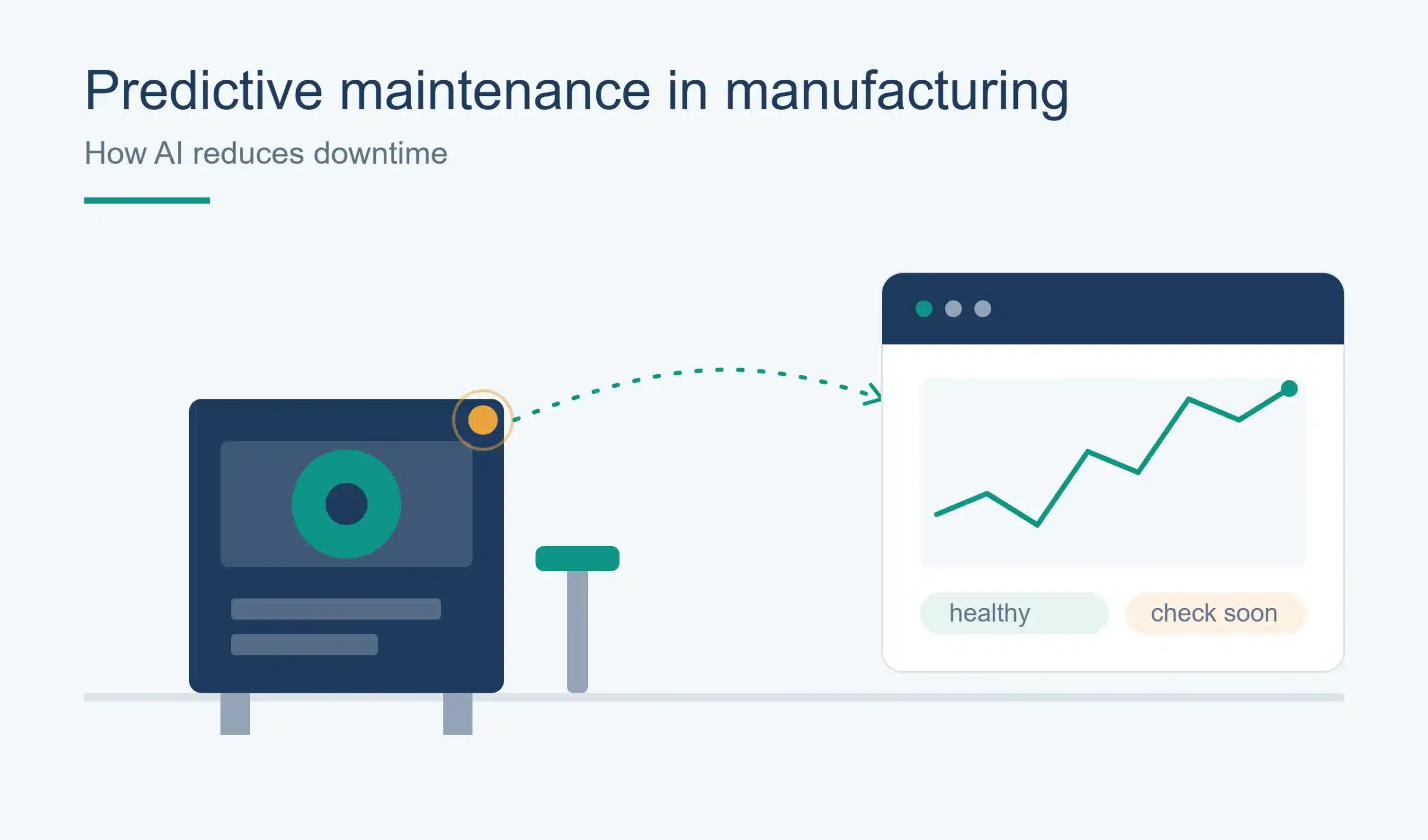
Unplanned equipment failure is one of the costliest problems in manufacturing. A single unexpected breakdown can halt an entire production line, delay shipments, and drive up repair costs. This is why more manufacturing managers, plant managers, and reliability engineers are turning to AI-powered predictive maintenance — a data-driven approach that predicts failures before they happen, instead of reacting after the damage is done.
In this guide, we’ll break down how predictive maintenance in manufacturing works, why AI makes it dramatically more accurate, and how facilities across process industries, energy, chemicals, pharmaceuticals, and oil & gas are using it to reduce machine downtime and extend asset life.
What Is Predictive Maintenance in Manufacturing?
Predictive maintenance is a maintenance strategy that uses real-time data from equipment sensors to predict when a machine is likely to fail — so maintenance teams can intervene before it actually breaks down.
Unlike traditional maintenance approaches, predictive maintenance doesn’t rely on fixed schedules or guesswork. Instead, it continuously tracks indicators like vibration, temperature, pressure, and acoustic signals to detect early warning signs of wear, misalignment, or component degradation.
This shift matters because manufacturing equipment failures rarely happen without warning. Small anomalies — a slight vibration increase, a temperature spike, a change in motor current — often appear weeks before a breakdown. Predictive maintenance technology is built to catch exactly these signals.
How AI-Powered Predictive Maintenance Works
AI-powered predictive maintenance combines sensor data, machine learning models, and historical failure patterns to forecast equipment health with far greater precision than manual monitoring.
Here’s the typical workflow:
- Data Collection – IoT sensors continuously monitor equipment parameters such as vibration, temperature, pressure, and current draw.
- Data Processing – The collected data is cleaned, structured, and streamed to an analytics platform in real time.
- Pattern Recognition – Machine learning models analyze historical and live data to identify patterns associated with specific failure modes.
- Failure Prediction – The system flags anomalies and estimates the probability and timeline of a potential failure.
- Actionable Alerts – Maintenance teams receive alerts with specific recommendations, allowing them to schedule repairs before failure occurs.
The key advantage of AI here is its ability to learn continuously. As more data flows in, the models become more accurate at distinguishing between normal operational variation and genuine early-stage faults — something that’s extremely difficult to do with manual monitoring or fixed-threshold alarms alone.
How AI Helps Reduce Equipment Downtime
Downtime reduction is the primary reason manufacturers invest in AI predictive maintenance. Here’s how it directly contributes:
- Early anomaly detection flags subtle deviations long before they escalate into full equipment failure.
- Failure probability scoring helps prioritize which machines need urgent attention versus routine monitoring.
- Root cause insights reduce diagnostic time, so technicians spend less time troubleshooting and more time fixing the actual issue.
- Optimized maintenance scheduling ensures repairs happen during planned downtime windows rather than during production runs.
By shifting maintenance from reactive to predictive, manufacturers avoid the cascading effects of a single failure — line stoppages, missed deadlines, and safety risks.
Key Benefits of AI-Powered Predictive Maintenance
- Early Fault Detection
AI models can detect deviations in equipment behavior long before they’re visible through manual inspection, giving teams a critical head start. - Reduced Unplanned Downtime
By catching issues early, plants can schedule repairs proactively, minimizing disruptive, unplanned stoppages. - Lower Maintenance Costs
Predictive maintenance analytics reduce unnecessary part replacements and labor spent on routine inspections that don’t find anything wrong. - Improved Equipment Reliability
Continuous condition monitoring means equipment operates closer to optimal performance for longer periods. - Longer Asset Life
Addressing minor issues before they compound helps extend the operational lifespan of critical machinery.
AI Predictive Maintenance vs. Preventive Maintenance
A common question from operations managers is how AI predictive maintenance compares to traditional preventive maintenance.
Preventive maintenance follows a fixed schedule — servicing equipment every 30, 60, or 90 days regardless of its actual condition. It reduces some failures but often leads to unnecessary maintenance on healthy equipment, or missed failures that occur between scheduled checks.
AI-powered predictive maintenance, on the other hand, is condition-based. It only triggers maintenance when data indicates a real risk of failure, which means:
| Factor | Preventive Maintenance | AI Predictive Maintenance |
|---|---|---|
| Maintenance Trigger | Fixed schedule | Real-time condition data |
| Downtime Risk | Moderate | Low |
| Maintenance Costs | Higher | Lower |
| Failure Prediction | Not possible | AI-driven forecasting |
For most manufacturing environments, a hybrid approach — using predictive maintenance for critical assets and preventive maintenance for lower-risk equipment — delivers the best balance of cost and reliability.
Common Manufacturing Applications
AI predictive maintenance is used across a wide range of industrial equipment, including:
- Pumps – Detecting cavitation, bearing wear, and seal degradation early.
- Motors – Monitoring current, vibration, and temperature to catch winding faults or misalignment.
- Compressors – Identifying pressure irregularities and mechanical wear before breakdowns.
- HVAC Systems – Tracking performance drift to prevent costly system failures.
- Production Equipment – Monitoring conveyors, mixers, and other line equipment to avoid production stoppages.
These applications span manufacturing, process industries, energy, chemicals, pharmaceuticals, and oil & gas — anywhere rotating or critical equipment failure carries a high operational cost.
Why Real-Time Monitoring Matters
Real-time condition monitoring is the backbone of effective predictive maintenance. Without continuous data, even the most advanced AI model has nothing current to analyze.
Real-time monitoring allows manufacturing teams to:
- Catch fast-developing faults that periodic manual checks would miss
- Respond to anomalies within minutes instead of days
- Build a continuously growing dataset that improves prediction accuracy over time
- Reduce reliance on manual inspection routes across large facilities
For plants running multiple production lines or geographically distributed assets, real-time monitoring is often the difference between a minor fix and a major unplanned outage.
How XPump Supports AI-Based Predictive Maintenance
XPump is built specifically for AI-powered equipment monitoring and predictive maintenance in industrial environments. It continuously tracks the health of pumps, motors, compressors, and other rotating equipment, using machine learning to detect early warning signs of failure.
With XPump, maintenance and reliability teams get:
- Real-time condition monitoring dashboards
- AI-driven failure predictions with actionable alerts
- Historical trend analysis to support long-term reliability planning
- Reduced diagnostic time through automated root-cause insights
If you’re evaluating tools to reduce downtime and extend asset life, explore our full range of Predictive Maintenance Solutions to find the right fit for your facility. You can also learn more about our broader Industrial Condition Monitoring capabilities designed for process industries and heavy manufacturing environments.
Conclusion
AI-powered predictive maintenance is transforming how manufacturers approach equipment reliability. By replacing guesswork and fixed schedules with real-time data and machine learning, plants can detect failures earlier, reduce unplanned downtime, cut maintenance costs, and extend the life of critical assets.
For manufacturing managers, reliability engineers, and operations teams looking to modernize their maintenance strategy, adopting AI predictive maintenance technology isn’t just a competitive advantage — it’s quickly becoming an operational necessity.


