
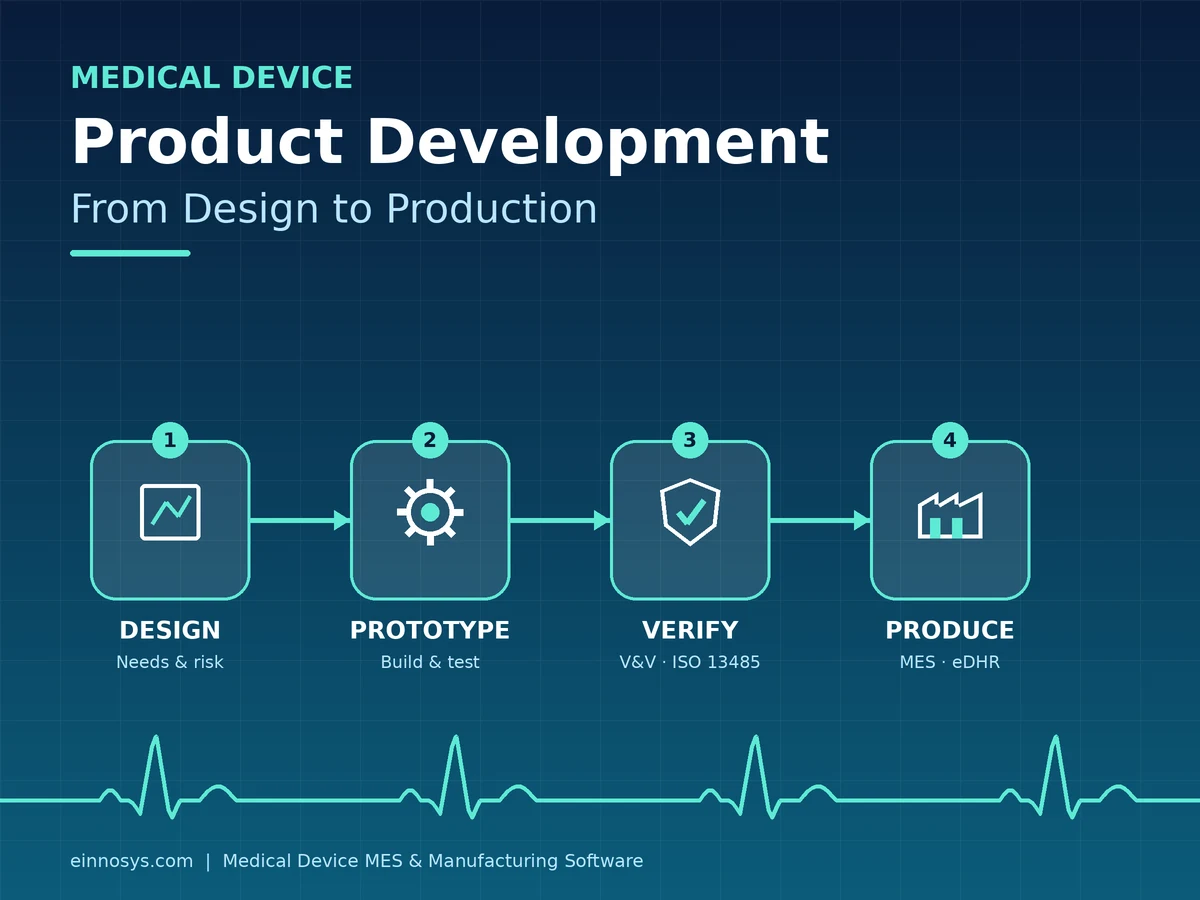
Bringing a medical device to market is hard. A single idea must pass through design controls, regulatory review, validation, and scaled production. Each step carries risk, and each step must be documented.
Medical device product development is no longer only an engineering task. It now depends on connected data, traceable processes, and reliable manufacturing software. This guide explains the full lifecycle. It also shows how a medical device manufacturing execution system and equipment connectivity help teams move from prototype to compliant production faster.
What Is Medical Device Product Development?
Medical device product development is the structured process of turning a clinical need into a safe, approved, manufacturable product. It covers concept, design, testing, regulatory approval, and production.
Unlike consumer electronics, medical devices operate under strict rules. Regulators such as the FDA (US), the EU MDR framework, and agencies in Japan, India, and the Gulf region require evidence at every stage. Quality standards like ISO 13485 add further expectations for documentation, risk management, and traceability.
So the goal is not only to build a good device. The goal is to prove, with data, that every unit is built the same way, every time.
The Six Stages of the Medical Device Product Development Lifecycle
- Concept and Feasibility:-
Teams define the clinical need, the intended use, and the target users. They also run early risk assessments. A clear scope here prevents costly redesigns later. - Design Inputs and Design Controls:-
Next, requirements become measurable specifications. Design controls link every requirement to a test, a risk, and a result. Strong traceability at this stage makes audits far easier. - Prototyping and Verification:-
Engineers build prototypes and verify that the design meets its inputs. Testing often repeats several times. Therefore, clean data capture matters. Manual notes slow teams down and introduce errors. - Validation and Regulatory Submission:-
Validation confirms that the device works for its intended users in real conditions. Meanwhile, the team compiles technical files and submits them for approval. Manufacturing processes also need validation, including installation, operational, and performance qualification. - Design Transfer:-
Design transfer moves the product from R&D to the factory. It is where many projects stall. Drawings, work instructions, test methods, and equipment settings must all be handed over accurately. Gaps in this handoff lead to yield loss and rework. - Production and Post-Market Monitoring:-
Once approved, the device enters full production. Quality teams track complaints, nonconformances, and corrective actions. Production data feeds back into design improvements.
Key takeaway: Stages 5 and 6 are where software has the biggest impact. This is also where many manufacturers still rely on paper and spreadsheets.
Why Manufacturing Software Matters
Paper records are slow. Spreadsheets are fragile. Neither scales well under regulatory scrutiny.
Modern medical device manufacturing software replaces manual tracking with automated, auditable workflows. It captures who built what, on which machine, with which materials, and under which settings. As a result, teams reduce errors and shorten audit preparation.
The right medical device manufacturing software solutions typically provide:
- Electronic batch and device history records
- Real-time process monitoring
- Material and component genealogy
- Automated quality checks and alerts
- Integration with ERP, PLM, and QMS systems
Many manufacturers also need custom medical device manufacturing software. Every product line has different assembly steps, test methods, and equipment. Off-the-shelf tools rarely fit perfectly. A flexible medical device manufacturing software company can tailor workflows to the actual shop floor instead of forcing the shop floor to adapt.
MES for Medical Device Manufacturing
A manufacturing execution system sits between planning systems and production equipment. It controls and records what happens on the floor, in real time.
MES for medical device manufacturing helps with several critical tasks:
- Enforcing process sequences. Operators cannot skip steps or use unapproved materials.
- Electronic device history records (eDHR). Every unit gets a complete, searchable record.
- Full traceability. If a component issue appears, teams can find affected devices within minutes.
- Compliance support. Audit trails and electronic signatures align with FDA 21 CFR Part 11 expectations.
- Faster design transfer. Approved routings and instructions load directly into production.
In short, medical device MES software turns design intent into controlled execution. It closes the gap between what engineering specified and what operators actually build.
However, an MES is only as good as its data. That data comes from machines. This brings us to equipment connectivity.
Equipment Connectivity: The Missing Link
Many factories run equipment from different vendors, built in different years, using different protocols. Without a common layer, machine data stays trapped. Operators then re-type values by hand, and errors creep in.
Equipment connectivity solves this. It lets machines share status, recipes, alarms, and measurements automatically with the MES and other systems. Einnosys offers several solutions that support this layer:
- EIGEMBox helps bring legacy and modern machines into a connected environment.
- EIGEMEquipment and EIGEM300Equipment support standards-based equipment communication for automated production.
- EIGEMLink helps link equipment and host systems for smoother data exchange.
- EIGEM84 supports automated material handoff between equipment and handling systems.
- EIGEMHMI gives operators a clear, intuitive interface to monitor and control processes.
Together, these tools give the MES reliable, real-time data. Consequently, manufacturers gain better yield, fewer manual entries, and stronger compliance records.
Test Before You Go Live with Simulation
Commissioning new automation on a live line is risky. A mistake can halt production or damage validated equipment.
Simulation reduces that risk. With EIGEMSim, teams can test equipment communication and integration logic before connecting real machines. They find issues early, shorten commissioning time, and protect validated processes.
Best Practices for Smoother Product Development
Follow these steps to improve outcomes across the lifecycle:
- Plan for manufacturing early. Involve manufacturing engineers during design, not after.
- Digitize design transfer. Move routings, instructions, and parameters into a controlled system.
- Connect your equipment. Automate data capture to remove transcription errors.
- Build traceability in from day one. It is far easier than adding it later.
- Choose scalable software. Pick medical device production software that grows with new products and sites.
- Test integrations virtually. Simulate before you commission.
- Close the feedback loop. Use production data to improve future designs.
Learn more about how automation fits regulated production on our Medical Device Manufacturing Automation page.
Conclusion
Successful medical device product development depends on more than good design. It requires controlled execution, connected equipment, and complete traceability from the first prototype to the millionth unit. Choosing the right MES, connectivity tools, and automation approach can cut risk, speed up approvals, and improve quality.
Einnosys helps medical device manufacturers achieve this with proven equipment connectivity, automation, and manufacturing software solutions. Whether you are scaling a new device or modernizing an existing line, Einnosys can help you build a smarter, more compliant path from design to production.
Realated Blogs:-
- Medical Device Software Development Services for Modern Manufacturing
- Medical Device Software Development Companies: Services & Solutions
- Medical Device Software Development: Process & Best Practices


