
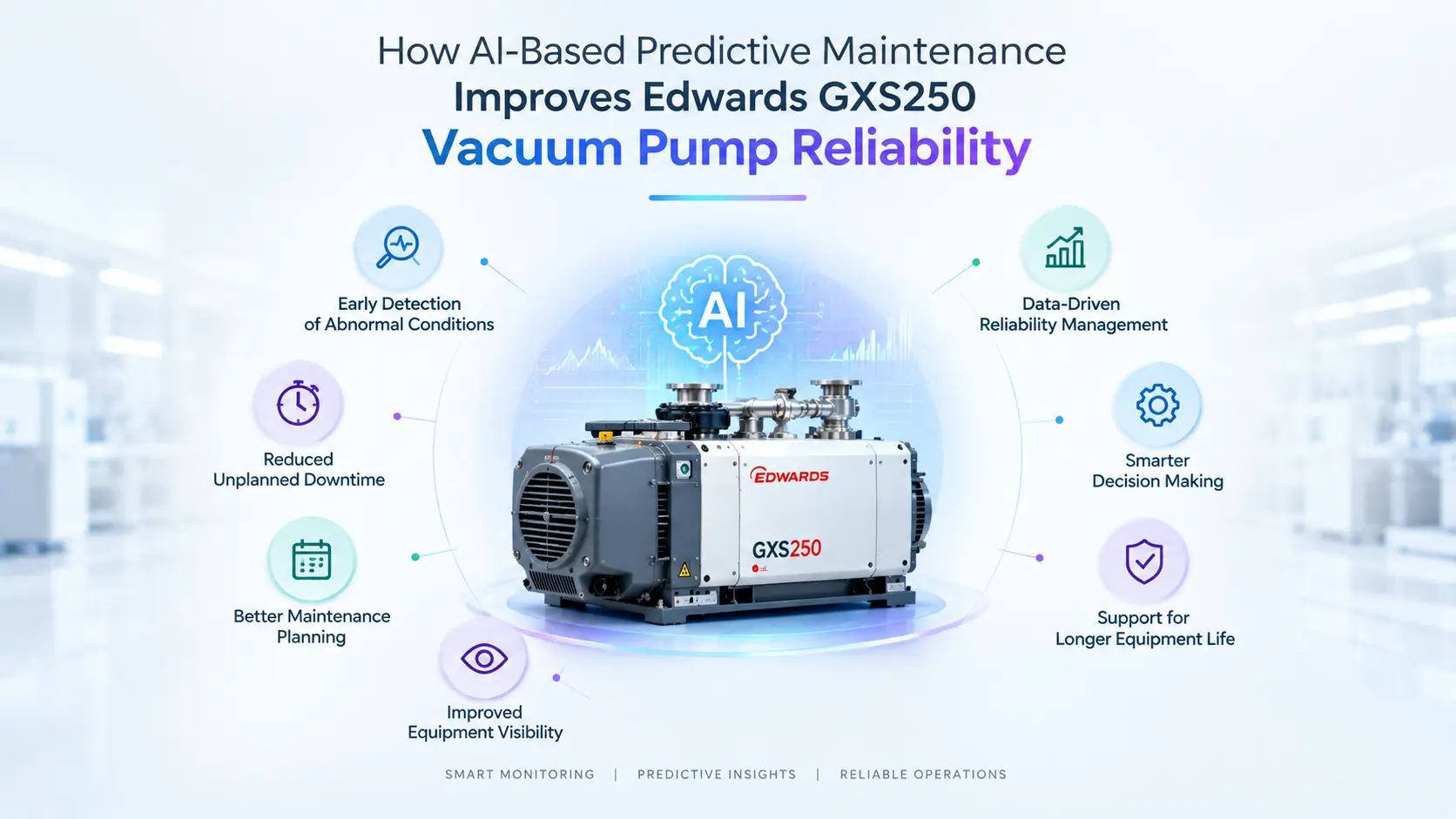
Vacuum pumps are foundational to semiconductor manufacturing, and even brief interruptions in vacuum performance can affect process stability, tool availability, and maintenance planning. Unplanned pump degradation is particularly disruptive because it often surfaces without warning, forcing reactive intervention at the worst possible time.
The Edwards GXS250 is a widely used dry vacuum pump in industrial and semiconductor applications, valued for its reliability in demanding process environments. As fabs push for higher equipment uptime and tighter operational efficiency, Edwards GXS250 predictive maintenance has become a practical way to gain earlier visibility into pump condition. Rather than waiting for a fault to appear, AI-based predictive maintenance analyzes available equipment condition indicators to help maintenance teams identify developing abnormalities before they escalate into unexpected failures.
It’s important to set expectations correctly: predictive maintenance does not eliminate failures outright. Instead, it gives engineering and maintenance teams more information, earlier, so they can make better-informed decisions about when and how to intervene.
Understanding the Edwards GXS250 Vacuum Pump
The Edwards GXS250 is a dry screw vacuum pump commonly deployed in semiconductor and industrial process environments where oil-free operation and stable vacuum performance are required. Dry pumps like the GXS250 are designed for continuous duty, often running for extended periods without interruption to support process throughput.
In a fab setting, several operational priorities depend directly on pump health:
- Stable vacuum performance to support consistent process conditions
- Continuous operation without unplanned interruptions
- High equipment availability across production tools
- Preventive maintenance scheduled around actual usage rather than guesswork
- Ongoing monitoring of pump condition to catch early warning signs
Because vacuum pumps operate continuously and often out of direct line of sight, maintenance teams benefit from having a clearer, ongoing picture of how each unit is performing over time.
Why Traditional Vacuum Pump Maintenance Can Be Challenging
Most facilities still rely on a mix of fixed maintenance schedules, manual inspections, reactive maintenance, and basic alarm thresholds. Each of these approaches has real limitations.
Fixed schedules assume a pump degrades at a predictable rate, which isn’t always true — a pump running under heavier load may need attention sooner, while another may still have useful service life left when it’s due for scheduled service. Manual inspections depend on technician availability and can miss subtle changes between visits. Reactive maintenance, by definition, only responds after a problem has already affected operation. And basic alarms typically trigger only once a parameter crosses a hard threshold, by which point the underlying issue may have been developing for some time.
In practice, equipment often experiences gradual changes — small shifts in vibration, temperature, or power draw — well before those changes become visible through standard alarms. Condition-based monitoring gives maintenance teams additional information during that earlier window, when there’s more room to plan a response.
How Edwards GXS250 Predictive Maintenance Works
Edwards GXS250 predictive maintenance typically relies on AI/ML-based condition monitoring layered on top of available equipment data. The general workflow follows a logical sequence:
Sensor Data → Data Collection → Condition Monitoring → AI/ML Analysis → Anomaly Detection → Maintenance Alert → Maintenance Action
Relevant operating signals may include parameters such as vibration, temperature, energy or power consumption, and other operating trends, depending on what data sources and sensors are available for a given installation. Not every parameter is necessarily available directly from the pump itself; in many cases, data comes from a combination of pump-level, tool-level, and facility-level sources.
It’s worth distinguishing between three different things that are often conflated:
- Measured data — raw readings collected directly from sensors or equipment interfaces
- Derived indicators — trends, averages, or calculated metrics built from that raw data
- AI-generated predictions — outputs from machine learning models that flag potential anomalies based on patterns in the underlying data
Keeping this distinction clear helps engineering teams properly evaluate and trust the information a predictive maintenance system provides.
Key Benefits of AI-Based Predictive Maintenance for GXS250 Pumps
- Early Detection of Abnormal Conditions
Trend analysis can help identify gradual shifts in pump behavior that may indicate a developing issue, often before it would trigger a conventional alarm.
- Reduced Unplanned Downtime
Earlier visibility into abnormal trends gives maintenance teams more lead time to plan an intervention before an unexpected stoppage occurs. This doesn’t guarantee downtime will be eliminated, but it can meaningfully improve planning.
- Better Maintenance Planning
Condition information supports more informed scheduling decisions and can help teams plan spare-parts availability around actual equipment condition rather than fixed calendar intervals.
- Improved Equipment Visibility
Centralized monitoring gives maintenance teams access to both historical and real-time condition data across multiple pumps, rather than relying on scattered manual logs.
- Data-Driven Reliability Management
Historical operating data, accumulated over time, can help engineers spot recurring patterns across similar equipment and refine maintenance strategies accordingly.
AI-Based Monitoring vs. Traditional Preventive Maintenance
| Aspect | Traditional Preventive Maintenance | AI-Based Predictive Maintenance |
|---|---|---|
| Maintenance Trigger | Fixed schedule | Equipment condition and trends |
| Data Usage | Periodic or manual | Continuous or frequent monitoring |
| Failure Detection | Inspection or equipment alarms | Pattern and anomaly analysis |
| Maintenance Planning | Calendar-based | Condition-based |
| Equipment Visibility | Limited historical context | Trend-based equipment visibility |
| Decision Support | Maintenance rules | Data-driven analysis |
What Parameters Can Be Monitored?
Predictive maintenance systems can analyze a range of available condition indicators, including:
- Vibration trends
- Temperature trends
- Energy consumption patterns
- Operating behavior over time
- Alarm history
- Maintenance history
- Other relevant equipment signals, where available
The exact parameters that can be monitored depend heavily on the monitoring architecture in place, the sensors installed, the equipment interface, and what data is accessible for a given pump and facility.
Integrating AI Predictive Maintenance Into Semiconductor Equipment Monitoring
Predictive maintenance for a single pump becomes considerably more valuable when integrated into a broader factory automation architecture. A simplified conceptual flow looks like this:
GXS250 Pump → Sensors/Data Sources → Monitoring Platform → AI/ML Analytics → Alerts/Dashboard → Maintenance Team
This kind of architecture, sometimes supported through AI predictive maintenance for GXS dry screw vacuum pumps, can serve multiple stakeholders across a fab, including equipment engineers, maintenance teams, factory engineering groups, reliability teams, and manufacturing operations. Where equipment data needs to be integrated with factory automation systems, this is also where SECS/GEM connectivity often plays a role in bringing pump-level and tool-level data together.
Deployment architecture — cloud-based, on-premises, or hybrid — is a separate decision that depends on facility IT policy, data governance requirements, and existing infrastructure, rather than a one-size-fits-all choice.
Practical Implementation Considerations
Before implementing predictive maintenance for GXS250 pumps or similar equipment, a few practical steps matter:
- Identify which equipment signals are actually useful and accessible
- Establish a baseline of normal operating behavior for comparison
- Collect sufficient historical data to support meaningful trend analysis
- Define what constitutes an anomaly condition for a given pump or process
- Configure alert thresholds appropriately to avoid alert fatigue
- Validate AI/ML outputs against engineering judgment before acting on them
- Integrate alerts into existing maintenance workflows rather than creating a parallel process
- Continuously refine models as new operating data becomes available
AI-generated predictions work best as a decision-support tool. They should inform and accelerate engineering judgment, not replace the validation that experienced maintenance and reliability engineers bring to the process.
How eInnoSys Supports AI-Based Predictive Maintenance
eInnoSys provides AI-based predictive maintenance technology designed for industrial equipment monitoring and semiconductor manufacturing environments. This includes supporting the kind of condition-based monitoring approach discussed throughout this article — helping equipment and maintenance teams move from fixed schedules toward more informed, data-driven maintenance decisions.
Within its portfolio, eInnoSys offers the XPump predictive maintenance system, built to monitor vacuum pump condition and support the kind of anomaly detection and trend analysis described above. eInnoSys’s broader work also connects with smart manufacturing initiatives, where equipment-level monitoring fits into larger factory automation and connectivity strategies.
As fabs continue to prioritize equipment reliability and operational efficiency, predictive maintenance approaches like these offer a practical path toward more proactive, informed maintenance decisions — without overstating what any single technology can guarantee.


