
The Core Technical Challenge: Tag Databases vs. State Models
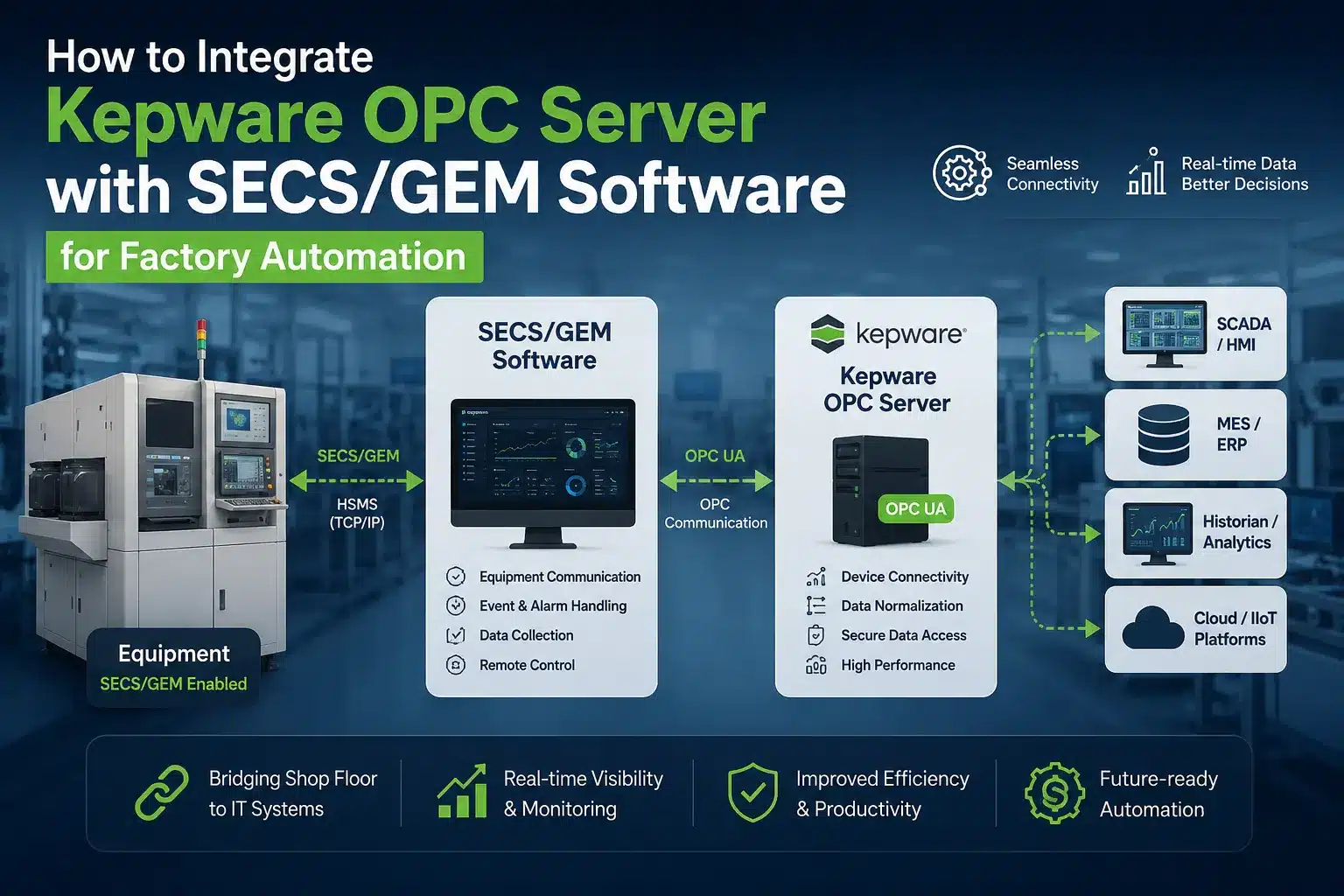
Before looking at the step-by-step deployment, it is vital to understand why direct communication between standard PLCs and a semiconductor host is natively impossible. A standard OPC UA Server Integration functions primarily on a tag-based architecture. It monitors memory registers within a controller—tracking an integer value representing a temperature variable or a boolean flag indicating a sensor state. Conversely, Semiconductor Equipment Communication demands a behavioral framework. The MES does not merely seek raw data points; it requires structured compliance models governed by the Generic Equipment Model (GEM / SEMI E30 standard). A GEM interface expects established protocol transitions, such as detailed operational lifecycles, structured event reporting configurations, and precise alarm notifications linked to physical anomalies. Without specialized translation middleware, raw industrial data points remain isolated from the broader factory ecosystem. By strategically combining a robust data collection engine like Kepware OPC Server with SECS/GEM Software, automation engineers can wrap generic industrial hardware in full SEMI-compliant logic, facilitating reliable, low-latency MES Integration with SECS/GEM.Architecture of a Unified Integration Architecture
Building a production-ready translation architecture requires a dual-stage software framework. The incoming data layer captures raw shop-floor signals, while the processing layer maps those data streams into standardized message types.The Inbound Layer: Kepware OPC Server
The deployment utilizes the Kepware OPC Server as the primary hardware aggregation layer. Whether your processing tools operate on Siemens S7, Allen-Bradley ControlLogix, Beckhoff TwinCAT, or Mitsubishi Q-Series controllers, Kepware normalizes these varied protocols into a consolidated OPC UA tag directory. This system establishes a single, secure gateway for all raw shop-floor data.The Middleware Layer: SECS/GEM Integration Software
The secondary component is the SECS/GEM Integration Software layer, configured via a developer toolkit like the eInnoSys SECS/GEM SDK. This translation engine systematically maps individual OPC UA node variables to corresponding GEM data types, including: Status Variables (SVs): Read-only data points updated during manufacturing cycles. Equipment Constants (ECs): Operational parameters modifiable by the host system. Collection Events (CEs): Critical process milestones that trigger automated event reports. Once configured, this integrated layer establishes a high-performance framework for OPC UA to SECS/GEM conversion. The system continuously packages raw tag changes into standard SECS-II (SEMI E5) Stream and Function messages, broadcasting them over High-Speed SECS Message Services (HSMS / SEMI E37) via standard TCP/IP networks.Step-by-Step Integration Guide
Executing a reliable deployment requires systematic engineering across configuration, mapping, and protocol definition stages.Step 1: Optimizing the Kepware OPC UA Server Interface
Begin by configuring the tag database within the communications platform to ensure clean data delivery.- Group all relevant registers into dedicated device channels within the application dashboard.
- Structure your tag taxonomy logically based on machine modules (e.g., Channel1.Device1.ThermalZone1.Temperature).
- Enable the OPC UA Server interface module within the global settings panel.
- Establish security profiles by importing matching TLS/SSL certificates and setting up explicit user credentials to ensure safe data transport between layers.
Step 2: Establishing Node Connections in the SECS/GEM Software
Next, initiate the configuration within your target developer toolkit or deployment suite.- Open your dedicated Equipment Integration Software workspace.
- Initialize an inbound connection routing to the secure endpoint provided by your local OPC UA server.
- Authenticate using the credentials configured in the previous step.
- Execute a target endpoint scan to import the complete device tag tree directly into the integration workspace.
Step 3: Executing Precise Tag-to-SEMI Data Mapping
With both systems connected, you must map generic industrial data variables to precise semiconductor definitions to ensure protocol compliance.| Kepware OPC UA Tag Path | SECS/GEM Mapping Entity | SEMI Variable ID (VID) | Functional Description |
|---|---|---|---|
| Device1.Chamber.RawTemp | Status Variable (SV) | SV #1001: ChamberTemperature |
Monitored continuously during processing. |
| Device1.Control.TargetSpeed | Equipment Constant (EC) | EC #5002: RecipeProcessSpeed |
Modified remotely by host via S2F15 commands. |
| Device1.Sensors.CycleComplete | Collection Event (CE) | CE #201: WaferProcessCompleted |
Triggers a structured S6F11 event report to MES. |
| Device1.Hardware.EStopActive | Alarm Instance (ALID) | ALID #50: EmergencyStopTriggered |
Broadcasts an immediate S5F1 alarm message. |
Step 4: Configuring the Core GEM Control State Model
To ensure complete compliance, you must define the foundational control states within your workspace logic. The middleware must handle transitions between OFFLINE, ONLINE LOCAL, and ONLINE REMOTE modes seamlessly. For example, when the MES issues a remote initialization command via an S2F21 message, the integration layer parses this instruction and toggles the corresponding control register within the device tag tree. This configuration guarantees that your hardware behaves exactly as expected by centralized automation systems.Solving the Challenge of Legacy Equipment Integration
In manufacturing environments, automating advanced OSAT (Outsourced Semiconductor Assembly & Test) lines often involves managing mixed-generation hardware. While newer fabrication platforms ship with native SEMI capabilities, legacy handling systems, custom dicing saws, and older packaging stations frequently lack built-in communication stacks. Deploying the Kepware OPC Server with SECS/GEM Software offers a powerful solution for Legacy Equipment Integration. Instead of embarking on costly, high-risk retrofits of internal tool components, engineers can mount basic digital/analog I/O blocks or entry-level PLCs to capture critical physical signals. By routing these raw signals through the industrial protocol server and mapping them via your specialized automation middleware, decades-old machinery can be upgraded to full SECS/GEM compliance. This non-invasive upgrade path protects capital investments while integrating older assets directly into modern Smart Manufacturing Automation workflows.Advanced Implementations: Industrial IoT and Predictive Maintenance
Moving beyond basic compliance configuration enables the deployment of high-value operations data architectures across the manufacturing line. By establishing a unified data path using Kepware OPC Server with SECS/GEM Software, factories can simultaneously dual-stream shop-floor metrics. While the integration software manages critical, real-time control routines with the MES, the primary OPC server can mirror sensor streams to localized Industrial IoT Integration platforms or big-data cloud repositories. This parallel architecture allows engineering teams to deploy advanced predictive maintenance models. High-frequency thermal fluctuations, mechanical vibration signatures, and power draw metrics can be analyzed continuously without interrupting vital machine-to-host control loops, driving down unscheduled downtime across the facility.Technical Validation and Testing Workflow
Before moving your updated interface layout to a live production environment, execute a rigorous verification protocol using dedicated simulation toolkits:- Validate Basic Connectivity: Use an independent OPC UA client to verify data visibility, check communication response times, and confirm that update rates align with your technical requirements.
- Simulate Host Operations: Connect a specialized tool like the eInnoSys SECS/GEM Simulator to mirror full host behavior. Run verification cycles for connection handshakes (S1F13/S1F14), execute remote commands, and check event reporting arrays.
- Execute Stress Testing: Flood the input registers with simultaneous tag changes to ensure the integration middleware packages and transmits data packets smoothly without message drops or latency spikes.
Conclusion
Bridging the operational gap between raw shop-floor logic and high-level semiconductor manufacturing requirements is essential for modern fab optimization. By implementing a reliable translation architecture combining the Kepware OPC Server with SECS/GEM Software, facilities can eliminate data silos and build highly responsive production environments. Deploying this integrated framework optimizes data flow, simplifies the modernization of legacy tools, and provides a scalable foundation for advanced automation. Utilizing specialized developer tools like eInnoSys SECS/GEM Integration Software ensures your factory achieves total compliance, maximizes tool availability, and stays competitive within the Industry 4.0 landscape.Contact Us Today


