
Semiconductor manufacturing runs on precision, speed, and airtight data integrity. At the center of that equation sits equipment communication. This is the invisible layer that lets a fab’s tools “talk” to its Manufacturing Execution System (MES) in real time. That’s where a SECS/GEM Driver comes in. Whether you’re a semiconductor equipment OEM building a new tool, or a fab engineer integrating legacy machines into a smart factory network, the SECS/GEM Driver you choose can make or break your automation roadmap.
So, in this guide, we’ll break down what a SECS/GEM Driver actually does. We’ll also cover why the right choice matters more than most teams realize, along with the ten features that separate a merely functional driver from one that scales with your operation.
What is a SECS/GEM Driver?
A SECS/GEM Driver is a software component that implements the SEMI SECS-II and GEM (Generic Equipment Model) standards. In other words, it allows semiconductor manufacturing equipment to communicate with host systems like MES, SCADA, or equipment automation platforms. Specifically, it handles the message structure, state models, and data exchange rules defined under SEMI E30 (GEM) and related standards, typically over HSMS (High-Speed SECS Message Services) communication.
In practical terms, the driver acts as the translator between a piece of fab equipment and the rest of the factory’s digital ecosystem. As a result, it manages everything from equipment status reporting and alarm handling to recipe management and data collection, without requiring engineers to build a communication stack from scratch.
Why Choosing the Right SECS/GEM Driver Matters
Not all SECS/GEM Drivers are built the same, and the difference shows up fast once a driver is deployed on the fab floor. For example, a poorly designed driver can mean dropped connections and incomplete data logging. It can also lead to non-compliance with SEMI standards, or costly custom development just to support a new tool.
A well-built driver, on the other hand, becomes a reusable foundation. It shortens equipment qualification timelines, reduces engineering overhead, and keeps a fab’s automation strategy flexible as new tools and standards emerge.
For OEMs, the stakes are just as high. Fabs increasingly require GEM compliance as a condition of equipment purchase, and a driver that’s slow to certify or difficult to customize can delay time-to-market and jeopardize deals.
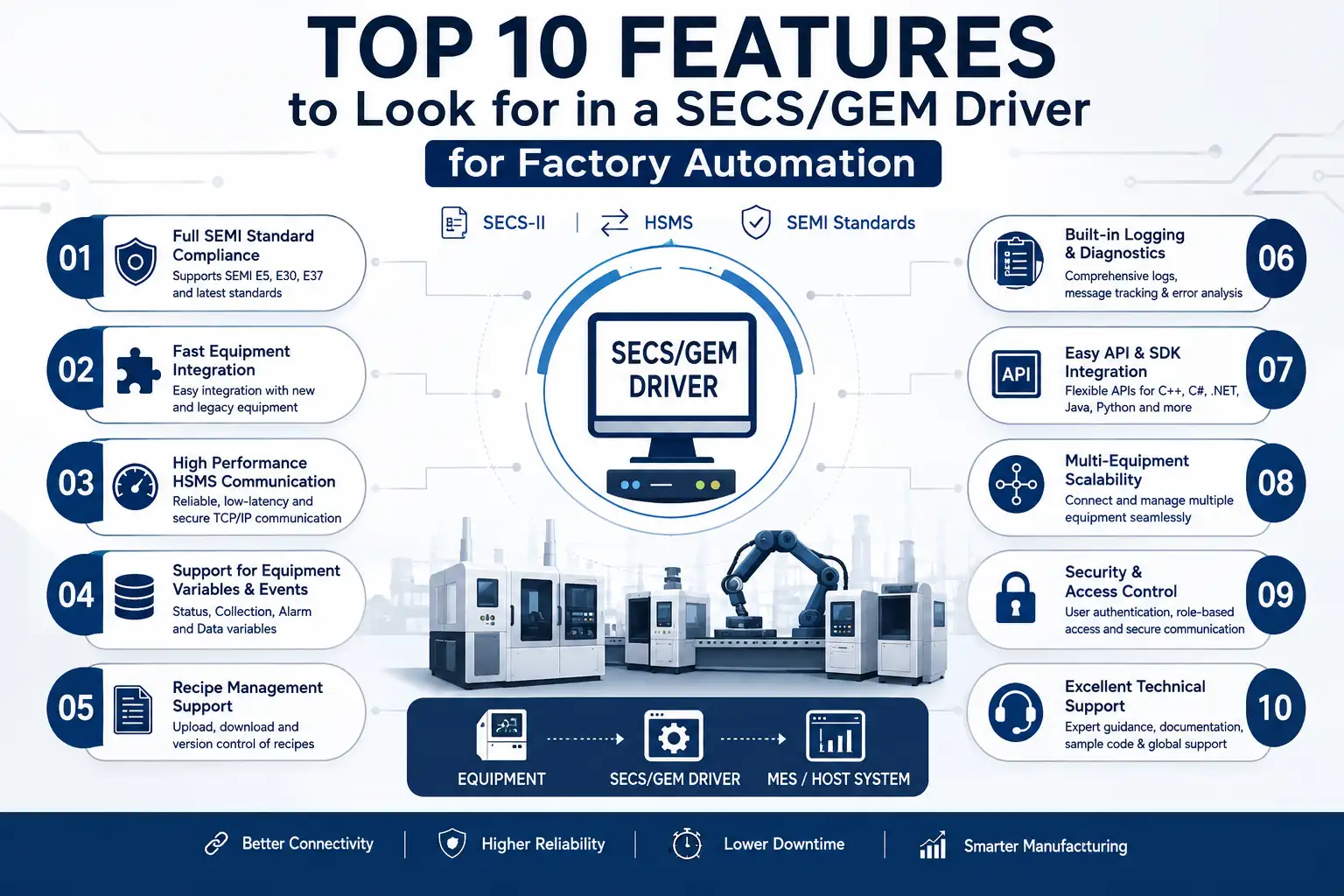
Top 10 Features to Look for in a SECS/GEM Driver
1. Full SEMI E30 (GEM) and SECS-II Compliance
The foundation of any driver is standards compliance. Look for full support of the GEM state models (communication, control, and processing states), along with correct implementation of SECS-II message formats. Partial or non-standard implementations often surface as integration headaches down the line.
2. Robust HSMS Communication Support
Most modern equipment communicates over Ethernet rather than the older SECS-I serial protocol. So, strong HSMS communication support is essential. This includes support for both Active and Passive connection modes, plus proper handling of the HSMS state machine and resilience against network interruptions.
3. Configurable GEM Capabilities
Every tool has different automation needs. A flexible driver lets you configure which GEM capabilities are active — alarm management, event reporting, remote commands, equipment constants, and more — without requiring a code rewrite for each new equipment type.
4. Reliable Recipe Management
Recipe management is one of the most operationally sensitive functions in equipment automation. A strong driver should support recipe upload/download, verification, and versioning in a way that prevents mismatches between what the host expects and what the equipment executes.
5. Real-Time Data Collection and Reporting
Fabs run on data. Look for drivers that support trace data collection, event-driven reporting, and configurable data variables (SVIDs, ECIDs, DVVALs) so engineering and quality teams can monitor equipment performance without manual intervention.
6. Alarm and Exception Handling
Equipment downtime is expensive, so alarm handling can’t be an afterthought. A capable driver should support structured alarm reporting, severity classification, and integration with host-side alerting so issues are caught and resolved quickly.
7. Ease of Integration with MES and Automation Platforms
A driver shouldn’t exist in isolation. It needs to integrate smoothly with your Manufacturing Execution System (MES), SCADA, or broader equipment automation software stack — ideally through well-documented APIs or SDKs that reduce custom development work.
8. Support for Legacy Equipment Integration
Many fabs run a mix of new and decades-old tools. A driver that supports legacy equipment integration can bridge older SECS-I equipment, or non-standard implementations, into a modern communication layer. As a result, it extends the life of existing capital equipment instead of forcing costly replacements.
9. Scalability Across Multiple Equipment Types
As a fab or OEM’s equipment fleet grows, the driver needs to scale with it. Look for architecture that supports multiple simultaneous equipment connections, multi-tool deployments, and consistent behavior across different tool types without a linear increase in engineering effort.
10. Vendor Support, Documentation, and SEMI Standard Updates
SEMI standards evolve, and equipment requirements shift with them. A driver backed by responsive vendor support, clear documentation, and a track record of staying current with SEMI standard revisions protects your long-term investment far better than a one-time software purchase.
Why Choose EIGEMEquipment
Built Around Standards Compliance and Flexibility
eInnoSys EIGEMEquipment is built around these exact priorities. Namely, it delivers a fully SEMI E30-compliant SECS/GEM Driver with robust HSMS communication and configurable GEM capabilities. It also offers native support for recipe management, real-time data collection, and alarm handling, all through a well-documented SECS/GEM Driver SDK designed for both OEMs and fabs.
Built to Scale with Your Fab
Its architecture supports legacy equipment integration alongside modern tool connectivity, making it a practical fit for mixed-fleet environments. Additionally, the EIGEMEquipment SDK is engineered for scalability. So, whether you’re connecting a single tool or managing an entire fab floor, the same foundation grows with your needs. Combined with ongoing vendor support and alignment with evolving SEMI standards, EIGEMEquipment offers a dependable path to semiconductor equipment integration without the custom-build overhead.
Ultimately, for teams evaluating SECS/GEM communication software, EIGEMEquipment stands out as an equipment connectivity solution built specifically for the realities of semiconductor factory automation.
Conclusion
Choosing the right SECS/GEM Driver isn’t just a technical checkbox. Rather, it’s a decision that shapes how efficiently your equipment communicates, how quickly you can qualify new tools, and how well your factory automation strategy scales over time. In short, from SEMI E30 compliance and HSMS communication to recipe management and legacy equipment support, the ten features outlined above form a practical checklist for evaluating any driver on the market.
Looking for a reliable SECS/GEM Driver? Discover how EIGEMEquipment simplifies semiconductor equipment communication with full SEMI compliance. Visit: https://www.einnosys.com/eigemequipment/


