
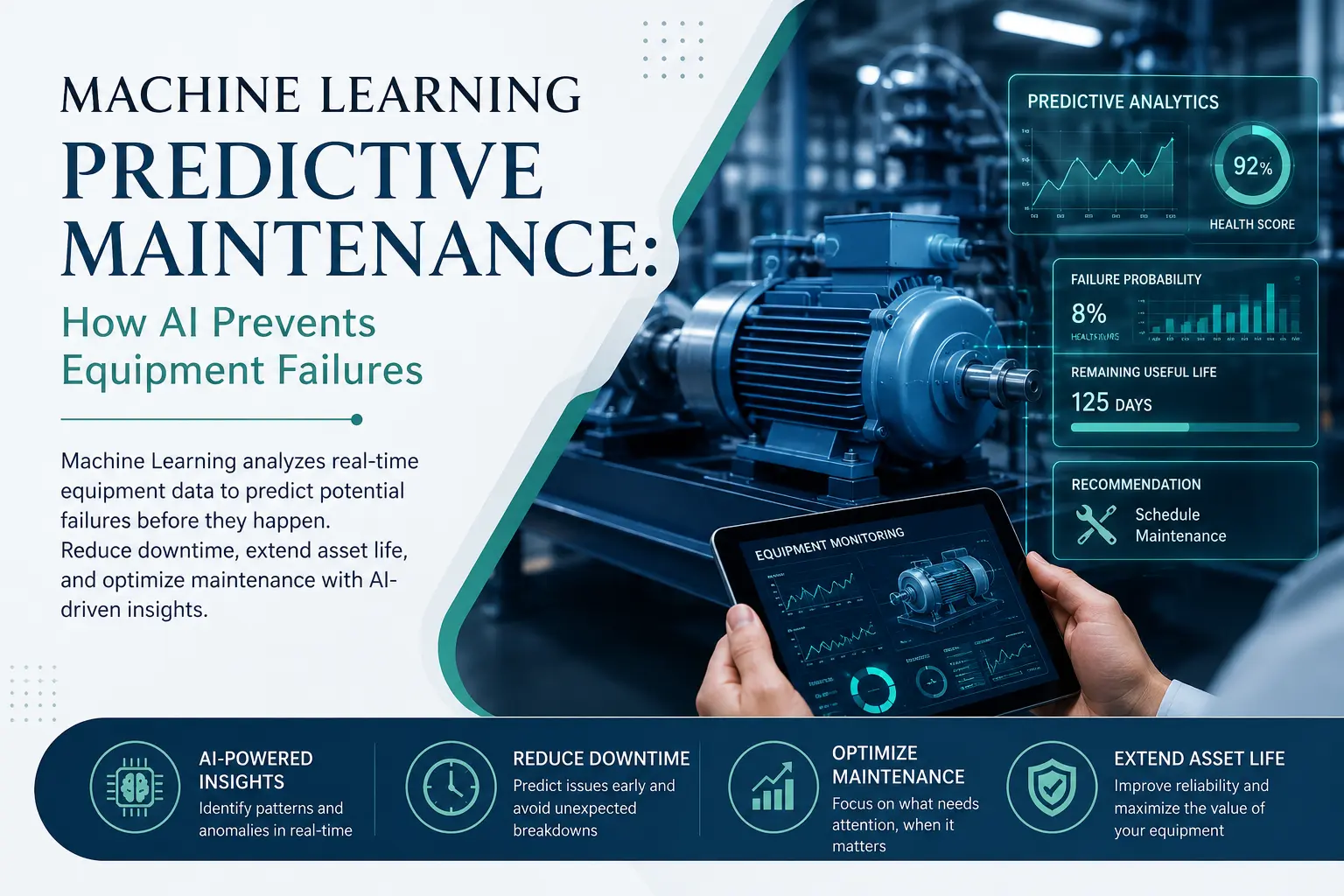
Unplanned equipment downtime is one of the most expensive problems in modern manufacturing. In semiconductor fabs, a single unexpected tool failure can halt production for hours, scrap in-process wafers, and cost hundreds of thousands of dollars in lost output. As fabs push toward tighter tolerances, higher throughput, and 24/7 operations, the old model of reactive repairs and calendar-based preventive maintenance is no longer good enough.
Machine learning predictive maintenance is changing that. By combining real-time equipment data with AI-driven analytics, manufacturers can now predict failures before they happen, schedule maintenance only when it’s actually needed, and keep critical tools running longer and more reliably.
This guide breaks down how AI predictive maintenance works, why it matters for semiconductor manufacturing, and how the right data infrastructure — like EIGEMBridge — makes it possible.
What Is Predictive Maintenance?
Predictive maintenance is a maintenance strategy that uses data — sensor readings, historical performance, and operating conditions — to predict when a piece of equipment is likely to fail, so teams can intervene before it does.
It sits between two older approaches:
- Reactive maintenance: Fix equipment after it breaks. Simple, but costly in downtime and unplanned scrap.
- Preventive maintenance: Service equipment on a fixed schedule, regardless of actual condition. Safer than reactive maintenance, but often wastes resources servicing healthy equipment — or misses failures that happen between scheduled checks.
Predictive maintenance replaces the guesswork of fixed schedules with condition-based insight. Instead of asking “when is this component due for service?” it asks “what is this equipment’s data telling us right now?” That shift is what makes machine learning for equipment maintenance so valuable — it turns raw sensor data into an early warning system.
How Machine Learning Works in Maintenance
Machine learning models learn from historical and real-time data to recognize the subtle patterns that precede equipment failure — patterns that are often too complex or too gradual for a human operator to catch by watching a dashboard.
The typical workflow looks like this:
- Data collection — Sensors and equipment controllers continuously capture parameters like temperature, vibration, pressure, current draw, cycle counts, and process recipe data.
- Data aggregation and contextualization — Raw signals are collected, time-stamped, and linked to specific tools, chambers, and process steps.
- Model training — Algorithms are trained on historical data, including past failure events, to learn what “normal” looks like and what patterns tend to precede a breakdown.
- Real-time inference — Once trained, models continuously score live equipment data, flagging anomalies or degrading trends as they emerge.
- Alerting and action — When risk crosses a threshold, the system notifies maintenance teams with enough lead time to plan an intervention.
The result is a continuously learning system that gets more accurate as it accumulates more equipment history — something a fixed maintenance calendar can never do.
How AI Detects Equipment Failures Early
Equipment failure prediction using AI relies on a few core techniques working together:
- Anomaly detection — Identifying when equipment behavior deviates from its normal operating baseline, even subtly.
- Trend and degradation analysis — Tracking gradual shifts in parameters (like rising vibration or slowing cycle times) that indicate wear.
- Pattern recognition across failure history — Comparing current sensor signatures against patterns that previously led to failure, so the system can recognize an early version of a known problem.
- Multivariate correlation — Looking at combinations of parameters together, since many failures only become visible when several variables move in tandem, not in isolation.
Because these models work on continuous, real-time equipment monitoring rather than periodic manual checks, they can catch problems days or weeks before a breakdown — often while the equipment is still running within its nominal specification limits, just trending in the wrong direction.
Benefits of AI Predictive Maintenance
Manufacturers adopting AI predictive maintenance typically see measurable gains across several areas:
- Reduced unplanned downtime — Failures are addressed before they cause a full stoppage.
- Lower maintenance costs — Service is performed based on actual equipment condition, not an arbitrary calendar, cutting unnecessary part replacements and labor.
- Improved Overall Equipment Effectiveness (OEE) — Less downtime and fewer quality excursions directly raise availability, performance, and quality metrics.
- Extended equipment lifespan — Catching problems early prevents minor issues from cascading into major component damage.
- Better resource and spare parts planning — Maintenance teams can schedule work and order parts proactively instead of scrambling during an outage.
- Improved safety — Early detection reduces the risk of catastrophic failures that could endanger personnel or damage adjacent systems.
- Data-driven decision-making — Engineering and operations teams gain visibility into equipment health trends across the entire fab, not just isolated incidents.
Together, these benefits compound: less downtime means higher throughput, and higher throughput means a stronger return on every dollar spent on capital equipment.
Predictive Maintenance in Semiconductor Manufacturing
Semiconductor fabs are one of the most demanding environments for maintenance strategy — and one of the industries with the most to gain from getting it right.
A few reasons predictive maintenance in semiconductor manufacturing is especially critical:
- High equipment cost and complexity — Tools like etchers, deposition systems, and lithography equipment cost millions of dollars and involve hundreds of interacting subsystems.
- Tight process windows — Even small equipment drift can shift process parameters enough to affect yield, long before an outright failure occurs.
- Continuous operation — Fabs typically run 24/7, so unplanned downtime has an outsized impact on output and delivery commitments.
- High cost of scrap — A tool failure mid-process can scrap an entire lot of wafers, each representing significant material and processing investment.
- Complex, multi-vendor equipment fleets — Fabs often run tools from many different OEMs, each with its own data formats and communication protocols, making unified monitoring a real challenge.
For fab managers and equipment engineers, the objective isn’t just avoiding breakdowns — it’s protecting yield, throughput, and process stability at the same time. That requires equipment data that is timely, complete, and connected across the entire tool fleet.
How EIGEMBridge Enables Real-Time Equipment Data Collection
AI predictive maintenance is only as good as the data feeding it. Machine learning models can’t predict what they can’t see — and in most fabs, equipment data is scattered across different tools, protocols, and legacy systems that don’t talk to each other.
This is where EIGEMBridge plays a central role. EIGEMBridge is built to bridge the gap between fab equipment and the software systems that need real-time visibility into that equipment’s condition. It enables:
- Real-time equipment monitoring across diverse tool sets, including legacy and multi-vendor equipment
- Standardized data collection, translating equipment-specific protocols (such as SECS/GEM) into consistent, usable data streams
- Continuous, high-fidelity data feeds that give machine learning models the granularity they need to detect early-stage anomalies
- Seamless integration with MES, analytics platforms, and predictive maintenance models, so equipment data flows directly into the systems making predictions
- Scalability across the fab, connecting new and existing tools without requiring a complete infrastructure overhaul
In short, EIGEMBridge provides the real-time equipment data backbone that makes industrial IoT predictive maintenance possible at fab scale. Without reliable, real-time data collection, even the most sophisticated machine learning model is working with an incomplete picture.
Best Practices for Implementation
Rolling out AI predictive maintenance successfully takes more than just deploying a model. Fab managers and smart manufacturing decision makers should keep a few best practices in mind:
- Start with reliable data infrastructure first. Before investing heavily in modeling, make sure equipment data is being captured consistently, in real time, and in a usable format.
- Prioritize high-impact equipment. Begin with tools that have the highest downtime cost or the most frequent failure history, so early wins are visible and measurable.
- Involve equipment and reliability engineers early. Their domain knowledge of failure modes is essential for training accurate, trustworthy models.
- Set realistic alert thresholds. Too many false alarms erode trust in the system; too few risk missing real issues. Thresholds should be tuned iteratively.
- Integrate predictions into existing workflows. Alerts should flow into the maintenance and MES systems teams already use, not create a separate tool no one checks.
- Treat it as a continuous program, not a one-time project. Models improve as more data and more failure events are captured, so plan for ongoing tuning and expansion.
- Measure and communicate ROI. Track downtime reduction, OEE improvement, and maintenance cost savings to build the case for scaling across more of the fab.
Conclusion
Machine learning predictive maintenance gives semiconductor and industrial manufacturers a way to move from reacting to equipment failures to anticipating them. By combining real-time equipment monitoring with AI-driven analysis, fabs can reduce unplanned downtime, extend equipment life, and protect the yield and throughput that drive profitability.
But every predictive maintenance strategy depends on one foundational requirement: consistent, real-time access to equipment data. That’s exactly what EIGEMBridge is built to deliver.
Use EIGEMBridge to collect real-time equipment data and enable AI-driven predictive maintenance for smarter, more reliable manufacturing operations. Learn more about EIGEMBridge.


