
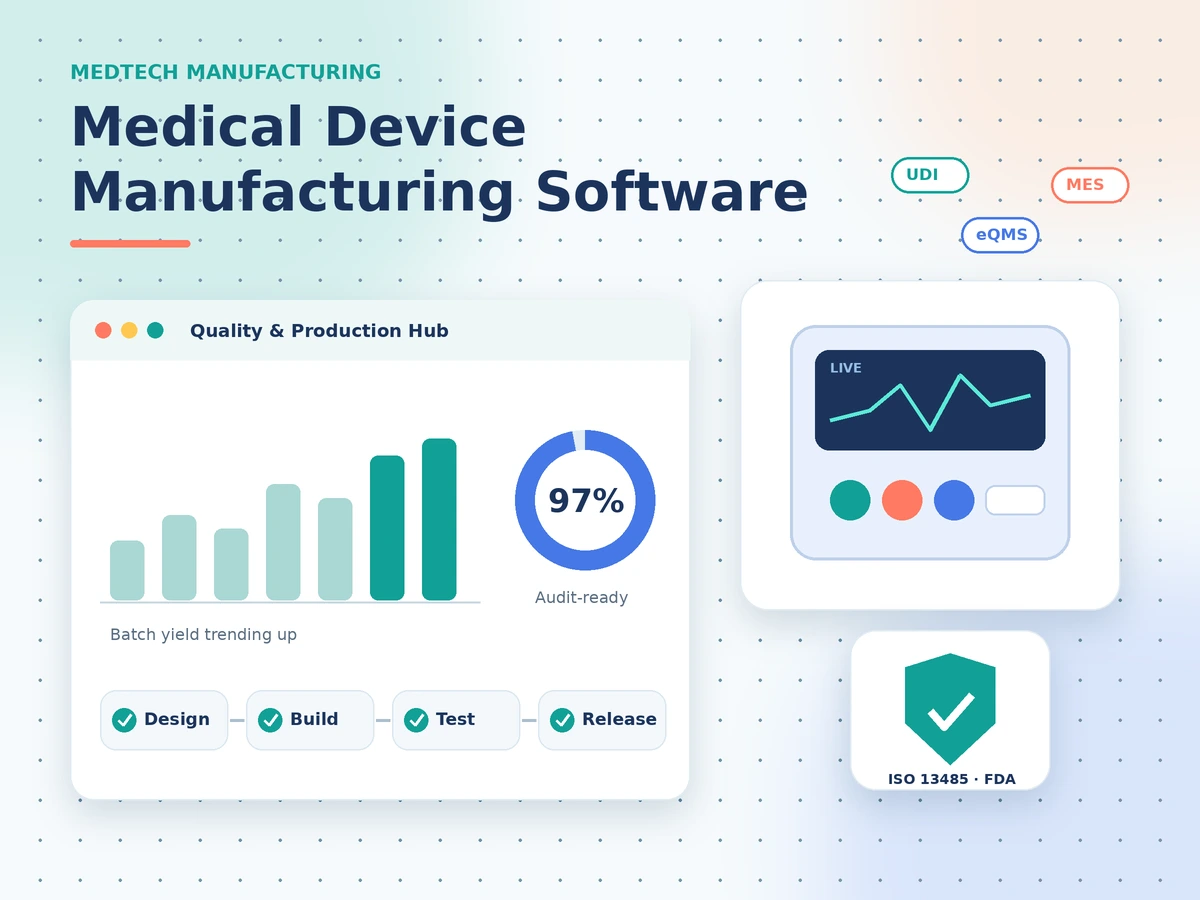
Medical device manufacturing software helps manufacturers control production, maintain compliance, and trace every unit from raw material to shipment. The industry faces strict regulations, complex supply chains, and zero tolerance for defects. Spreadsheets, paper travelers, and disconnected machines can no longer keep up.
This guide explains what medical device production software does, why a manufacturing execution system (MES) matters, and how integration and automation reduce risk. It is written for production managers, quality teams, manufacturing engineers, and IT decision-makers.
What Is Medical Device Manufacturing Software?
Medical device manufacturing software is a set of digital tools that plan, run, monitor, and document production on the shop floor. It connects people, machines, and processes in one system.
Typical capabilities include:
- Work order and batch management
- Device history record (DHR) generation
- Real-time equipment monitoring
- Quality checks and non-conformance tracking
- Full lot and serial traceability
- Audit-ready reporting
Medical device production software works alongside ERP and QMS platforms. ERP handles planning and finance. QMS handles quality documents. The shop floor layer fills the gap between them and records what actually happens during production.
Why Medical Device Manufacturers Need Specialized Software
Medical device makers operate under frameworks such as FDA 21 CFR Part 820, 21 CFR Part 11, and ISO 13485. These standards demand documented, controlled, and traceable processes.
Generic software often falls short for four reasons:
- Compliance gaps. Manual records are slow to produce and prone to error.
- Limited traceability. A recall requires finding affected units within hours, not weeks.
- Data silos. Machines, inspection stations, and business systems rarely share data.
- Scaling problems. Paper-based methods break down as volume and product variety grow.
Purpose-built software addresses these issues directly. It enforces process steps, captures data automatically, and builds the compliance record as work happens.
MES for Medical Device Manufacturing
A medical device manufacturing execution system is the core of a digital factory. It manages and records production in real time. Manufacturers often search for this under terms such as MES software for medical device manufacturers, medical device MES software, or manufacturing execution system medical devices. All of them refer to the same layer: the system that runs between the plan and the machine.
Core MES Functions
- Production control: Guides operators through each step and blocks out-of-sequence work.
- Electronic batch and device records: Builds the DHR automatically instead of by hand.
- Genealogy and traceability: Links components, operators, equipment, and test results to each finished device.
- Quality management on the line: Triggers holds when a measurement falls outside limits.
- Performance visibility: Tracks OEE, downtime, yield, and cycle time.
Business Benefits
- Faster audit preparation
- Fewer deviations and reworks
- Shorter release times for finished lots
- Stronger data integrity
- Better use of equipment and labor
An MES is only as strong as the data it receives, so connectivity matters as much as software features.
MES Integration for Medical Devices
MES integration for medical devices means connecting the MES with equipment, ERP, QMS, and other plant systems. Without it, operators re-key data, and every manual entry is a compliance risk.
Strong integration delivers three results:
- Automatic data capture from machines, with no transcription errors
- Two-way communication so recipes, parameters, and work orders flow down to equipment
- A single source of truth across production, quality, and planning
Medical equipment software integration is often the hardest part of a digital project. Plants run machines from different vendors and different decades, and each speaks its own protocol. A flexible connectivity layer solves this. It translates between legacy equipment and modern software, so you do not have to replace working machines.
Medical Device Manufacturing Automation
Medical device manufacturing automation goes beyond robots and conveyors. It covers any step where software removes manual effort or human variation.
Common examples include:
- Automated recipe download to machines
- Barcode-driven material verification
- Electronic signatures and approvals
- Automatic hold and release logic
- Real-time alerts for process drift
Automation reduces variation, which supports consistent device quality. It also frees skilled staff from data entry so they can focus on improvement work.
Einnosys Solutions for Medical Device Manufacturers
Einnosys builds equipment connectivity and integration tools that help manufacturers link machines to MES and enterprise systems. Its medical devices industry page outlines how these solutions apply to regulated production environments.
Here is how the product line supports a connected medical device factory:
- EigemBox supports equipment connectivity and data gathering at the machine level.
- EigemHMI provides an operator interface for monitoring and interacting with connected equipment.
- EigemEquipment helps connect production equipment to host and MES systems.
- Eigem300Equipment extends connectivity to equipment that follows 300 mm standards.
- EigemLink links equipment and software systems for dependable data exchange.
- Eigem84 supports integration for specific equipment and protocol requirements.
- EigemSim simulates equipment so teams can test integrations before going live.
Simulation deserves special mention. Testing against a simulator reduces commissioning time and avoids disrupting live production, which matters in validated environments.
How to Choose a Medical Device Manufacturing Software Partner
- Not every vendor understands regulated production. Use these criteria when you compare options.
- Regulatory readiness. Ask how the system supports Part 11 controls, audit trails, and electronic signatures.
- Integration depth. Confirm that the vendor can connect to your existing equipment, not just new machines.
- Scalability. Choose a platform that works for one line today and many sites tomorrow.
- Validation support. Look for documentation and testing tools that shorten your validation effort.
- Service and expertise. Implementation quality often matters more than feature lists. Look for domain experience and responsive support.
- Total cost of ownership. Consider licensing, integration, validation, and long-term maintenance together.
Implementation Best Practices
A phased approach lowers risk:
- Map your current process. Identify manual steps, paper records, and data gaps.
- Prioritize quick wins. Start with a line where traceability or downtime hurts most.
- Connect equipment first. Reliable data is the foundation for everything else.
- Test before go-live. Use simulation and pilot runs.
- Train operators early. Adoption decides whether the project succeeds.
- Expand gradually. Replicate proven configurations across lines and sites.
Conclusion
Medical device manufacturing software is no longer optional for manufacturers that want to stay compliant, competitive, and audit-ready. A strong MES, solid equipment integration, and targeted automation work together to improve traceability, reduce errors, and speed up release.
Einnosys helps medical device manufacturers connect equipment, integrate systems, and build a dependable data foundation for MES and automation projects. Explore the solutions above to find the right fit for your production environment.
Related Blogs:-
- Medical Device Software Development: A Complete Guide
- Medical Device Software Development Companies: Services & Solutions
- ERP for Medical Device Manufacturers: Key Benefits & Features


