
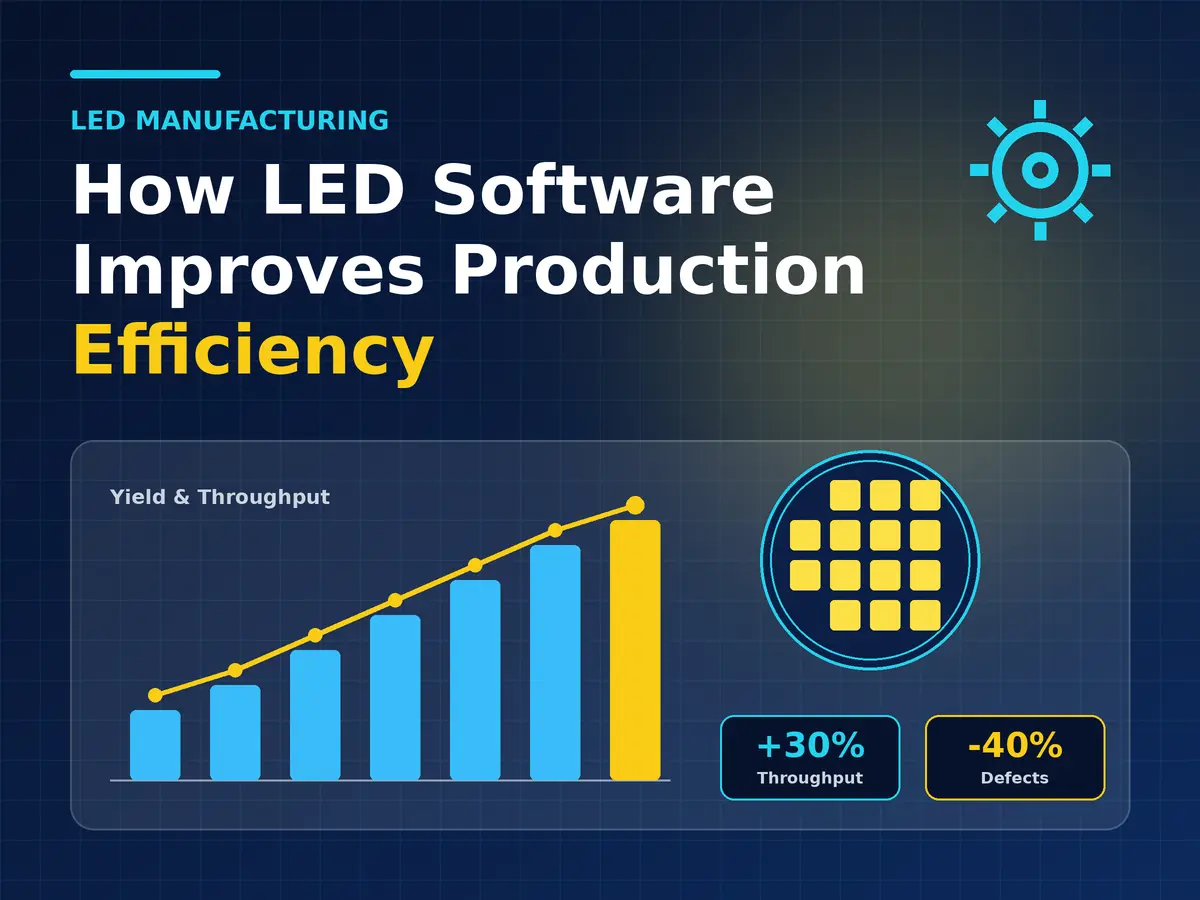
LED manufacturing software connects machines, processes, and production data in one system. As a result, factories run faster, make fewer errors, and respond quickly to problems.
LED production involves many stages and many machines. When those machines work in isolation, problems follow. Data gaps appear, manual work increases, and downtime goes unnoticed. Traceability also suffers.
Automation and MES (Manufacturing Execution System) tools solve these problems. This guide explains how they work and how to apply them.
Key takeaways
- LED manufacturing software links equipment, recipes, alarms, and quality data.
- Equipment integration is the foundation of automation.
- An LED manufacturing MES adds tracking, traceability, and visibility.
- KPIs such as OEE show whether the software delivers results.
What Is LED Manufacturing Software?
LED manufacturing software is a set of tools that manages and connects LED production activities. It gives manufacturers one clear view of what happens on the floor.
It typically manages:
- Production processes and equipment
- Production data, recipes, and parameters
- Alarms and events
- Quality information
- Material and product traceability
- Host and MES systems
In other words, it turns separate machines into a coordinated production line
Key Challenges in LED Manufacturing
Most LED plants face similar obstacles. Common challenges include:
- Multiple machines from different vendors
- Disconnected equipment and systems
- Manual data collection
- Limited real-time production visibility
- Equipment downtime and production bottlenecks
- Strict traceability requirements
- Legacy equipment that is hard to integrate
- Inconsistent process data
- Difficulty scaling automation
Because of these issues, teams spend more time chasing data than improving output
How LED Manufacturing Software Improves Production Efficiency
The right software improves efficiency in several ways. The table below summarizes the main capabilities.
| Capability | Efficiency Impact |
|---|---|
| Equipment Integration | Connects machines for automated data exchange |
| Real-Time Monitoring | Provides live visibility into equipment and production status |
| Production Tracking | Tracks products, lots, and production progress |
| Data Collection | Reduces manual data entry and improves data accuracy |
| Recipe Management | Maintains consistent production parameters |
| Alarm Management | Enables faster response to equipment and process issues |
| Traceability | Maintains complete production and process records |
| Performance Monitoring | Identifies bottlenecks, downtime, and inefficient processes |
| System Integration | Connects equipment with MES, host, ERP, and other factory systems |
Together, these capabilities reduce waste and keep production steady.
The Role of LED Manufacturing Automation
LED manufacturing automation removes repetitive manual tasks from daily operations. It also makes production data more reliable.
Key automation functions include:
- Automated equipment communication
- Machine data collection
- Production status monitoring
- Recipe and parameter management
- Automated alarms and events
- Material and product tracking
- MES integration and production analytics
Consequently, operators can focus on process improvement instead of paperwork.
How an LED Manufacturing MES Supports Production
An LED manufacturing MES manages and tracks production from start to finish. It sits between machines and business systems such as ERP.
An MES typically provides:
- Production planning and execution
- Work-in-progress tracking
- Material and process traceability
- Production data collection
- Quality tracking and reporting
- Real-time visibility
Moreover, an MES depends on good equipment data. That is why integration matters so much.
Equipment Integration in LED Manufacturing
Equipment integration is the backbone of LED factory software. Without it, even the best MES has little data to work with.
SECS/GEM is the standard protocol for equipment-to-host communication. eInnoSys offers several products that support it:
- EIGEMEquipment: Adds SECS/GEM equipment integration so machines can exchange standardized data with host systems.
- EIGEMHost: Provides SECS/GEM host software for host-side communication between the factory and its equipment.
- EIGEMLink: Delivers equipment integration software that connects manufacturing equipment with other software systems.
- EIGEMBox: Enables legacy equipment integration, so older machines join modern automation environments without replacement.
Notably, EIGEMBox lets plants modernize step by step. They keep valuable machines and still gain connectivity.
Benefits of LED Factory Automation
LED factory automation delivers benefits across the plant:
- Higher production throughput
- Reduced manual intervention
- Improved equipment utilization
- Lower production errors
- Reduced downtime
- Better traceability
- Faster response to alarms
- Improved production visibility
- More consistent processes
- Easier scalability
Many of these gains compound. For example, faster alarm response reduces downtime, which then raises throughput.
LED Production Software: Key Features
When comparing LED production software, look for these features:
| Feature | Purpose |
|---|---|
| Equipment Connectivity | Connects machines with factory systems |
| SECS/GEM Communication | Enables standardized equipment-to-host communication |
| Real-Time Monitoring | Tracks equipment and production status |
| Data Collection | Captures equipment and process data |
| Recipe Management | Maintains consistent production parameters |
| Alarm Management | Tracks and manages equipment alarms |
| Traceability | Records product, lot, and process history |
| Reporting | Provides production and equipment performance insights |
| MES Integration | Connects production operations with manufacturing systems |
Best Practices for Implementing LED Manufacturing Software
A careful rollout reduces risk. Follow these steps:
- Assess existing equipment and processes.
- Identify production bottlenecks.
- Prioritize critical machines for integration.
- Standardize equipment communication.
- Centralize production data.
- Integrate equipment with MES and host systems.
- Implement real-time monitoring and traceability.
- Start with high-impact processes, then scale gradually.
- Choose software that supports future expansion.
Measuring the Impact of LED Manufacturing Software
Track clear KPIs to confirm results. Useful measures include:
- OEE (Overall Equipment Effectiveness)
- Production throughput and cycle time
- Equipment utilization and availability
- Downtime
- First-pass yield and defect rate
- Production lead time
- Manual intervention
Compare these numbers before and after implementation. Then adjust your plan based on the data.
The Future of LED Manufacturing Automation
LED factories are becoming smarter. Several trends are emerging:
- AI and machine learning-based production analytics
- Predictive maintenance
- Smart factory systems and IIoT connectivity
- Automated material handling
- Cloud and edge manufacturing systems
- Data-driven production optimization
These trends all rely on connected equipment and clean data.
Conclusion
LED manufacturing software improves production efficiency by connecting equipment, automating data collection, and giving teams real-time visibility. Combined with an MES, it also strengthens traceability and process control.
eInnoSys helps manufacturers build this foundation. Its SECS/GEM products connect new and legacy machines to host and MES systems. Explore our LED manufacturing solutions or learn more about our factory automation solutions to start improving efficiency today.


