
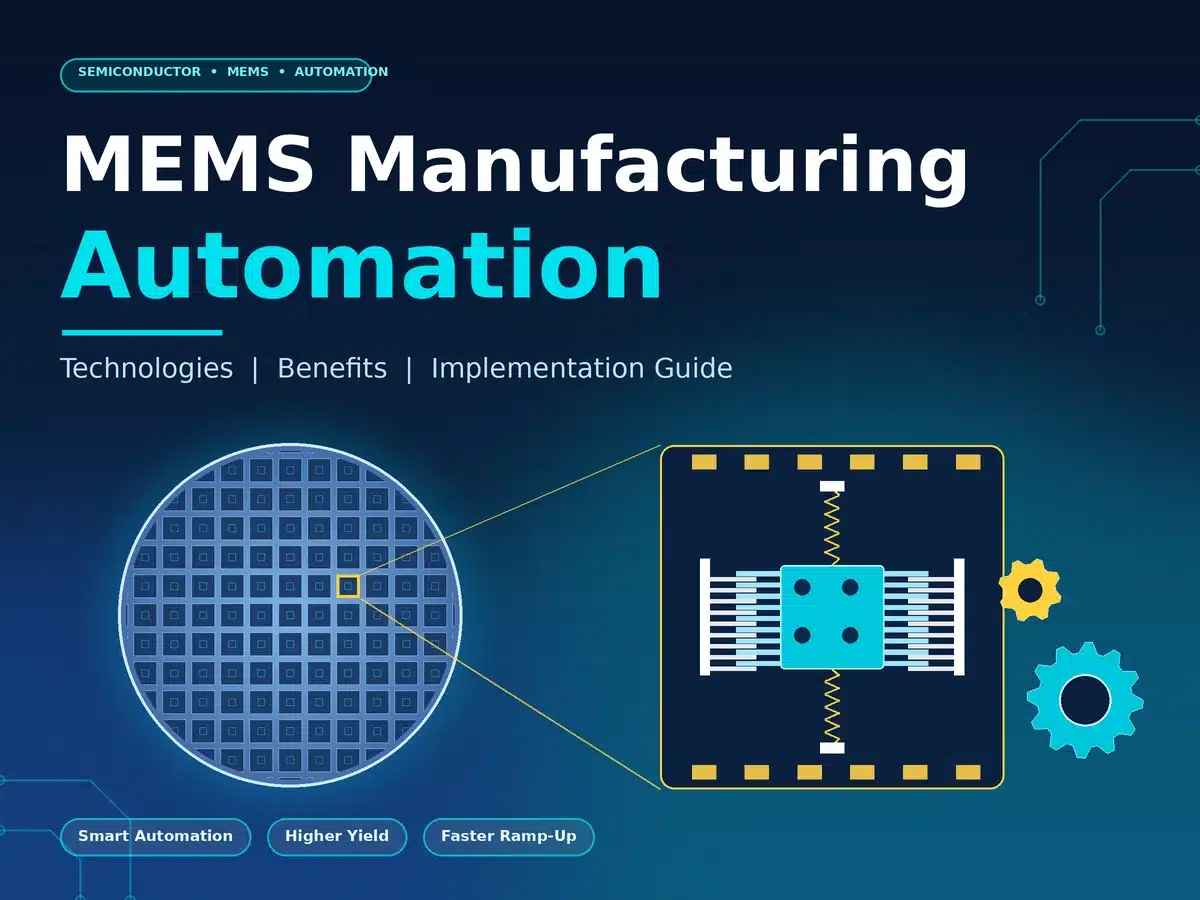
MEMS manufacturing automation connects tools, software, and data so a fab can run with fewer errors and less manual work. MEMS devices are tiny, complex, and sensitive to small process shifts. A single missed alarm can scrap an entire wafer lot.
That is why more fabs now automate production. This guide explains the core technologies, benefits, challenges, and a practical path to implementation.
What Is MEMS Manufacturing Automation?
MEMS manufacturing automation is the use of connected equipment, standard communication protocols, and software to control and monitor MEMS production with minimal manual input.
It covers several layers:
- Equipment that communicates using standards such as SECS/GEM
- Software that collects and analyzes process data
- Systems that manage production, recipes, and tracking
Together, these layers turn separate tools into one coordinated factory.
Why Automation Matters in MEMS Manufacturing
MEMS production is different from standard chip making. Devices combine mechanical and electrical parts, and product mixes change often. Volumes can also be low.
Manual processes struggle under these conditions. Operators must load recipes by hand, record data on paper, and react slowly to alarms. As a result, errors and downtime increase.
Automation solves these problems. It enforces consistency, speeds up decisions, and creates a reliable data trail. It also supports Industry 4.0 goals, which many customers now expect.
Key Technologies Used in MEMS Manufacturing Automation
Several technologies work together in a modern MEMS fab:
- SECS/GEM: The standard language for equipment-to-host communication.
- Equipment connectivity: Links every tool to a central system.
- Manufacturing data collection: Captures process and equipment data in real time.
- Real-time equipment monitoring: Shows tool status and alarms instantly.
- Recipe management: Controls which recipe runs on which tool.
- Alarm management: Routes critical alerts to the right people fast.
- Production traceability: Tracks every lot, wafer, and process step.
- AI/ML-based analytics: Finds patterns that humans often miss.
- Predictive maintenance: Flags tool problems before they cause downtime.
MEMS Semiconductor Manufacturing Automation: Core Applications
MEMS semiconductor manufacturing automation applies these technologies across the process flow. Common applications include:
- Lithography and etching: Automated recipe download keeps critical steps consistent.
- Deposition and bonding: Data collection tracks the parameters that affect device performance.
- Inspection and test: Results link back to the exact tool and lot.
- Material handling: Lot movement is tracked and controlled automatically.
Each application reduces manual touchpoints. In turn, yield becomes easier to protect.
MEMS Equipment Integration and Connectivity
MEMS equipment integration means connecting every tool to a host or factory system. MEMS equipment connectivity then allows data and commands to flow both ways.
This is often the hardest part. MEMS fabs use tools from many vendors, and some are decades old. Each may speak a different protocol.
SECS/GEM solves most of this. It gives equipment a common way to report status, send data, and accept commands. For new tools, EIGEMEquipment adds SECS/GEM communication to MEMS equipment. On the factory side, EIGEMHost connects the host or MES to those tools and manages them centrally.
Older machines need a different approach. EIGEMLink handles protocol conversion so mixed equipment can still connect. EIGEMBox offers plug-and-play SECS/GEM for legacy tools that lack native support.
Role of MEMS Manufacturing Software
MEMS manufacturing software turns raw equipment data into useful action. Without it, connected tools only produce more numbers.
Good software does four things:
- Collects data from every connected tool
- Displays live dashboards for operators and managers
- Triggers alerts when values drift outside limits
- Stores records for audits and root-cause analysis
As a result, engineers spend less time hunting for data and more time improving the process.
MEMS MES Integration for Production Management
A Manufacturing Execution System (MES) manages what is produced, where, and how. MEMS MES integration links that system directly to the equipment.
Without integration, the MES relies on manual entries. Those entries are slow and prone to mistakes. With integration, the MES receives accurate data automatically.
This enables several capabilities:
- Automatic lot tracking from start to finish
- Recipe validation before a run begins
- Real-time work-in-progress visibility
- Complete genealogy for every device
For MEMS makers serving automotive or medical customers, this traceability is often required.
Benefits of MEMS Manufacturing Automation
The advantages are measurable:
- Higher yield: Fewer manual errors mean fewer scrapped wafers.
- Better traceability: Every lot has a full digital history.
- Less downtime: Predictive maintenance catches problems early.
- Faster decisions: Live data replaces end-of-shift reports.
- Lower costs: Less rework and less manual labor.
- Easier compliance: Audit records are generated automatically.
Challenges in Implementing MEMS Factory Automation
Automation projects can stall without planning. Watch for these common issues:
- Legacy equipment: Older tools may lack any standard interface.
- Mixed vendors: Different protocols complicate connectivity.
- Data overload: Collecting everything without a plan creates noise.
- Skills gaps: Teams may lack automation or SECS/GEM experience.
- Process variety: Frequent product changes demand flexible setups.
The good news is that each challenge has a proven solution. Most start with the right connectivity tools and a phased plan.
How to Implement MEMS Manufacturing Automation
Follow these steps for a smooth rollout:
- Audit your equipment. List every tool, its age, and its supported protocols.
- Set clear goals. Choose targets such as yield, uptime, or traceability.
- Connect the equipment. Use SECS/GEM natively or through converters and gateways.
- Integrate with the MES. Link tools to your host for recipes and tracking.
- Add analytics. Start with monitoring, then move to predictive models.
- Pilot first. Test on a few tools, then scale across the fab.
- Train your team. Make sure operators and engineers trust the new system.
A phased approach limits risk and shows value early.
How eInnoSys Supports MEMS Manufacturing Automation
eInnoSys provides a complete set of tools for MEMS manufacturing automation. EIGEMEquipment, EIGEMHost, EIGEMLink, and EIGEMBox cover new tools, legacy tools, and host connectivity. Together, they help fabs move from isolated machines to a connected factory.
Conclusion
MEMS manufacturing automation helps fabs improve yield, strengthen traceability, and reduce downtime. The key building blocks are SECS/GEM, equipment connectivity, manufacturing software, and MES integration. Start with an equipment audit, connect your tools in phases, and add analytics over time.
eInnoSys offers the solutions and experience to make this journey simple. To connect your MEMS equipment and build a smarter fab, explore the eInnoSys automation and connectivity solutions today.


