
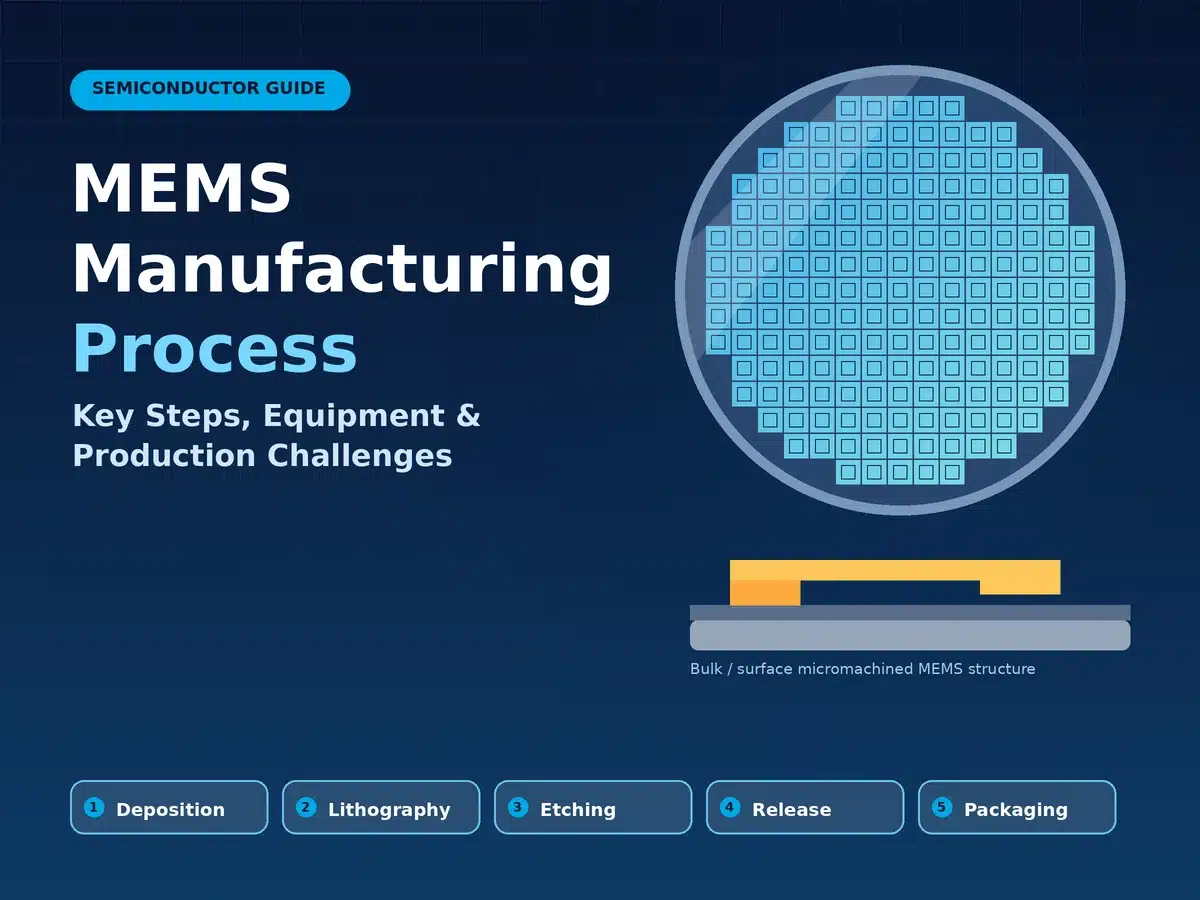
MEMS manufacturing is the process of building tiny mechanical and electrical structures on silicon wafers using semiconductor fabrication techniques. These devices power sensors, microphones, and actuators in cars, phones, and medical tools. This guide explains the key steps, equipment, and production challenges. It also shows how automation keeps output consistent.
What Is MEMS Manufacturing?
MEMS stands for Micro-Electro-Mechanical Systems. These are microscale devices that combine moving parts with electronics. Unlike standard chips, MEMS devices have physical structures such as membranes, beams, and cavities.
MEMS manufacturing adapts semiconductor processes to create those structures. This adds complexity, because the process must form, protect, and release moving parts without damaging them.
Key Steps in MEMS Manufacturing
- Wafer preparation: Wafers are cleaned and inspected to remove particles and defects.
- Thin-film deposition: Thin layers of materials such as silicon, oxide, or metal are added to the wafer.
- Photolithography: Light transfers a circuit or structure pattern onto a photosensitive layer.
- Etching: Unwanted material is removed to form the device shape.
- Doping and implantation: Ions are added to change the electrical properties of selected areas.
- Wafer bonding: Two wafers are joined to seal cavities or create layered structures.
- MEMS structure formation: Beams, membranes, and chambers take their final form.
- Release processes: A sacrificial layer is removed so the structure can move freely.
- Wafer-level testing: Devices are checked electrically and mechanically before cutting.
- Dicing: The wafer is cut into individual dies.
- Packaging: Each die is protected in a package that suits its application.
- Final testing and inspection: Finished devices are verified against specifications.
- Data collection and traceability: Process data is recorded for every wafer and lot.
Equipment Used in MEMS Manufacturing
A MEMS fab relies on many types of tools:
| Equipment | Function |
|---|---|
| Deposition Equipment | Adds thin material films. |
| Lithography Systems | Creates wafer patterns. |
| Etching Equipment | Removes material precisely. |
| Doping & Implantation Equipment | Modifies electrical properties. |
| Wafer Bonding Systems | Joins wafers under controlled conditions. |
| Cleaning Equipment | Removes contaminants. |
| Inspection & Metrology Equipment | Measures defects, thickness, and alignment. |
| Dicing, Packaging & Testing Equipment | Handles back-end processing and testing. |
| Material Handling Systems | Moves wafers between equipment. |
Each tool produces data, and each needs to communicate with the factory systems.
MEMS Semiconductor Manufacturing Automation
MEMS semiconductor manufacturing automation reduces manual work and keeps processes repeatable. Automated recipe downloads, lot tracking, and alarm handling lower the risk of human error.
Automation matters even more in MEMS fabs, which often run many product types in small batches. Frequent recipe changes raise the chance of mistakes unless the system manages them.
MEMS Equipment Integration and Connectivity
MEMS equipment integration links each tool to the factory host system. MEMS equipment connectivity is what allows tools to send status, alarms, and process data in real time.
Most fabs use the SECS/GEM standard for this communication. The challenge is that MEMS fabs mix new and older tools from many vendors, and each may use a different protocol. Solutions such as EIGEMEquipment help enable SECS/GEM communication, while EIGEMLink converts equipment protocols to support connectivity.
Role of MEMS Manufacturing Software
MEMS manufacturing software controls, monitors, and records production. It manages recipes, tracks wafer lots, and collects equipment data.
Host-level tools like EIGEMHost support equipment management and manufacturing connectivity from one point. Good software gives engineers a clear view of what is happening on the floor.
MEMS MES Integration in Production
MEMS MES integration connects a Manufacturing Execution System to the tools on the floor. The MES then knows which wafer is on which tool and which recipe applies.
This link enables:
- Accurate work-in-progress tracking
- Automatic recipe verification
- Full lot genealogy for quality reviews
- Faster response to deviations
Without integration, operators rely on manual entries, which slow production and invite errors.
Common Challenges in MEMS Manufacturing
- Process complexity: Moving structures need precise etching and release steps.
- Diverse equipment: Tools from different vendors use different interfaces.
- Legacy tools: Older equipment often lacks modern communication support.
- Yield sensitivity: Tiny variations can cause device failure.
- Traceability demands: Automotive and medical customers require complete records.
- High product variety: Frequent changeovers increase setup errors.
How Automation Addresses MEMS Manufacturing Challenges
Automation turns these challenges into manageable tasks. Standard communication removes vendor differences, and automatic recipe control reduces setup mistakes. Real-time data collection helps engineers spot drift early, before it affects yield.
For older tools, EIGEMBox brings legacy MEMS equipment connectivity and SECS/GEM integration without replacing the machine. This lets fabs modernize gradually and protect their existing investment.
Benefits of Connected and Automated MEMS Manufacturing
- Higher yield through tighter process control
- Faster throughput with fewer manual steps
- Complete traceability for audits and customers
- Lower operating costs from reduced rework
- Easier scaling when new tools or products are added
Conclusion
MEMS manufacturing combines precise fabrication steps with complex equipment and strict quality needs. Connected, automated production is the most reliable way to protect yield and traceability. eInnoSys helps MEMS manufacturers achieve this through equipment integration, SECS/GEM connectivity, and manufacturing automation software, so fabs can run faster, cleaner, and more consistently.


