
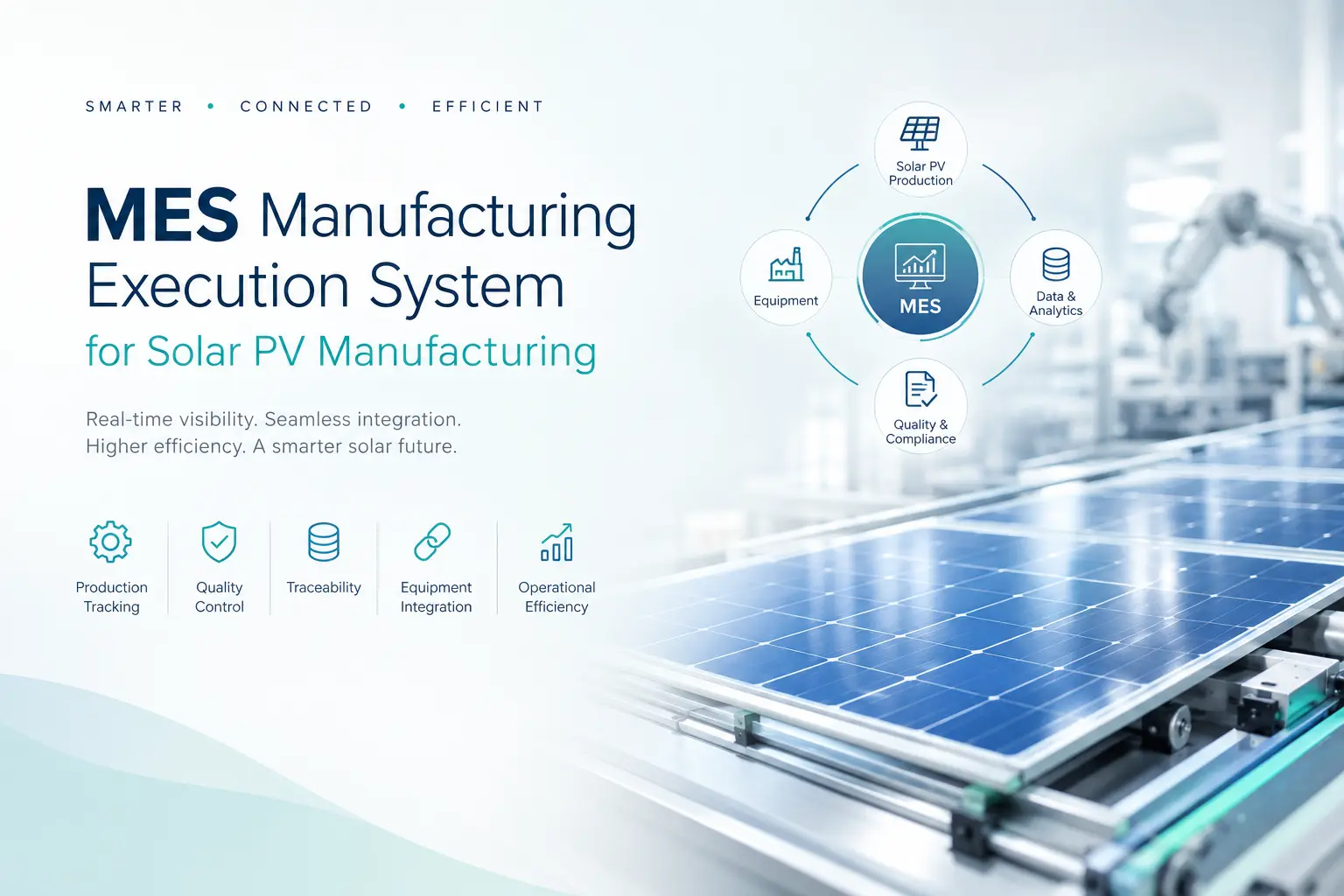
Solar PV manufacturing runs on precision. A single cell line can process thousands of wafers a day across multiple process steps, and even small gaps in visibility can lead to yield loss, rework, or missed quality issues. This is where an MES Manufacturing Execution System becomes essential. It connects the shop floor to the rest of the business, giving solar manufacturers real-time control over production, quality, and traceability.
In this guide, we’ll break down what an MES is, why it matters specifically for solar PV manufacturing, and how it fits into a broader smart-factory strategy.
What Is an MES Manufacturing Execution System?
A Manufacturing Execution System sits between enterprise-level planning tools, such as ERP, and the equipment on the production floor. While ERP manages business functions like orders, inventory, and resource planning, an MES manages what actually happens during production — tracking work orders, capturing equipment data, monitoring quality, and recording every step a product goes through.
In simple terms, an MES turns raw production activity into structured, usable data. It tells manufacturers not just what was planned, but what actually happened on the line, in real time.
Why MES Is Important for Solar PV Manufacturing
Solar PV production involves multiple interconnected stages — wafer handling, cell processing, module assembly, and testing — often running on high-speed automated equipment. An MES brings structure and visibility to this environment in several ways:
- Production visibility — See exactly what’s happening across every line and station.
- Real-time manufacturing data — Capture equipment and process data as it’s generated, not after the fact.
- Quality control — Catch defects and process deviations earlier in the line.
- Material traceability — Track raw materials, lots, and components through every stage.
- Production scheduling — Coordinate work orders across equipment and shifts.
- Equipment integration — Connect directly with manufacturing tools and automation systems.
- Reduced manual data entry — Automate data capture instead of relying on paper logs or spreadsheets.
- Compliance and reporting — Maintain audit-ready records for customers and regulators.
Together, these capabilities reduce waste, improve yield, and give plant managers the information they need to make faster decisions.
How MES Works in Solar PV Manufacturing
At a high level, MES acts as the operational backbone connecting materials, equipment, and enterprise systems:
Raw Materials → Production Equipment → MES → Quality & Traceability → ERP/MES Analytics → Finished Solar Modules
As materials move through the line, the MES collects data from equipment at each step, applies quality checks, records genealogy information, and feeds insights upward to ERP systems and analytics dashboards — giving a complete, connected view of the manufacturing process.
Key MES Features for Solar PV Manufacturing
A strong MES platform for solar PV manufacturing typically includes:
- Production planning and tracking
- Work-in-progress (WIP) monitoring
- Material and lot traceability
- Recipe and process management
- Quality management
- Equipment integration
- Real-time production dashboards
- Downtime monitoring
- Automated data collection
- Electronic work instructions
- Genealogy and historical records
- Reporting and analytics
These features work together to give manufacturers a single source of truth for everything happening on the production floor.
MES Integration with Solar PV Manufacturing Equipment
One of the biggest challenges in solar PV manufacturing is connecting diverse equipment — often from different vendors and generations — into a single data ecosystem. MES platforms bridge this gap using industrial communication technologies that let equipment share status, process data, and alarms directly with the software layer.
This is especially important in environments where equipment automation architectures resemble those found in semiconductor manufacturing, where standardized equipment communication protocols play a central role.
MES and SECS/GEM Integration
SECS/GEM (SEMI Equipment Communications Standard / Generic Equipment Model) is a widely used standard for equipment-to-host communication in high-tech manufacturing, including solar PV production. It allows:
- Automated, standardized equipment data collection
- Host-to-equipment commands and status monitoring
- Real-time visibility into equipment state and performance
- Reduced manual intervention in data capture
By integrating MES with SECS/GEM-compliant equipment, solar manufacturers gain a much more automated and reliable flow of manufacturing data. If you’re new to the standard, our introduction to SECS/GEM explains how it works in more detail.
Using EIGEMBox for Equipment Connectivity
Not all equipment on a solar PV line is easy to integrate directly with MES software — especially older or legacy tools that weren’t built with modern connectivity in mind. This is where a connectivity solution like EIGEMBox becomes valuable, acting as a bridge between equipment and the MES layer so manufacturers don’t have to replace hardware just to gain data visibility.
MES Migration for Solar PV Manufacturers
Many solar PV manufacturers are still running on legacy MES platforms, custom-built applications, or spreadsheet-based tracking systems. Over time, these approaches become harder to scale and maintain. Common reasons manufacturers consider migration include:
- Limited scalability as production volume grows
- Difficulty integrating with newer equipment
- Lack of real-time visibility
- Increasing maintenance costs on outdated systems
A successful migration requires careful planning around data integrity, equipment connectivity, historical records, system interfaces, validation, and production continuity — migrating without disrupting live operations. Our MES migration support resources cover what manufacturers should consider before making the switch.
Benefits of MES for Solar PV Manufacturing
| Manufacturing Challenge | MES Capability |
|---|---|
| Limited production visibility | Real-time production monitoring |
| Manual data collection | Automated equipment data collection |
| Difficult traceability | Lot, material, and product genealogy |
| Quality inconsistencies | Integrated quality management |
| Equipment downtime | Equipment status and downtime tracking |
| Data scattered across systems | Centralized manufacturing information |
| Legacy equipment | Equipment connectivity and integration |
MES for Different Solar PV Manufacturing Processes
MES capabilities apply across multiple stages of solar PV production, including:
- Wafer processing
- Solar cell production
- Module assembly
- Testing and inspection
- Packaging and final production
Each stage benefits from the same core capabilities — data capture, traceability, and quality control — adapted to the specific equipment and process requirements of that step.
MES, ERP, and Equipment Automation: What’s the Difference?
It helps to think of manufacturing systems as three connected layers:
ERP → Business and resource planning MES → Manufacturing operations and execution Equipment/Automation → Physical production
ERP decides what needs to be produced and when. MES manages how it’s actually executed on the floor. Equipment and automation systems carry out the physical work. MES is the critical link that keeps these layers synchronized.
How to Choose an MES for Solar PV Manufacturing
When evaluating MES platforms, solar manufacturers should consider:
- Equipment integration capabilities
- Scalability for future growth
- Traceability and genealogy features
- Real-time data collection
- API availability for custom integrations
- ERP integration
- Support for legacy equipment
- Analytics and reporting depth
- Cybersecurity
- Migration support and services
- Multi-site manufacturing capabilities
The Role of MES in Smart Solar Manufacturing
MES is a foundational piece of Industry 4.0 strategies in solar manufacturing. Combined with connected equipment, IIoT sensors, and automated data collection, MES enables manufacturers to move toward predictive maintenance, smarter production analytics, and fully digital traceability — creating a more responsive, resilient factory.
Conclusion
As solar PV manufacturing scales to meet growing global demand, production visibility, traceability, and equipment connectivity are no longer optional — they’re operational necessities. An MES Manufacturing Execution System gives manufacturers the real-time data and control needed to reduce waste, maintain quality, and keep pace with industry growth.
Einnosys specializes in helping solar PV manufacturers implement, integrate, and migrate MES platforms — including SECS/GEM equipment connectivity and legacy system migration — so production teams get accurate, real-time data without disrupting operations. To learn more about building a connected, traceable solar manufacturing environment, explore Einnosys’ Solar PV / Photovoltaic solutions.


