
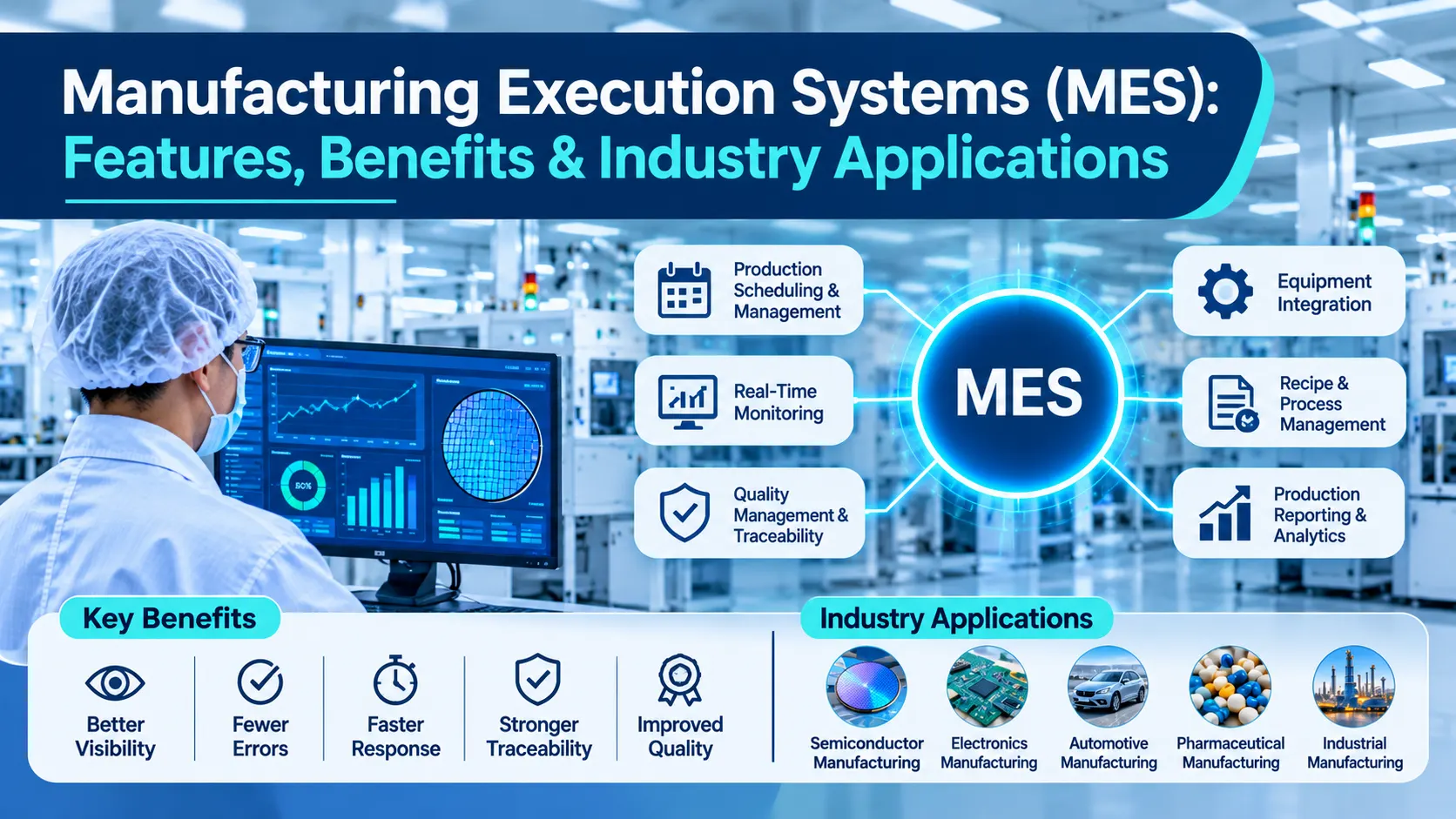
Modern factories produce more data than ever. However, data alone does not improve output. Production teams also need to know what is running, what is delayed, which lot sits on which tool, and whether a process stayed within limits. That is where Manufacturing Execution Systems (MES) help, because they answer these questions in real time.
MES matters most in semiconductor manufacturing. For example, a single wafer lot passes through hundreds of process steps on many tools. First, this guide explains what an MES does, along with its key features and benefits. Then it shows how different industries use MES, with extra depth on semiconductor MES. Finally, it covers how MES connects to equipment and ERP, and why SECS/GEM matters for that connection.
What Is a Manufacturing Execution System (MES)?
A Manufacturing Execution System is software that manages and records production activity on the factory floor as it happens. It sits between business planning systems (ERP) and the machines that make the product.
In simple terms, ERP decides what should be made and when. The MES controls how it is made, step by step, and records what actually happened.
How Does an MES Work?
An MES works as a continuous loop between planning, execution, and feedback:
- Receive orders. Production orders arrive from ERP or planning systems.
- Schedule and dispatch. The MES assigns lots or batches to equipment and operators.
- Control execution. It checks that the right material, recipe, and tool are used.
- Collect data. Equipment status, process parameters, and results are recorded.
- Report back. Progress, yield, and genuine consumption are sent to ERP and dashboards.
For example, in a fab, a lot arrives at an etch tool. The MES confirms the lot is due for that step and that the tool is qualified and available. It then ensures the correct recipe is used. After processing, it logs the result and moves the lot to the next step.
Key Features of Manufacturing Execution Systems
Different vendors package features differently, but these capabilities are common. Industry analyst reports on Critical Capabilities for Manufacturing Execution Systems typically assess areas like these.
Production Scheduling and Management
The MES sequences work orders against equipment, labor, and material availability. It helps planners adjust when tools go down or priorities change.
Real-Time Production Monitoring
Supervisors see line status, throughput, and delays as they happen instead of in end-of-shift reports.
Work-in-Progress Tracking
The MES tracks every lot, batch, or unit through each process step. In semiconductor fabs, this lot tracking is essential because lots move through very long routes.
Quality Management and Traceability
Inspection results, deviations, and holds are recorded against each lot. If a problem appears later, teams can trace which tool, material, and recipe were involved.
Equipment Integration and Data Collection
The MES collects status and process data from machines and can send commands such as recipe selection. This is where standards like SECS/GEM come in, covered later in this article.
Recipe and Process Management
Recipes define how a tool processes a product. The MES helps make sure the approved recipe version is used for the right product at the right step.
Production Reporting and Performance Analysis
Reports on yield, cycle time, equipment utilization, and downtime help managers find bottlenecks and track improvement.
Major Benefits of Manufacturing Execution Systems
| Benefit | What It Means in Practice |
|---|---|
| Better Visibility | One view of orders, lots, equipment, and production status. |
| Fewer Manual Errors | Less paperwork and manual data entry through standardized process rules. |
| Faster Response | Production problems and delays become visible sooner. |
| Stronger Traceability | Quick access to material, equipment, and recipe history for each lot. |
| Improved Quality Control | Consistent application of quality checks, inspections, and process holds. |
| Better Equipment Use | Production dispatching based on actual equipment availability. |
| Audit Readiness | Complete production records for customers and regulatory requirements. |
The size of these gains depends on the factory, the quality of equipment data, and how well the MES is implemented.
Industry Applications of Manufacturing Execution Systems
Semiconductor Manufacturing
Semiconductor MES is among the most demanding MES applications. If you are new to the topic, a semiconductor fab is a highly controlled facility where silicon wafers are processed through hundreds of steps such as lithography, etching, deposition, and inspection to build integrated circuits.
MES in semiconductor manufacturing typically handles:
- Lot and wafer tracking across long, re-entrant process flows
- Dispatching to the right tool at the right time
- Recipe control, so each lot runs the approved recipe
- Equipment state tracking for utilization and downtime analysis
- Genealogy and traceability from wafer to tool, chamber, and material
- Hold and release control when a process excursion is detected
- Material movement coordination with automated handling systems
Because tools come from many suppliers and generations, equipment connectivity is often the hardest part of a semiconductor MES project. The MES is only as reliable as the data it receives from the tools. OSAT (assembly and test) facilities have similar needs, with different process steps.
Electronics Manufacturing
In SMT and PCB assembly, MES tracks boards through printing, placement, reflow, and inspection. It supports component traceability and line changeovers.
Automotive Manufacturing
Automotive plants use MES for sequence control, torque and process data capture, and part genealogy. This helps with recalls and quality audits.
Pharmaceutical Manufacturing
Pharma MES supports batch records, material verification, and compliance documentation, with strict control over procedures and approvals.
Industrial Manufacturing
General industrial plants use MES for work order execution, labor tracking, downtime logging, and performance reporting.
MES Integration with ERP, Equipment, and Factory Automation Systems
An MES delivers its full value only when connected to the systems around it.
| Connection | Direction of Data | Purpose |
|---|---|---|
| ERP ↔ MES | Orders down; production results up | Align production planning with actual execution. |
| MES ↔ Equipment | Commands down; status and data up | Control and monitor manufacturing processes. |
| MES ↔ Factory Automation (EAP, RMS, FDC) | Two-way communication | Automate equipment control, recipe management, and fault detection. |
A simple view of the layers:
- ERP handles finance, procurement, and order planning.
- MES manages production execution and tracking.
- Equipment automation layer (such as an EAP) translates between the MES and individual tools.
- Equipment runs the process.
In many fabs, the MES does not talk to each tool directly. An Equipment Automation Program (EAP) sits between them, handling tool-specific communication so the MES can stay standardized.
Why Is SECS/GEM Important for Semiconductor MES Integration?
SECS/GEM is a set of SEMI standards that lets semiconductor equipment communicate with a factory host in a common way. It defines how tools report status, send events and data, raise alarms, and accept remote commands such as recipe selection or start and stop.
Without a standard, every tool brand would need custom integration. With SECS/GEM, the host can use a consistent approach across many tools.
For 300 mm fabs, GEM300 adds standards for areas like carrier management, job control, and process control, which support fully automated material handling and tool control.
SECS/GEM is not strictly part of every MES, but for semiconductor MES integration it is the most common, practical path to reliable equipment data and control.
Common Challenges in MES Implementation
- Legacy equipment that lacks SECS/GEM or modern interfaces
- Mixed tool generations and vendors with inconsistent data
- Unclear requirements or scope growth during the project
- Data quality problems, such as missing or inconsistently named parameters
- Integration complexity between MES, ERP, and automation layers
- Change management, since operators and engineers must adopt new workflows
- MES training gaps, where teams do not fully understand the system they run
Early planning on equipment connectivity and clear data definitions prevents many of these problems.
How eInnoSys Supports Semiconductor MES Integration and Factory Automation
eInnoSys is not an MES vendor. It focuses on the layer that makes an MES effective: equipment connectivity and factory automation integration for semiconductor fabs, OSATs, and equipment manufacturers.
Areas where eInnoSys can support your MES program:
- SECS/GEM and GEM300 connectivity for equipment, supported by SDKs for equipment manufacturers
- EIGEMBox, a plug-and-play SECS/GEM solution for older or legacy equipment
- Equipment Automation Program (EAP) capabilities that link tools to the factory host
- Recipe Management System (RMS) for controlled recipe distribution and version control
- Smart FDC and AI/ML-based analytics for fault detection and equipment health
- MES integration and migration support
- SECS/GEM training for engineering teams
These solutions help a fab or OSAT connect its tools reliably to whichever MES it uses. For a platform view, see EINIVA, eInnoSys’ suite for connecting, analysing, and controlling the factory.
Conclusion
Manufacturing Execution Systems give factories real-time control, traceability, and visibility. In semiconductor manufacturing, the value of an MES depends heavily on reliable connections to equipment through standards like SECS/GEM and GEM300, supported by automation layers such as EAP, RMS, and FDC.
Choosing MES software or comparing MES software companies is only part of the job. Equipment connectivity decides whether the data reaching your MES is complete and trustworthy.


