
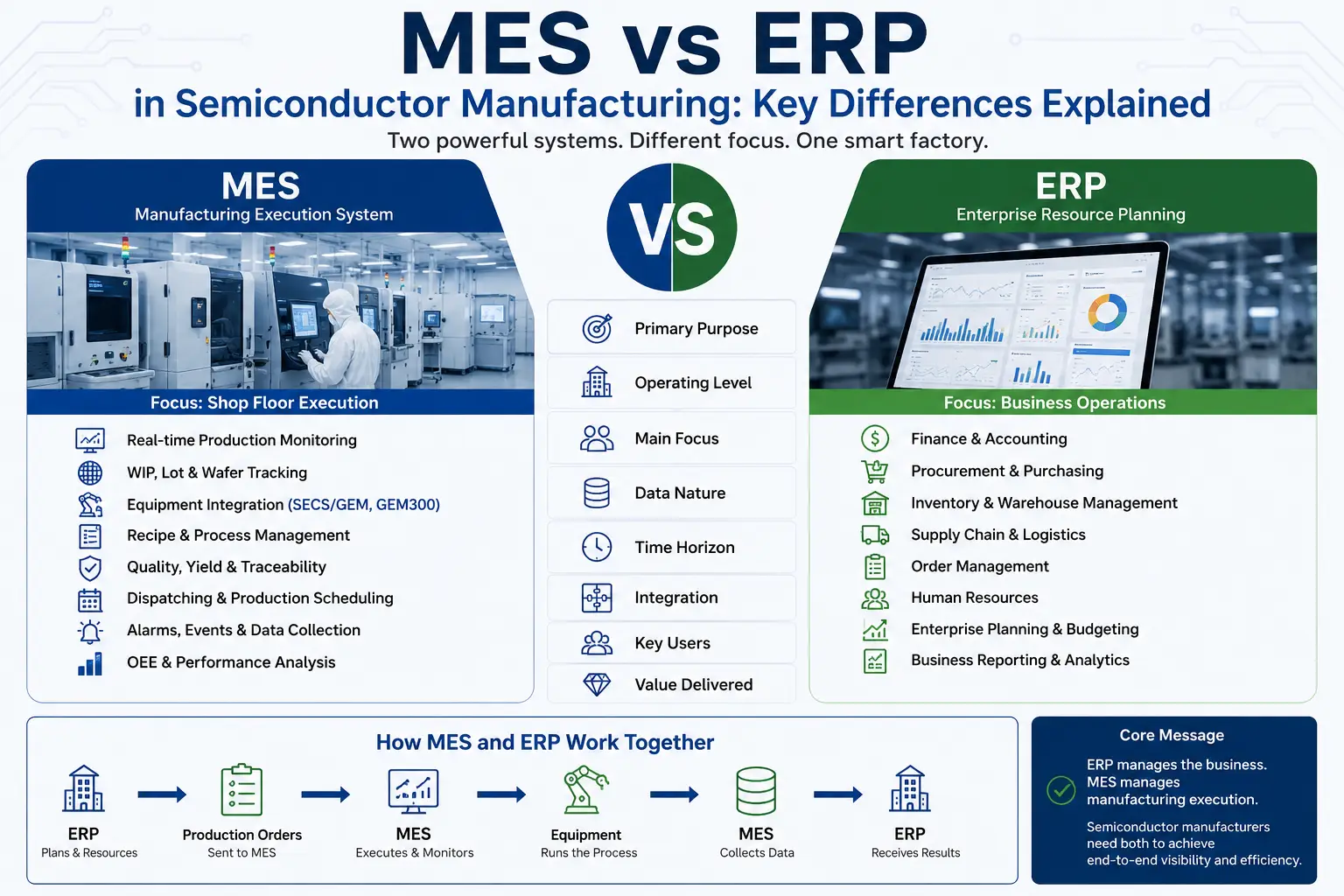
MES vs ERP in Semiconductor Manufacturing
Ask a fab manager and a finance director to define “the system of record,” and you’ll likely get two different answers — and both would be right.
In semiconductor manufacturing, MES (Manufacturing Execution System) and ERP (Enterprise Resource Planning) are often mentioned in the same breath, but they solve fundamentally different problems. ERP manages enterprise-level business processes, while MES focuses on manufacturing execution, shop-floor operations, equipment connectivity, WIP tracking, and production traceability.
Confusing the two — or trying to make one system do the other’s job — can create unnecessary complexity, integration problems, and costly automation projects.
Why the Difference Matters in Semiconductor Manufacturing
The distinction is particularly important in semiconductor fabs because manufacturing involves highly complex process flows, expensive equipment, strict traceability requirements, wafer and lot tracking, recipe management, and real-time equipment data.
A modern semiconductor factory typically needs both systems working together:
ERP → MES → Equipment
ERP handles business planning and resources. MES translates production requirements into manufacturing execution and connects with equipment and shop-floor systems.
This guide explains what MES and ERP actually do in a semiconductor fab, why the distinction matters, and the seven key differences every fab manager, MES manager, and IT team should understand before evaluating an MES implementation or migration.
MES vs ERP: The Core Distinction
At the highest level, the difference comes down to where each system operates:
- MES runs at the production floor level. It executes, tracks, and controls manufacturing in real time — WIP movement, equipment connectivity, recipe management, and traceability, wafer by wafer, lot by lot.
- ERP runs at the enterprise level. It manages the business side — finance, procurement, inventory planning, supply chain, and order management — across the entire organization, not just the fab floor.
In a generic manufacturing environment, this distinction matters. In semiconductor manufacturing, it’s critical. Fabs run hundreds of process steps per lot, dozens of equipment types communicating over SECS/GEM and GEM300 standards, and yield-sensitive processes where a few minutes of untracked downtime or a missed recipe parameter can scrap a high-value wafer lot. ERP was never built to operate at that level of granularity or speed — and it shouldn’t be forced to.
7 Major Differences Between MES and ERP in Semiconductor Manufacturing
1. Manufacturing Execution vs. Business Management
MES exists to execute and control what happens on the fab floor — starting jobs, sequencing process steps, and enforcing the exact recipe and routing a lot needs at every station. ERP exists to manage the business that surrounds manufacturing: budgets, purchase orders, customer orders, and enterprise-wide resource planning. MES answers “what is happening on the floor right now.” ERP answers “what does the business need to plan for?”
2. Real-Time Equipment Connectivity
This is where semiconductor MES diverges sharply from ERP — and from MES in other industries. Fab equipment communicates using SECS/GEM and, for 300mm fabs, the broader GEM300 standard set (HSMS transport, carrier management, job control, and equipment status reporting). MES connects directly to this equipment layer, pulling real-time status, alarms, and process data. ERP has no equivalent connection; it operates on batched, summarized data that arrives long after the equipment event actually happened.
3. WIP and Lot Tracking
MES tracks work-in-process (WIP) at the wafer and lot level, in real time, as material physically moves through the fab — which tool processed it, when, under what recipe, and with what result. ERP tracks inventory and orders at a much coarser level, typically as aggregated quantities and stages, useful for planning but not for the moment-to-moment traceability a fab requires.
4. Production and Process Visibility
MES gives shop-floor teams live visibility into process flows: equipment states, queue times, bottlenecks, and in-process exceptions, all updated continuously. ERP’s visibility is reporting-oriented — dashboards and summaries built from data that’s already been through MES and rolled up into business metrics. Fab teams troubleshooting a live process issue need MES visibility; leadership planning next quarter’s capacity needs ERP visibility.
5. Recipe and Process Management
Recipe management — the exact parameters a tool needs to run a given process step correctly — lives in MES, tightly coupled to the equipment integration layer so recipes can be validated, downloaded, and enforced automatically via SECS/GEM. ERP has no mechanism for this; it has no visibility into equipment-level process parameters at all.
6. Quality, Yield and Traceability
MES owns quality and yield tracking at the process level — linking defects, in-process test results, and equipment events back to specific wafers and lots for root-cause analysis. This lot-level, equipment-linked traceability is what makes yield investigations possible. ERP supports quality management at a business level (compliance records, supplier quality metrics) but doesn’t have the granular process linkage MES provides.
7. Data Exchange and Integration
MES and ERP aren’t competitors — they’re meant to work together, with a clear data flow: ERP → MES → Equipment, and back again. ERP pushes down production plans, orders, and business constraints; MES executes against them on the floor, pulling real-time equipment and process data; and MES pushes summarized production results (completions, yield, WIP status) back up to ERP for business reporting. When this integration is done well, each system does what it’s built for, and neither is stretched into a role it can’t handle.
Why Semiconductor Fabs Specifically Need MES
Some manufacturing operations can get by with lighter-weight execution tracking. Semiconductor fabs generally can’t, because of a few industry-specific realities:
- Complex, long process flows — a single lot can pass through hundreds of process steps across dozens of equipment types.
- High-value wafers — the cost of misprocessing or losing track of a lot is significant, making real-time traceability non-negotiable.
- Equipment diversity and volume — fabs run many different tool types, each needing standardized SECS/GEM and GEM300 connectivity to report status and receive instructions.
- Strict traceability requirements — for both internal yield analysis and, often, external quality/compliance obligations.
- Yield management — connecting equipment-level data to yield outcomes requires the kind of granular, real-time data only MES captures.
Without MES, none of this is manageable at scale — and ERP, however well-implemented, cannot fill that gap.
When to Consider MES Implementation or Modernization
For semiconductor manufacturers still relying heavily on manual tracking, spreadsheets, or an aging MES that predates current GEM300 standards, a few signals typically point toward implementation or modernization:
- Equipment integration is inconsistent, custom-built per tool, or missing GEM300 compliance
- WIP visibility depends on manual floor checks rather than real-time data
- Recipe management is handled manually or outside a standardized system
- Yield investigations take days instead of hours due to poor traceability
- ERP is being asked to do jobs it was never designed for, creating reporting gaps
Any one of these is worth a closer look. Several together usually mean it’s time for a serious MES evaluation.
Planning an MES Migration: What It Involves
Moving to a new or modernized MES isn’t a simple software swap — it touches equipment connectivity, historical data, and live production, so it has to be handled deliberately. A well-run migration typically includes:
- Legacy MES assessment — understanding what the current system does well, what it doesn’t, and what must carry over
- Data migration — moving historical WIP, lot, and production records without gaps
- Equipment integration — re-establishing or upgrading SECS/GEM and GEM300 connections for every tool
- Interface mapping — aligning MES-to-ERP data exchange so nothing breaks on either side
- Recipe migration — carrying over validated process recipes accurately
- WIP history preservation — ensuring in-flight lots aren’t lost in the transition
- ERP integration — reconnecting the ERP → MES → Equipment data flow end to end
- Testing, validation, and production cutover — proving the new system works before it takes over live production
This is precisely the kind of project that benefits from experience with both sides of the equation — semiconductor process requirements and SECS/GEM equipment integration.
Final Thoughts
MES and ERP aren’t rivals competing for the same job — they’re two systems built for two different layers of the business, and semiconductor manufacturing depends on both working together correctly. MES owns real-time execution: equipment connectivity, WIP tracking, recipe management, and yield traceability. ERP owns the enterprise view: finance, procurement, and business planning. Understanding where one ends and the other begins is the first step toward a fab that runs efficiently — and it’s essential groundwork before any MES implementation or migration project.
Planning an MES migration or modernization project? Explore eInnoSys MES Migration Support to see how a structured approach to equipment integration, data migration, and ERP alignment can make the transition smoother.


