
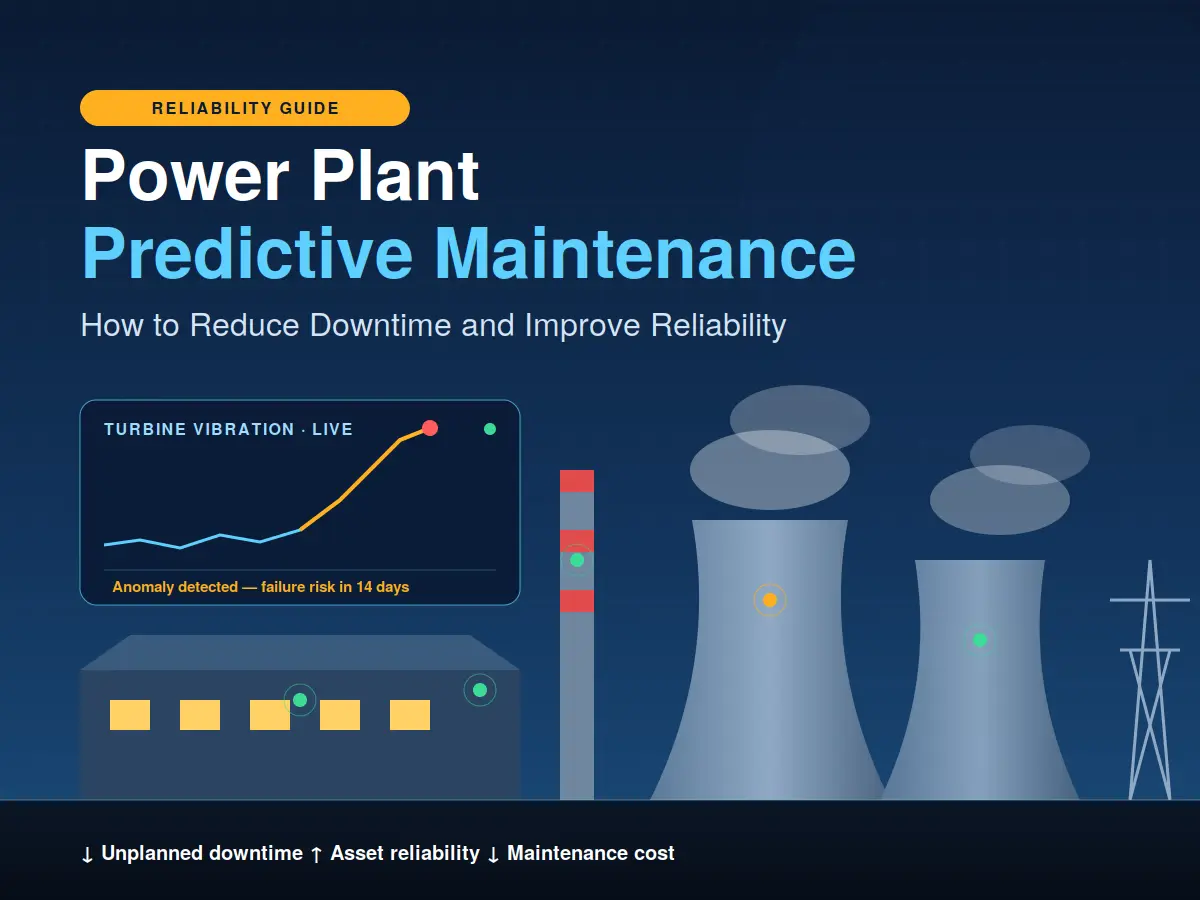
Every hour of unplanned downtime in a power plant is costly. You lose generation, pay for emergency repairs, and risk penalties. Yet many plants still rely on fixed schedules or run-to-failure habits.
Power plant predictive maintenance offers a smarter path. It uses live equipment data to spot problems early, so teams can act before a failure happens. This guide explains how it works, which technologies matter, and how it improves reliability across pumps, fans, turbines, and motors.
What Is Power Plant Predictive Maintenance?
Power plant predictive maintenance is a condition-based strategy. Instead of servicing equipment on a calendar, you service it when the data says it needs attention.
Sensors track the health of critical assets around the clock. Analytics then compare current readings against normal behavior. When a pattern drifts, the system raises an alert long before a breakdown.
This differs from the other common approaches:
- Reactive maintenance: you fix equipment after it fails.
- Preventive maintenance: you service equipment at fixed intervals, needed or not.
- Predictive maintenance: you act on real equipment condition.
The result is fewer surprises and better use of your maintenance budget.
How Predictive Maintenance Reduces Power Plant Downtime
Most failures do not happen suddenly. Bearings wear, alignment shifts, and lubrication degrades over weeks or months. These changes leave early signals in vibration, temperature, and power draw.
Predictive maintenance catches those signals in three ways:
- Early fault detection. Small anomalies appear long before an outage.
- Planned interventions. Teams schedule repairs during planned outages instead of emergency shutdowns.
- Better spare parts planning. You know what is failing, so you order parts in advance.
In short, unplanned downtime becomes planned maintenance. That shift protects both availability and revenue.
Predictive Maintenance for Pumps
Pumps are among the most critical assets in any plant. Boiler feed pumps, cooling water pumps, and condensate pumps all keep generation running. If one fails, output can drop quickly.
Predictive maintenance for pumps focuses on the faults that most often cause trouble:
- Bearing wear and lubrication issues
- Cavitation
- Impeller damage
- Shaft misalignment and imbalance
- Seal leakage and overheating
Monitoring vibration, temperature, and motor current reveals these faults early. For example, a rising vibration trend at a specific frequency often points to a failing bearing. Your team can then plan a replacement instead of reacting to a trip.
eInnoSys built XPump – Predictive Maintenance for exactly this need. It helps teams monitor pump health continuously and act on early warnings.
Predictive Maintenance for Rotating Equipment
Pumps are only part of the picture. Predictive maintenance for rotating equipment covers turbines, generators, motors, fans, compressors, and gearboxes. These assets share similar failure patterns, so the same monitoring principles apply.
Rotating machines produce clear signatures when healthy. When something changes, the signature changes too. Common issues include:
- Imbalance and looseness
- Misalignment
- Gear and bearing defects
- Electrical faults in motors
- Thermal stress
Because these assets are interconnected, one failure can spread. A degraded fan or motor can overload other components. Monitoring the whole fleet gives you a complete view of plant health.
Key Technologies Used in Power Plant Predictive Maintenance
Effective programs combine several technologies. Each one adds a different piece of the picture.
- Vibration Monitoring
Vibration is the most widely used indicator for rotating machinery. Sensors detect imbalance, misalignment, looseness, and bearing defects. Spectrum analysis shows not just that something is wrong, but what is wrong. - Temperature Monitoring
Heat often signals friction, poor lubrication, or electrical problems. Tracking bearing, winding, and casing temperatures helps you catch overheating early. - Current and Energy Monitoring
Motor current reveals load changes and electrical faults. Energy data also exposes inefficiency. A pump drawing more power for the same output may be wearing out. - AI/ML Analytics
Machine learning models learn what normal looks like for each asset. They then flag subtle deviations that humans or simple thresholds might miss. Over time, they also help estimate remaining useful life and reduce false alarms. - Real-Time Equipment Monitoring
Continuous data streaming gives your team live visibility. Dashboards and alerts mean problems reach the right person quickly, even across multiple sites.
Benefits of Predictive Maintenance for Power Plants
A well-run program delivers measurable value across operations.
- Reduced unplanned downtime: Early warnings prevent forced outages.
- Improved equipment reliability: Assets stay in better condition and fail less often.
- Lower maintenance costs: You avoid unnecessary servicing and costly emergency repairs.
- Longer asset life: Fixing small issues early prevents secondary damage.
- Improved operational efficiency: Well-maintained equipment runs closer to its design performance, and staff spend time where it matters.
These benefits also improve safety. Catching a failing component early reduces the risk of dangerous, sudden breakdowns.
How Predictive Maintenance Software Supports Power Plants
Sensors produce huge volumes of data. Without the right tools, that data becomes noise. Predictive maintenance software for power plants turns it into clear, actionable insight.
Good software typically offers:
- Centralized dashboards that show asset health at a glance
- Automated alerts based on trends, not just fixed limits
- Diagnostic tools that point to the likely fault
- Historical analysis to support root cause investigations
- Reporting that helps managers prioritize work
It also bridges teams. Operators, reliability engineers, and managers all see the same data. That shared view speeds up decisions and reduces guesswork.
Predictive Maintenance Solutions for Power Generation
Every plant is different. Some run coal or gas units, others manage hydro, wind, or combined-cycle assets. The right predictive maintenance solutions for power generation should fit your equipment, your data, and your team.
When evaluating a solution, look for:
- Support for pumps and other rotating equipment
- Easy integration with existing sensors and control systems
- Scalable monitoring across units and sites
- Clear, usable analytics rather than raw data
- Industry experience in power generation
To see the wider approach, explore eInnoSys Predictive Maintenance Solutions. For sector-specific needs, review the Power Generation Solutions page.
Conclusion
Power plant predictive maintenance moves your team from reacting to failures to preventing them. By combining vibration, temperature, and current monitoring with AI analytics, you gain early warning on your most critical assets. That means less downtime, lower costs, and stronger reliability.
eInnoSys helps power generation teams put this into practice with intelligent monitoring and analytics built for industrial environments. To learn more about how we support reliable operations, visit the eInnoSys homepage or talk to our team about your plant’s needs.


