
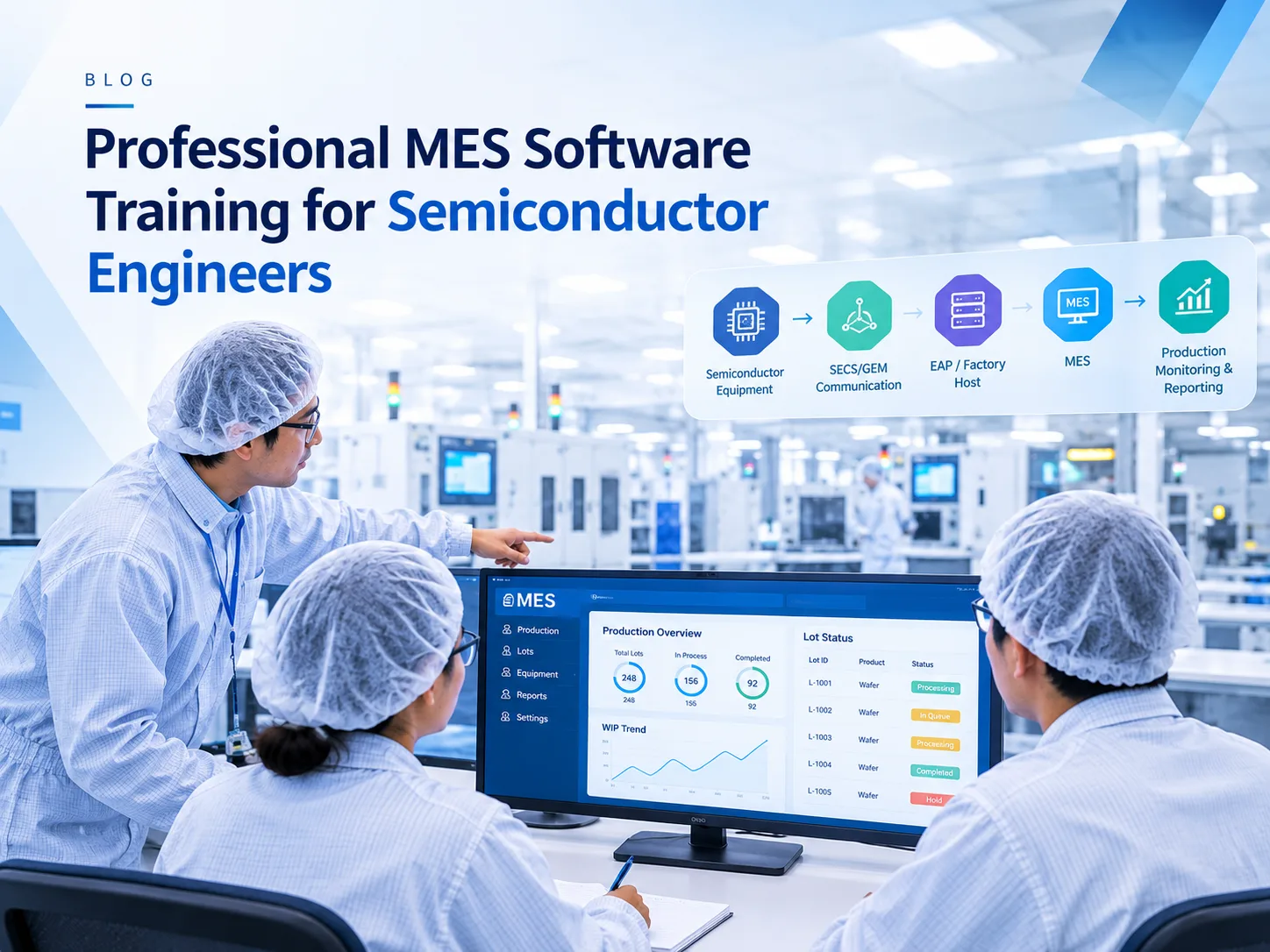
A wafer lot moves through hundreds of process steps, across many tools, over days or weeks. Someone, or something, has to decide what runs where, record what happened, and keep every lot traceable. In most fabs and back-end facilities, that job belongs to the Manufacturing Execution System (MES).
MES software training for semiconductor engineers helps teams understand how that system works and how it connects to the equipment on the floor. It covers production workflows, equipment communication, data flow, and troubleshooting. Without that knowledge, integration projects slow down and small communication problems turn into long investigations.
This guide explains what MES is, why training matters, what a strong program should cover, and how to choose one. It is written for beginners but stays technically accurate.
What Is MES Software in Semiconductor Manufacturing?
A semiconductor manufacturing execution system (MES) is the software layer that manages and records production on the factory floor. It sits between business systems (such as ERP) and the equipment that processes wafers.
In general terms, an MES in a semiconductor facility is responsible for:
- Lot and wafer tracking: knowing where each lot is, what step it is at, and what has been done to it.
- Routing and dispatching: deciding which lot goes to which tool, and in what order.
- Recipe and process control: making sure the right recipe is used for the right product and step.
- Genealogy and traceability: keeping a history of tools, recipes, materials, and operators for each lot.
- Data collection: receiving production and equipment data for reporting and analysis.
The MES does not usually talk to every tool directly. In many factories, an equipment-side communication layer and a factory host or Equipment Automation Program (EAP) sit in between. The exact setup differs from site to site, which is one reason hands-on understanding matters.
Why Do Semiconductor Engineers Need MES Software Training?
Semiconductor manufacturing is highly automated, and automation only works when systems exchange accurate information. Engineers who understand MES and its connections can work faster and with fewer surprises.
Training is useful for several practical reasons:
- MES projects touch many disciplines. Equipment, software, IT, and process teams all depend on the same data. A shared vocabulary reduces misunderstandings.
- Equipment integration is detail-heavy. Message formats, event definitions, and state models must match what the host expects.
- Troubleshooting needs a system view. A missing lot status might come from the tool, the communication link, the host layer, or the MES configuration. Engineers who see the whole chain find the cause sooner.
- Standards are specific. SEMI standards such as SECS/GEM have precise rules that are hard to learn from scattered documents alone.
- Teams change. New engineers and integrators need a structured way to learn a system that experienced staff already understand.
Professional MES software training does not replace experience on your own systems. It gives engineers a solid foundation so that experience builds faster.
What Should Professional MES Software Training Cover?
Good semiconductor MES training connects three layers: the production workflow, the equipment communication, and the data. Here is what a well-rounded program should include.
MES Fundamentals and Semiconductor Production Workflows
Engineers should start with how production actually flows. Useful topics include:
- The role of MES compared with ERP, EAP, and equipment controllers
- Lot lifecycle: creation, routing, track-in, track-out, hold, and completion
- Process steps, recipes, and how they are assigned to tools
- Differences between front-end fab flows and back-end (OSAT/assembly and test) flows
- Typical integration points between MES and factory systems
Equipment Integration and SECS/GEM Communication
This is where MES meets the machines. SECS/GEM is the set of SEMI standards that lets equipment and a factory host exchange data and commands. In simple terms:
- SECS-II defines the structure of messages.
- HSMS carries those messages over Ethernet (TCP/IP). SECS-I is the older serial transport.
- GEM defines standard equipment behaviors such as state models, event reporting, alarms, and remote commands.
- GEM300 extends this for 300mm automation, including areas such as carrier and job management.
Engineers should learn how these pieces work together, how to read message logs, and how to test a connection. Understanding the roles of the equipment, the communication interface, the EAP or factory host, and the MES is essential, because architectures vary between factories.
Production Data, Traceability, and Troubleshooting
Data is only useful if it is correct and complete. Training should cover:
- How equipment events, alarms, and status changes become production records
- What traceability requires, and where gaps usually appear
- Reading communication logs to isolate a problem
- A structured way to troubleshoot: check the tool, the link, the host layer, then the MES
- Common causes of mismatched states, missing events, or rejected commands
Benefits of Professional MES Software Training
The main benefit is shared, accurate understanding. The advantages below are practical expectations, not guaranteed results; outcomes depend on the team, the systems, and how the knowledge is applied.
- Clearer communication between teams: equipment, IT, and process engineers use the same terms.
- Faster onboarding: new engineers learn the system structure sooner.
- More confident integration work: teams know what to specify, build, and test.
- Better troubleshooting habits: engineers follow a method rather than guessing.
- Stronger standards awareness: fewer assumptions about how SECS/GEM should behave.
| Training Topic | What Engineers Learn | Practical Value |
|---|---|---|
| MES Fundamentals | Lot tracking, routing, recipes, and system roles | Shared understanding of how production is controlled |
| Production Workflows | Front-end and back-end flows, track-in/track-out, and holds | Fewer workflow misunderstandings during projects |
| SECS/GEM Basics | SECS-II messages, HSMS, and GEM behaviors | Ability to read and plan equipment communication |
| GEM300 Concepts | Carrier and job management concepts for 300 mm automation | Readiness for advanced automation environments |
| EAP / Factory Host Concepts | How a host layer connects equipment and MES | Clearer architecture decisions |
| Alarms and Event Reporting | How equipment events reach the host | More reliable monitoring and data collection |
| Traceability and Data Flow | Genealogy, records, and data consistency | Better audit readiness and data quality |
| Troubleshooting Methods | Log analysis and isolating faults across system layers | Shorter diagnosis time for integration issues |
| Testing and Validation | Simulation and acceptance testing basics | Fewer surprises during go-live |
Who Should Attend MES Software Training?
Training is most useful for people who build, connect, or depend on MES data:
- Semiconductor engineers new to factory automation
- MES developers and system integrators who connect tools to the host
- Equipment automation engineers responsible for tool communication
- Manufacturing IT professionals supporting fab or OSAT systems
- Process and production engineers who rely on accurate lot and recipe data
- Equipment manufacturers and engineering managers planning SECS/GEM or GEM300 compliance and integration with customer factories
Beginners can start with fundamentals. Experienced engineers can use training to fill gaps, align on standards, or prepare for a new project.
Why Consider eInnoSys for Semiconductor Engineering Training?
eInnoSys works in semiconductor factory automation and equipment software, so its training is connected to the integration work engineers face every day. The company’s SECS/GEM training for semiconductor engineers describes live online and onsite delivery, hands-on labs, and customization for your tools and workflows.
The published programs focus on the equipment-to-host side of the stack, which is the foundation of any MES integration:
- SECS/GEM equipment interface training (SECS-II, HSMS, GEM compliance, alarms, event reporting)
- GEM300 equipment interface training
- Factory or equipment-supplier host development, including integration with MES and factory automation platforms
- EDA / Interface A equipment-side connectivity
- Equipment development using SECS/GEM, GEM300, and EDA
Other eInnoSys resources can support your learning and projects, including the introduction to SECS/GEM, the SECS/GEM and GEM300 solutions page, and the SECS/GEM simulator for testing communication. If you are planning a system change, the MES migration and support service is also available.
If you need training scoped to a specific MES or factory environment, contact the eInnoSys team to discuss what can be arranged.
Conclusion
Professional MES software training for semiconductor engineers gives teams a common understanding of production workflows, equipment communication, and data flow. It helps engineers connect the dots between tools, SECS/GEM interfaces, factory hosts, and the MES, so projects run more smoothly and problems are easier to trace.


