
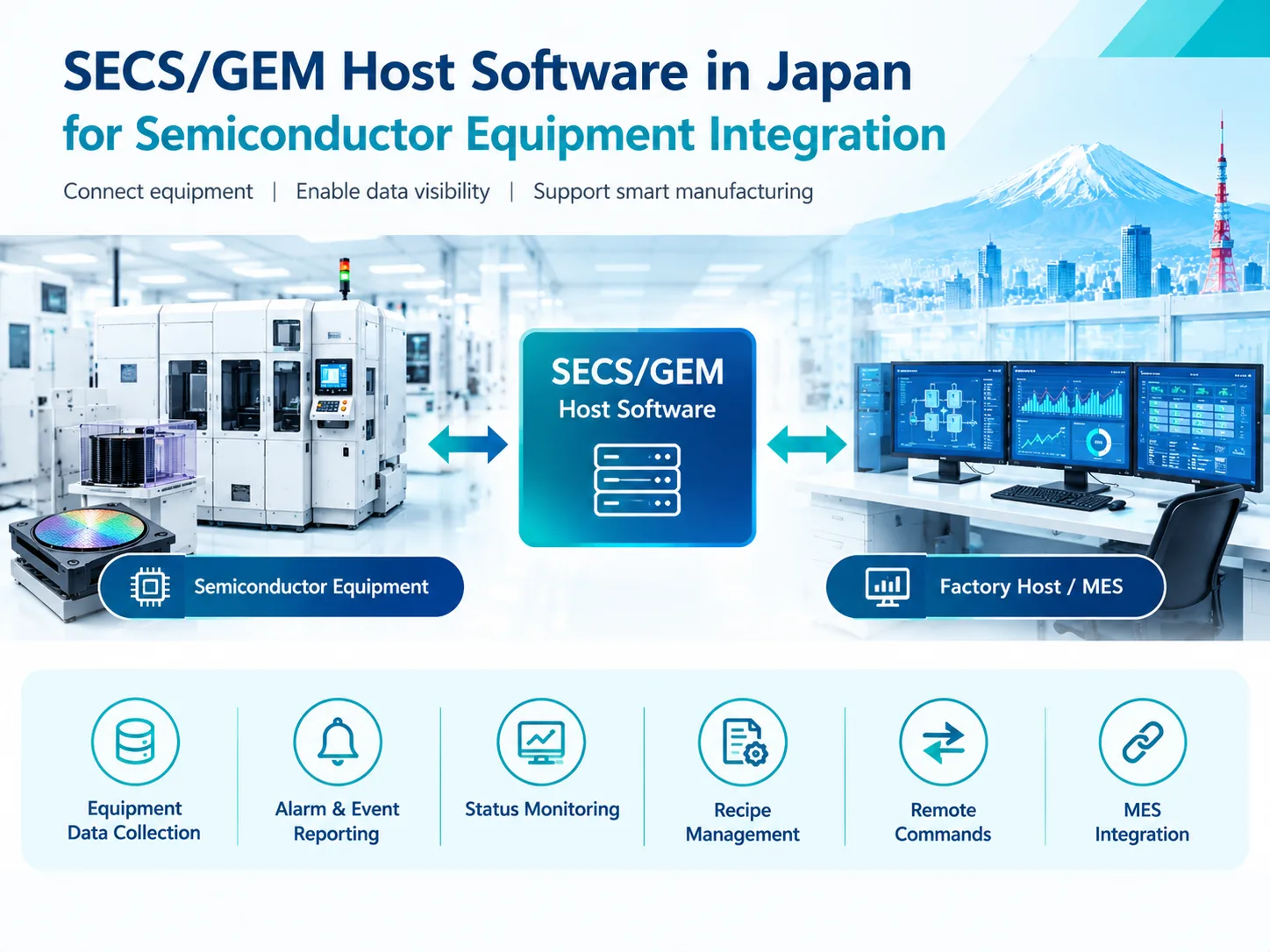
Japan has one of the most advanced semiconductor ecosystems in the world. Fabs, equipment makers, and system integrators all depend on precise, repeatable production. To achieve this, every tool on the floor must share data with the factory systems that manage it.
That is where SECS/GEM communication comes in. It is the standard language between semiconductor equipment and factory software. Reliable SECS/GEM host software lets a fab collect data, control equipment, and connect tools to the Manufacturing Execution System (MES). This article explains how it works, why it matters in Japan, and how to choose the right integration approach.
What Is SECS/GEM Host Software?
SECS/GEM is a set of SEMI standards for equipment-to-host communication. It has three main parts:
- SECS-II (SEMI E5) defines the message format. It describes how data, commands, and alarms are structured.
- GEM (SEMI E30) defines how equipment should behave. It covers states, events, alarms, and remote control.
- HSMS (SEMI E37) defines the transport. It sends SECS-II messages over a standard TCP/IP Ethernet network.
In this model, the equipment acts as the “equipment” side. The factory system acts as the “host” side.
SECS/GEM host software is the application on the host side. It connects to the equipment, sends commands, and receives events, alarms, and process data. Because it speaks the same standard language, one host can work with many tool types.
Why Semiconductor Equipment Manufacturers in Japan Need SECS/GEM Integration
Japanese equipment makers serve customers around the world. Most fabs expect new tools to support SECS/GEM, so a missing or weak interface can slow down a sale or an installation.
Several challenges make integration important:
- Customer requirements: Fabs often list SECS/GEM compliance in their purchase specifications.
- Mixed equipment fleets: Fabs run new and older tools together. A common standard reduces custom work.
- Quality and traceability: Fabs need accurate records of what happened on each tool and when.
- Smart manufacturing goals: Automation and data analysis depend on reliable equipment data.
In addition, building a GEM interface from scratch takes time and specialist knowledge. Therefore, many OEMs choose proven software instead of writing the protocol layer themselves.
Key Features of SECS/GEM Host Software
Good host software should be easy for engineers to use and dependable in production. Look for these capabilities:
- Reliable HSMS connection handling. The software should manage connect, disconnect, and reconnect events cleanly.
- Message handling. It should send, receive, and decode SECS-II messages correctly.
- Event and alarm collection. Engineers need to see equipment events and alarms as they happen.
- Data collection. The host should read status variables and equipment constants.
- Remote commands. Authorized users can start, stop, or hold processes through standard commands.
- Recipe handling. The software can support recipe upload, download, and selection where the equipment allows it.
- Logging and message monitoring. Detailed logs make troubleshooting faster.
- Easy MES connectivity. The host should pass data to higher-level systems without heavy custom coding.
Not every tool supports every GEM capability. As a result, you should always check what each piece of equipment actually offers.
How SECS/GEM Connects Semiconductor Equipment with MES
An MES manages work orders, lots, routes, and quality records. However, it usually does not talk to equipment directly. Instead, the SECS/GEM interface and host software sit in between.
The flow looks like this:
Semiconductor Equipment → SECS/GEM Interface → Factory Host / MES
First, the equipment reports events, alarms, and data through its SECS/GEM interface. Next, the host software receives these messages over HSMS. Then it passes the information to the MES. Finally, the MES can send instructions back, such as lot information or process commands.
This two-way link supports MES integration for semiconductor equipment. It also reduces manual data entry, which lowers the risk of human error. Learn more about this layer in our overview of factory automation for semiconductor fabs.
SECS/GEM Integration Solutions from eInnoSys
eInnoSys offers several ways to add SECS/GEM capability, depending on the equipment. You can browse the full range of equipment software on the eInnoSys website.
EIGEMEquipment SECS/GEM SDK
EIGEMEquipment is an SDK for equipment makers. It helps developers add a SECS/GEM interface to their own tools. Because the SDK handles the protocol layer, engineering teams can focus on their core equipment features. It is a strong fit for OEMs that control the equipment software.
EIGEMBox for Legacy Equipment Connectivity
Many older tools have no SECS/GEM support, and changing their software is often risky or impossible. EIGEMBox offers a way to connect legacy equipment to factory systems without rebuilding the tool. This helps fabs bring older assets into a connected environment.
EIGEMHMI for Supported PLC/HMI Integration
Some equipment is built around a PLC and an HMI. EIGEMHMI supports SECS/GEM integration for supported PLC/HMI setups. Compatibility depends on the specific controller and software, so a technical review is the best first step.
How to Choose the Right SECS/GEM Integration Approach
| Equipment Situation | Possible Integration Approach | Key Considerations |
|---|---|---|
| New equipment with accessible control software | SECS/GEM SDK, such as EIGEMEquipment | Requires development effort but provides greater control over the communication interface. |
| Legacy equipment without SECS/GEM support | Add-on connectivity, such as EIGEMBox | Can avoid modifying the original tool; verify available signals and data. |
| Equipment using a supported PLC/HMI | EIGEMHMI | Depends on controller, HMI, and interface compatibility. |
| Fab needs to collect data from multiple equipment types | Host software integrated with MES | Confirm the supported GEM features and communication requirements of each tool. |
Conclusion
Strong equipment connectivity is a practical need for Japan’s semiconductor industry. Reliable SECS/GEM host software helps fabs and equipment makers share data, support automation, and connect tools to the MES. The right approach depends on whether your equipment is new, legacy, or PLC/HMI-based.
eInnoSys offers options for each case, from SDKs to legacy connectivity. Choosing early and testing carefully will save time during installation.


